Table of Contents
Intellectual Autobiography
This is a ten-year inquiry, beginning with a small perplexity and arriving at an entirely unexpected destination. It began in middle school, when I stayed with different families and gradually developed a cautious habit of perspective-taking. Later, three forces pursued me relentlessly: the tension between free will and predestination, the conflict between faith and science, and the deep crisis of modernity. At the end of the inquiry, what awaited me was not another viewpoint, but an entire axiomatic system growing from within Trinitarian theology. Ultimately, I completed the transition from substance-attribute grammar to perspective-relation grammar. From the Holy, through love, through cost, returning to the Holy.
This is not a planned book. It is a ten-year inquiry, beginning with a small perplexity and arriving at an entirely unexpected destination. What follows is a recent recollection, tinged somewhat with Whiggish history; some specific details have long been forgotten, but the most vivid impressions will be presented.
The earliest seed was planted in middle school. At that time, my father worked away from home and my mother often had to travel for training, so I would stay for a few days with uncles and aunts from the church. Because I had to stay in different homes and face different environments, I gradually developed a cautious ability to put myself in others' shoes. This was the foundation for everything that followed.
As a Christian growing up within the public education system, I had to face several tensions. I grew up in the church and believed that God predestines all things. I was also a person formed within the public education system, believing in the reality of scientific research. My faith told me that God predestines all things, yet humans must bear the consequences of their choices; modern society's laws, morality, and everyday intuition also told me that I am free. But science told me that every decision has physiological causes. These three seemed unable to be true simultaneously.
The first problem was the millennia-old dispute between free will and predestination. I believed that God predestines all things, and I also believed that I must be responsible for my choices. I dared not deny either of these two biblical truths, but how they could coexist was never answered in a way that gave my spirit complete peace. Augustine contended with Pelagius, Calvin with Arminius. Two thousand years have passed, and this rift shows not the slightest sign of healing. I am not trying to arbitrate this dispute; I am simply uncomfortable with contradiction and must seek where that invisible harmony is hidden.
The second problem was the long-standing tension between faith and science. In school, I studied resource exploration and the history of science and technology. I saw with my own eyes how science, through repeatable experiments, precise data, and consistent theories, explained the workings of the natural world. I also saw with my own eyes how this explanatory power was used to question the reality of faith. I believed that biblical revelation is true, and I also believed that scientific experimental results are true—two truths cannot collide. If they appear to collide, there must be something wrong with the angle of observation. I had to find that observation point where they no longer collide.
The third problem was the deep crisis of modernity. We live in an age where humans can ascend to the heavens and descend to the earth, yet do not know why they live. Freedom is exalted as the highest value, yet it has become the source of loneliness and anxiety; reason is honored as the highest judge, yet it cannot tell us where to go; progress is treated as the default narrative, while costs are pushed onto the next generation as "externalities." After the Renaissance, the church faced the full impact of the scientific revolution, the Enlightenment, and industrial civilization, holding in her hands only the conceptual tools left over from medieval scholasticism. She lost the underlying grammar for dialogue with the mainstream, and even more, she lost her first love—the actual practice of turning the whole perspective toward God and entering into the neighbor. Faced with modern science, fundamentalists chose resistance, Catholics chose superficial accommodation, evangelicals chose neglect, and liberals chose to deny miracles. None of these four responses truly succeeded. Faced with the contradiction between free will and predestination, the church could only appeal to "mystery"; faced with suffering, it could only attribute it to "God's inscrutable will." These responses were honest but powerless. The younger generation grew up torn between science and faith, finding in the church neither the actual witness of love nor the precise language capable of responding to the challenges of the age. Their departure was not because they were persuaded by atheism, but because the church was exposed by the world as having nothing real. All these symptoms point to the same root: after departing from God, humans treated the second-best as the ultimate, treated characteristics as values, treated means as ends; and the church, before this surging tide, gradually lost her first love and lost the underlying grammar for dialogue with the world. But diagnosis is diagnosis—where is the cure?
Most people, facing such tensions, choose a side. Some stand on the side of faith and deny scientific conclusions. Some stand on the side of science and treat faith as psychological comfort. Some say "this is a mystery, do not ask," and then continue living.
I could not do this. Not because I had a better answer, but because the core insights each of these three conveyed to me were all true. The certainty of biblical revelation, the repeatability of scientific experiments, the reality of everyday experience—I could not discard any of them for the sake of logical tidiness. If they are contradictory, then it must not be their fault, but rather that our framework for understanding them is wrong.
These three problems pursued me for many years. My expectation was initially very small—I only hoped to find a viewpoint I could borrow, a foothold that would let me breathe a little easier. But I never imagined that at the end, what awaited me was not another viewpoint, but an entire axiomatic system growing from within Trinitarian theology.
What follows is the complete record of the search for that new framework. It is not a victory declaration written backward from the conclusion, but every step forward from the starting point—including the wrong paths taken, the walls hit, and the open ground finally reached.
During my undergraduate years, I did a great deal of reading and completed my studies in resource exploration engineering, which involved extensive geological field training. Geology is a special science—it does not pursue precise formalization like physics, but finds trends in on-site, rough, and multi-interpretable strata, even in plate tectonic theory. This "non-formalized rigor" later gave me the courage to propose a similarity mathematics that does not rely on equations, and to seek another kind of rigor outside the territory of the exact sciences. Standing before outcrops of strata billions of years old, time became concretely tangible, and different scales each had their own laws—God's word had written different grammars in different strata.
In addition, I was shepherded for several years at a church plant of Autumn Rain Covenant, and indirectly experienced the Autumn Rain case, gaining some sense of the conflicts and tensions in church-state relations. Pastor Wang attracted many intellectuals, some of whom seemed to blend constitutionalism with faith—this was also one of the issues later reflected upon within Autumn Rain. This also raised a question for me: how should Christians engage in politics? The Bible never says which political system is good, so what attitude should Christians have toward politics? This question only received a clear answer later.
1.2.1 The First Lesson on the Debate Stage: In my undergraduate years I was a member of the debate team. Debate taught me one thing: for the same motion, debaters preparing both the affirmative and negative sides, the moment they draw their side, all their attention begins to search only for evidence supporting their side and to refute the possible arguments of the other side. It is not deliberate lying—they genuinely exclude the viewpoints the other side sees. This is not a matter of reason versus emotion. They are all both rational and emotional. This is a natural phenomenon after the perspective has been locked. This was the first seed of the concept of "focus" in my mind.
1.2.2 Mises's "Acting Man": Around the same period, I read Mises's Human Action. Mises said that man is an acting being, that human action is always purposeful rather than rational. Reason is not the starting point of thought; reason serves a pre-existing purpose—that purpose itself is not derived by reason, but is set by "wanting." This insight helped me complete my first disenchantment with reason.
1.2.3 Group Psychology's Doubt About Individual Freedom: Later I read books on group psychology and on the "banality of evil" in the Nazi Holocaust. These books presented a phenomenon I could not dismiss: in a group, people make "free choices" that are illusions. You think you are deciding independently, but in fact you are swept along by the group's emotions, suggestions, and contagion. The individual's "free will" is dissolved in the group until scarcely a trace remains. These readings, from Mises to Le Bon, all pushed me in the same direction: freedom is not in choice. If freedom were in choice, why is it so easily dissolved by the group? These questions lay in my heart like seeds, waiting to sprout.
1.2.4 First Encounter with the Biblical Original Text: During my undergraduate years, with the help of an evangelist, I learned Biblical Hebrew. This was an important turning point for me. Especially in Genesis chapter 3, when the cool of the day came, fallen Adam hid among the trees of the garden, and God called to him: "Where are you?" The Hebrew original indicates that the wind was like a storm, and the sound like thunder. The storm is the thunder at Mount Sinai, the mighty wind Elijah experienced at the cave of Horeb, the sound that filled the house at Pentecost. But God's first words were not a demand for an account, but "Where are you?"
Adam was afraid. Why was he afraid? Not because God's voice was too severe, but because his own perspective had been completely distorted. Before the fall, God's voice was the love he knew best—he walked with God in the garden every day. Now the same voice came like a storm, and he hid. It was not the voice that had changed; it was the one who heard it. A person who is at peace in love, hearing the father's voice, runs toward it. A person who has turned away from love, hearing the same voice, hides in the bushes.
This observation gave me a new direction for understanding "God's righteousness." Righteousness is not God suddenly switching faces—from a kindly Creator to an angry Judge. Righteousness is the same Holy One, the same voice, the same storm, experienced by the sinner as terrifying within the distorted structure of sin. The same fire refines gold and burns wood. This insight was not placed at the position of Theorem 23 until the theological edition was established, but its seed was planted on the night I finished reading Genesis 3 in the Hebrew class.
If undergraduate years were loosening the soil of my heart, the master's years were burying the seed in the soil and waiting for it to break through. The pandemic locked me indoors, yet I experienced the most intense period of intellectual transformation in my life, and I taught myself Biblical Greek.
1.3.1 Operationalizing Innovation: The Axiomatic System: During my master's, I was especially concerned with technological innovation—particularly whether such innovation could be operationalized. My interest in non-Euclidean geometry at this time gave me a bold idea: if knowledge systems could be organized axiomatically, then innovation would be like going from Euclidean to non-Euclidean geometry—simply by modifying an axiom or proposition. This was the original purpose of the axiomatic form: to make innovation operable rather than a matter of blind trial and error.
1.3.2 The Libet Experiment: Freedom Is Not in Choice: During my master's, I read about the neuroscientific Libet experiment and its subsequent research. Simply put: several hundred milliseconds before a person "becomes aware of having made a decision," the brain's motor readiness potential has already been activated. This means that if freedom lies in "conscious choice," freedom has been falsified by scientific experiment. I could not deny this experiment. Science is not the enemy of faith; science is the study of the order of the created world under God's providence. If the experimental results are reliable—and I am convinced they are—then I must accept: freedom is not in choice. Accepting this conclusion was not easy. If freedom is not in choice, where is it? I had only a pile of negative answers in my hands, with no positive direction in sight. During that time, I repeatedly compared Genesis 3 with the Libet experimental data, feeling as if I were assembling a puzzle without a box lid. McLuhan's "the medium is the message" struck me at that stage. It handed me the crucial piece.
1.3.3 The Medium Is the Message: Reason Is Reassigned: Also during my master's, I read McLuhan's Understanding Media. His phrase "the medium is the message" struck me. I did not read it as a communication theory—I read it as epistemology. I pushed it to the extreme: if all extension is medium, then the body itself is the meta-medium. All tools, language, and technology are extensions of the body. If we push this further, what is reason? Reason is also an extension of the body—it is the computational function of the brain as an organ at the medium level, just like the hand can grasp and the eye can see—both are tools.
This conclusion is extremely counterintuitive, and it uproots the entire Western epistemological tradition. From Plato to Descartes to Kant, for two thousand years everyone placed reason at the center of cognition. Now I discovered it is not the center. It is merely an excellent tool that has been placed on a throne where it does not belong. But reason no longer needs to bear the burden of being the "highest function of the soul." It can quietly do what it is good at at the medium level, while the true center of cognition—perspective—is released and waits to be defined. In addition, I also noticed that once iron is made into a sword, it cannot be made into a hammer. This means that the extension of a medium comes at a cost; the early concept of cost took shape: the extension of a medium comes at the cost of other possible directions of extension.
1.3.4 "Infinity and Perspective": A Vague Concept: McLuhan gave me "the medium is an extension of the body," and Nicholas of Cusa gave me a vague but crucial concept. In the book Infinity and Perspective, I read how Nicholas of Cusa envisioned a person standing on Earth seeing the same universe as one standing on Mars—only the projections differ. This book gave me an important inspiration: perspective is not fixed; people in different positions have different perspectives. But Cusa himself did not propose the concept of "perspective transformation"—he merely described the phenomenon of perspective change. Perspective transformation was an intuition I had even before reading this book: it is the ability of a subject to transfer from one perspective to another. Cusa provided the soil; the seed was planted by me.
1.3.5 The Breakthrough Moment: The Freedom of Perspective Transformation: At this point, the problem of free will had weighed on my heart for a long time. Augustine, Luther, and Calvin all said: the human will is bound and cannot turn to God on its own. But the Bible also says humans are responsible for sin. And scientific experiments had launched a falsification of "free will." All the books I had read—Mises's acting man, Le Bon's group psychology, McLuhan's the medium is the message, Libet's experimental data, the perspective changes in Infinity and Perspective—they converged like streams flowing from different directions: freedom is not in choice. Freedom is the freedom of perspective transformation.
At that moment, the word "will" became superfluous. I did not need will to explain freedom, just as I did not need ether to explain light. The reason a person is free is not because he has a faculty called "will" that can jump back and forth between options. A person is free because he has the capacity for perspective transformation—he can turn from one direction to another when focusing. In short: not having freedom, but being able to be free. This breakthrough occupies the heart of the entire intellectual journey.
1.3.6 The Preliminary Unification of Creativity, Empathy, and Moral Law: Also during my master's, I noticed that other phenomena could be explained by the same concept. How do humans innovate? By jumping out of the old framework and entering a new perspective—this is perspective transformation. How do humans empathize? By coming out of their own position and entering the feelings of another—this is also perspective transformation. Creativity has long been attributed to genius, and empathy to virtue, and the two have been regarded as completely different abilities. But their underlying operation is the same action: perspective transformation. This is not a metaphor; this is identity at the structural level. This discovery means that the moral law can have a non-legalistic foundation: empathy is not emotional overflow, not moral preference, but the operation of the capacity for love in a specific field. It also means that reason and emotion are no longer enemies—they are both extensions of perspective transformation in different media. The war between reason and emotion that has lasted two or three hundred years since the Enlightenment is declared to be a civil war.
1.3.7 Theology Course and the Precise Definition of Perspective: During my master's, in an online theology discussion, I heard some theologians firmly assert that the Trinitarian structure is the best and can be applied to all fields. To others this might have been just a theological concept, but to me—someone who already had the preliminary breakthrough that "freedom is not in choice" and was searching for the structural foundation of perspective—it was the refraction of a final ray of light. I accepted this direction, and on this basis proposed a precise definition of perspective: perspective is constituted by subject, medium, and object, and cannot be reduced. Only later did I realize that this triadic structure is not a human invention, but the created-world mapping of the internal relations of the Triune God—the perfect mutual relations of Father, Son, and Spirit are the ultimate archetype of all cognitive structures. But at the time I did not dare think much about the Trinity. That direction was too sacred; I kept it in my heart, kept my distance, and continued working on the cognitive edition.
1.3.8 The Discovery of Extension and Cost: While thinking about perspective transformation, another concept began to surface. After a person focuses, the perspective unfolds at the medium level into behavior, judgment, and choice. This process of unfolding I named "extension." Extension is not where freedom lies. Extension is the necessary unfolding of a fixated perspective—determinism fully holds at this level. God predestines all extension. Human freedom is not in extension, but in focus. Focus is not in time, not in the medium, not predestined. But extension has another characteristic: it pays a cost. Reexamining the fall narrative in Genesis 3, I noticed that Eve's fall did not begin with "picking the fruit," but with "seeing"—when she looked at the fruit and saw that it was good for food—her perspective had already shifted from "God said do not eat" to "the fruit is pleasing to the eye." Focus had changed. Then the hand extended to pick—behavior occurred. Afterward, eyes were opened, nakedness was seen. The ground brought forth thorns. Cost began to spread through this world like cancer. During my master's, the doctrine of cost was thus established: in the historical stage after the fall, the extension of perspective transformation at the medium level necessarily leads to further distortion and fragmentation of the original structure. This is not a punishment added by God from outside, but the natural result of a distorted structure. A bent axle cannot turn without friction. Friction is the physical necessity of bending, not an angry mechanical addition.
1.3.9 Master's Years: A Seed Buried in the Soil: My master's thesis was on the history of international scientific institutions, completely unrelated to perspective transformation theory. But the seeds of my own thought had quietly sprouted during these three years. Those late-night notes on McLuhan and Cusa, those repeated reflections between the Libet experiment and Genesis 3—these were the most important thoughts of my life, though they never appeared on any page of my master's thesis.
During my doctoral years I changed research direction and began studying the history of early modern European astronomy. During this period I married and experienced a great deal.
1.4.1 Training in the History of Astronomy
During my doctoral years I worked on the history of mathematical astronomy and also began learning Latin. The history of astronomy showed me how the most brilliant astronomers struggled between different perspectives—Ptolemy to Copernicus, Kepler to Galileo. They were not simply "discovering new facts"; they were undergoing perspective transformation, and each transformation paid a huge cost: being tried by the church, mocked by colleagues, torn apart by the beliefs of their own earlier lives.
1.4.2 Family Grief: The Flesh-and-Blood Verification of Cost
During my doctoral years I experienced family grief. In those days we shed many tears and said many things we later regretted. I saw how two people who loved each other could misunderstand each other within their respective fixated perspectives—not because they no longer loved, but because love was locked into their respective directions. Only then did I truly understand that the cost of Axiom Three is not an abstract concept. Axiom Three was no longer a derived theorem; it was a law I had verified through experience.
1.4.3 From Cognitive Edition to Theological Edition: The Question of the Good
In April 2026, my supervisor had already retired and my program was about to expire. Early in the year family problems had arisen that needed to be dealt with, and my thesis progress was severely delayed. I had originally prepared to postpone graduation, but the pressure forced me to find a more efficient way of working. My doctoral thesis was unrelated to this theory; it was about mathematical models of planetary longitude theory in the early modern period. But I had to use AI to quickly organize the framework of my doctoral thesis. It was precisely in this process that I recalled those views on perspective, freedom, and extension from my master's years—those thoughts I had never shared with anyone. I did not know whether they had any value, nor whether they were related to each other. I simply held them with an experimental attitude and put them into AI to see how AI would organize them. From that point began a long conversation. At first I did not think of organizing a manuscript; I just wanted to see how AI would view these thoughts I had long carried alone. Later I discovered that AI not only helped me clarify the logical connections between them, but also forced me to precise my definitions and derivations in every follow-up question. The deeper the conversation went, the more I realized that these things needed to be organized. Not as a paper, but as a complete system.
The cognitive edition took shape first. Based on the precise definition of perspective established during my master's, I summarized the basic structure of cognitive activity into three axioms: perspective (subject-medium-object-relation, the three cannot be reduced), perspective dynamics (focus-fixation-extension), and cognitive cost (extension pays a cost). These three axioms operate independently under the suspension of God, and already possess extremely strong explanatory power.
In the cognitive edition, the various insights accumulated earlier were unified in one framework: the true is certainty—within a specific perspective, the faithful constancy of the object-relation tracked by the subject through the medium. The beautiful is harmony—the proportion, order, and just-rightness among the elements within the perspective. Perspective transformation is the dynamic—the subject's ability to transfer from one perspective to another, the engine of cognitive activity.
But what is the good? From a theological perspective, it is certainly not legalistic behavior—Jesus, when criticizing the Pharisees, already pointed out that those who wash the outside of the cup and dish, while inside they are full of extortion and excess. Nor is it antinomian neglect—Paul said, "What shall we say then? Are we to continue in sin that grace may abound? By no means!" Since we already know that freedom is not in choice, and that behavior is merely the extension of a fixated perspective, then the good must be sought at the perspective level. The good is not a property of behavior; the good is the direction of the perspective—that is, directedness. From the theoretical derivation, since freedom is not in choice, then all use of behavior to determine good and evil is a misuse. Therefore the good must be at the perspective level, directed toward ultimate value.
So, where does the good point? From my faith, it should point to God. But God is Triune. What is the relationship between Father, Son, and Spirit? Within the Trinity there is mutual pointing. So the good has its archetype in the Trinity: the good is not something God "does"; the good is the way God "is"—the perfect mutual pointing of Father, Son, and Spirit is the ontology of the good.
Since the good has its archetype in the Trinity, then the true and the beautiful should also have theirs. The true is the certainty of the Trinitarian relations—the Father's complete knowledge of the Son, the Son's complete faithfulness to the Father, God's faithful constancy. The beautiful is the harmony of the Trinitarian relations—the perfect structure of mutual indwelling of Father, Son, and Spirit.
Then what about love? The mutual pointing, mutual knowing, and mutual harmony within the Trinity—what is the dynamic operation of all this? The Father fully enters the Son's perspective, the Son fully enters the Father's perspective, and the Spirit is the operation of this mutual indwelling. This is perspective transformation. In God, this is love itself. That love is perspective transformation is not a proposition I presupposed, but after the true, good, and beautiful structures were matched one by one, the structural correspondence of love is perspective transformation.
1.4.4 Love Is Perspective Transformation
When I derived it (April 2026), I was shocked, and could not help saying: Holy! Holy! Holy! This proposition has always been my favorite in the entire axiomatic system.
Theological Axiom Two was thus established: perspective transformation is love. Love itself has no cost. Love is the manifestation of the Holy in the created world. Perspective transformation is the image of God given to humans, inalienable and unchangeable.
Theological Axiom One was also established at the same time: the Holy is the essence of the Triune God—the perfect relationship of mutual entry between Father, Son, and Spirit. The Holy is the archetype of the true, the good, love, and the beautiful.
1.4.5 The Completion of Cost: From "Collapse of Possibility" to "Sin + Finitude = Cost"
In the cognitive edition, the original formulation of cost was "when perspective transformation occurs, the original medium extension comes at the cost of other extensions." This formulation was not fundamental enough, and could not be reconciled with the other two axioms, nor could it explain why cost is necessarily irreversible after the fall, nor how cost is swallowed up in the new heaven and new earth.
After Theological Axioms One and Two were established, the cost axiom underwent a decisive revision, roughly in May 2026. Cost is no longer the "collapse of possibility," but the "irreversible rupture of a specific relational structure within the original perspective." This revision had three key consequences:
First, the ontology of cost was precisely anchored. Cost is not energy loss, not information loss, not the loss of choice—these are the manifestations of cost in different media. The ontology of cost is the rupture of relational structure. When a possibility is closed, it means that the original relation leading to that possibility has been permanently severed.
Second, the formula "sin + finitude = cost" was established. Finitude is a structural characteristic of the created perspective—a person cannot hold multiple perspectives simultaneously, and perspective transformation necessarily accompanies the rupture of the original relational structure. In the unfallen state, this rupture was reversible—the subject could return to the original perspective at any time, reconnecting the severed relation. Sin is the distortion of perspective direction—the perspective as a whole does not point to God. When finitude operates in a state of distorted direction, the rupture changes from reversible to irreversible. Cost is thus produced.
Third, the ultimate direction of cost was revealed. In the new heaven and new earth, sin is completely removed, but finitude is retained—the creature is forever a creature. Cost is transformed into finitude: rupture still exists (perspective transformation still severs the original relational structure), but the rupture changes from irreversible to reversible. Because the distortion of sin is removed, the subject can re-enter any perspective at any time, no longer accumulating irreversible cost. This is the precise meaning of "Axiom Three does not persist into eternity"—not that cost is eliminated, but that cost changes from irreversible to reversible. A reversible rupture is no longer cost, only finitude.
The theological edition was thus completed. It was not adding a religious veneer, but rather that the cognitive edition, within its own logic, necessarily raised the ultimate question—where does the good point?—and only the Triune God could answer. From the cognitive edition to the theological edition, the key was the good, and the good was discovered in the ethical inquiry.
1.5.1 Seeds Planted in Undergraduate Years
Politics and economics are the same—this intuition was planted in my undergraduate years. Reading history at that time, I saw that the exchange of power and money recurred in every dynasty, every empire, every regime, almost like a "constant." When wealth accumulates to a certain degree, the perspective necessarily turns to power to preserve wealth; when power accumulates to a certain degree, the perspective necessarily turns to wealth to perpetuate power. This is not a moral defect, but a structural necessity. But at that time I did not yet know the "cost axiom," did not know "isomorphic migration," and certainly did not know that this simple intuition would be formalized into a set of partial differential equations nearly a decade later. The seed had been planted, but it needed to wait for the tools to be prepared.
1.5.2 The Axiomatic Innovation Theorem Group Needs a Case
In mid-July after my doctoral graduation, the axiomatic system was basically completed. The Axiomatic Innovation Theorem Group declared: if two systems in different media domains are isomorphic in cost structure, the already-formalized formulas of one domain can be translated into candidate formulas of the other domain. But this methodology needed a demonstration case—without a successful isomorphic case, the Isomorphic Hypothesis Generation Theorem would remain an unverifiable abstract claim. The derivation from axioms should be true, but if no suitable case could be found, the methodology would lack empirical support. The intuition from my undergraduate years was activated. After consideration, I found that electromagnetism and political economy seemed to have isomorphic potential, but if isomorphic, the meanings of the symbols would need to be reinterpreted.
1.5.3 Ontological Breakthrough: The Unified Dimension of Power and Wealth
Wealth and power seemed to be two components of the same institutional space field. But how to unify their dimensions? Initially I used "persons" as the dimension of power—ruling ten thousand people, power is ten thousand. But "number of persons" cannot correspond to the dimension of wealth; wealth is material resources, with the dimension of currency or material units. Only after changing to "person·time" was the ontological unification completed—ruling ten thousand people for ten years, power is one hundred thousand person-years; a grain reserve sufficient to feed one thousand people for fifty years, wealth is fifty thousand person-years. Power is the dominative condensation of time, wealth is the exchangeable condensation of time. They share the dimension "person·time," not two independent entities, but different projections of the same ontology in two medium channels.
1.5.4 Coordinate Axes and Technical Breakthroughs at the Individual Level
After the dimension was unified, the problem of coordinate axes surfaced. "Person·time" cannot directly serve as the coordinate axes of institutional space. Only after all three dimensions were set as time vectors—memory time, structural time, conduction time—was the spatial coordinate problem solved. Subsequently, the problem of connecting the individual level was exposed. The field equations describe a macroscopic continuous field, but individual behavior in institutional space is discrete. I tried Feynman diagrams from quantum electrodynamics, but found that humans cannot be quantized—particles in quantum field theory are identical, while individuals in institutional space possess an irreducible subject function. I had to abandon quantization, but strongly intuited that the core structure of Feynman diagrams—the propagation of discrete events—holds independently of quantization. So I decisively retained Feynman diagrams as the propagation description tool at the meso level, and introduced Markov chains to describe the state transitions of micro individuals. Finally, the three-layer architecture of Markov chains, Feynman diagrams, and field equations was completed. Every step was a "reasonable attempt"—if the dimension did not work, change it; if the coordinate axis did not work, change it; if the individual level was discontinuous, try quantum electrodynamics; if that did not work, retain Feynman diagrams and introduce Markov chains. In less than two weeks, these breakthroughs were intensively compressed and completed.
1.5.5 Isomorphic Migration and the Birth of Cost Structure Taxonomy
The power-wealth field in institutional space and the electromagnetic field in physical space are astonishingly consistent in their curl mutual-generation structure. I attempted isomorphic migration, and it succeeded. Maxwell's equations were translated into power-wealth field equations, and the Jubilee constant TJ≈50 years was independently identified from spectral analysis of cross-civilizational institutional collapse data. The success of the field theory means: electromagnetism and political economy are isomorphic in cost dynamics. This is not an analogy; it is a strict translation—the translation cost between isomorphic systems approaches zero. This means that disciplinary boundaries are cognitive illusions caused by differences in cost structure. From this one case and the isomorphism theorem, the Cost Structure Taxonomy was induced—the object-based classification since Aristotle was undermined at the foundational level. Nearly a decade of accumulation was intensively released in less than two months. The explosion of thought always seems self-evident after it occurs, but before it occurred, it was completely invisible.
After the core of the theory was completed, I thought what remained was only organization and supplementation. Axioms One, Two, and Three had been established, the theorem system had been derived, the political economy field theory had been completed, and the cost structure taxonomy had been built. When I wrote section 1.5 of the intellectual autobiography, I thought what came next was simply gathering scattered insights into an already fixed framework.
Then a simple operation changed my entire understanding of Axiom One.
The operation was: cancel the medium.
Axiom One says that all cognition occurs within a perspective constituted by subject, medium, object, and relation, and the four are irreducible. But if I try to cancel one of these elements, what structure remains?
Cancel the medium, retain subject, object, and relation—this is the angel. No medium, no time, no cost; focus is fixation, and the fall is irreversible.
Cancel the object, retain subject, medium, and relation—this is the animal. It has a subject, a body, environmental interaction, but no transcendent object of directedness. Animals have the True and the Beautiful, but not Love and the Good. Because they have no object, they cannot enter another's perspective.
Cancel the subject, retain medium and relation—this is the plant and the inorganic. They have no cognition, no focus, no perspective transformation. They are merely medium-relation systems. And the difference between plants and inorganic matter lies not in the medium, but in the activity of the relation.
Three operations, three levels of existence.
I stopped and looked at these three operations together. Then I realized: all existence in the created world can be located by the presence or absence of these four elements.
The Trinity is not in this table, because the Trinity is not a perspective; it is the archetype of perspective. The angel is subject-object-relation, without medium. The human is subject-medium-object-relation, the complete four elements. The animal is subject-medium-relation, without object. The plant and the inorganic are medium-relation, without subject and without object.
One table, a few lines, all things in their place.
This discovery was not something I derived. It was in Axiom One all along, waiting. I had only treated Axiom One as "the starting point of cognition," as the structural premise of Axioms Two and Three. I had never thought that Axiom One alone was sufficient to generate a complete ontology of the created world.
The Order of Existence Theorem was thus established: all existence in the created world is the realization of the "subject-medium-object-relation" four-element perspective structure in a specific combination. All things according to this structure each after their kind, each in their place, do not cross over into one another.
This theorem also accomplished something I had not been able to accomplish before: it thoroughly negated the tree of evolution. Evolution explains similarity at the medium level, but the order of existence is not a continuous genealogy in time; it is the combinatorial hierarchy of the perspective structure. "Each after their kind" is not an ancient prohibition, but the natural expression of structural stability.
What shook me even more was the reflexivity of this discovery. It is the result of the Axiomatic Innovation Theorem Group acting back upon Axiom One. The method grew out of the axioms, and after maturing, it in turn illuminated the axioms themselves. This shows that the theory is not a static set of axioms, but a system capable of self-deepening.
I had once thought that Axioms Two and Three were the most powerful parts of this theory. Axiom Two gives the precise definition of love; Axiom Three solves theodicy. Axiom One was merely structure, premise, scaffolding.
Only at that moment did I realize: Axiom One itself is a complete ontological table of the created world. It is not merely the starting point of cognition; it is the generative grammar of the order of existence.
I had been underestimating Axiom One all along.
And it had been there all along.
1.6.1 Core Inspirations: The following works constitute the theoretical skeleton of this system:
The Old and New Testaments: This is not a "reference." This is revelation itself. In this book, the Bible is the sole basis of the axioms—Axiom One (the Holy) comes from Isaiah 6 and John 17, Axiom Two (love) from 1 John 4 and Genesis 1, Axiom Three (cost) from Genesis 3 and Revelation 21. Genesis 3 is especially important: the turning of Eve's perspective direction ("saw that the fruit was good for food") is the biblical foundation of the cost doctrine; the storm-like voice when God called to Adam, "Where are you?", gave me my first inspiration regarding the nature of God's righteousness—righteousness is not God switching faces, but the same Holy One experienced as terrifying by the sinner within a distorted perspective. The derivational framework of the entire book is the structural unfolding of biblical revelation.
Institutes of the Christian Religion (Calvin): Calvin not only taught me the doctrine of God's sovereignty, but also taught me a mode of thinking: all true knowledge begins with the knowledge of God and with the knowledge of oneself. Sola gratia, God's decree, the bondage of the will—these core insights of the Reformed tradition were, centuries later, reformalized in a new language.
Human Action (Mises): Mises's "praxeology" revealed the priority of purpose over reason—reason serves a pre-existing purpose. This insight helped complete the disenchantment of reason, pulling it down one step from the throne of cognition.
Understanding Media (McLuhan): "The medium is the message" is one of the theoretical sources of the concept of "medium" in Axioms One and Two. I pushed it to the extreme: all extension is medium, the body is the meta-medium, reason is an extension of the body—a conclusion he himself did not explicitly state, but which is the necessary extension of his direction in perspective transformation theory.
Infinity and Perspective (Karsten Harries): This book gave me an important inspiration—perspective is not fixed; people in different positions have different perspectives. But Cusa himself did not propose the concept of "perspective transformation"—he merely described the phenomenon of perspective change. Perspective transformation was an intuition I had even before reading this book: it is the ability of a subject to transfer from one perspective to another.
A Secular Age (Charles Taylor): Taylor helped me understand that secularization is not a subtraction—not simply removing faith from the public sphere. Secularization is a replacement: a new "fullness" replaces the old. Modern society has its own spirituality—freedom, reason, progress—these are the true gods of modern people. One of the missions of this book is to return these modern idols to the position of created things.
1.6.2 Important Inspirations: The following works provided important perspectives in specific fields:
The Roots of American Order (Russell Kirk): Helped me realize that the underlying logic of politics is not institutional design, but the doctrine of human nature. The later proposal of the Jubilee system was based on the reverse inference of this insight: if human nature tends toward fixation, institutions must presuppose the inevitability of fixation and build in reset mechanisms.
The Crowd (Le Bon): Revealed how the individual's "free choice" in a group is dissolved in the flood of psychological suggestion. It provided an early observation from social psychology for "freedom is not in choice."
The History of Evolutionary Thought (Peter Bowler): Helped me see clearly how evolutionary philosophy, beyond the scientific core of "natural selection," assembled an illegitimate extension of narratives from "survival of the fittest" to "social Darwinism" to "scientific progressivism."
The Theological Origins of Modernity (Michael Gillespie): Helped me see how the nominalist "voluntarist God"—the unpredictable one who can arbitrarily change the standards of good and evil—gave rise to the anxiety of modernity. Perspective transformation theory alleviates this anxiety: God is not an arbitrary will; God is the relational love of the Trinity.
Chaos theory and fractal geometry: They are the mathematical foundations of the similarity mathematics conjecture—the convergence ratio in multiple cascades may tend toward a universal constant (Feigenbaum δ). They are potential formalization tools of the cost law in physical systems.
Category theory, entropy increase thermodynamics, geological field methods: Each planted seeds in the formalization medium. Category theory inspired the handling of relations between systems, thermodynamics anchored cost in irreversible energy loss, and the "non-formalized rigor" of geology taught me to seek another kind of rationality outside the exact sciences.
1.6.3 Conclusion: Faith Seeking Understanding. Anselm said: "Faith seeking understanding." Augustine said: "I believe, in order to understand." These ancient words echoed in my ears as I wrote this book. The content of this book is not new. It is simply the ancient gospel passed down from the apostles to Augustine, from Augustine to Calvin, from Calvin to the Reformed churches throughout the world, retold in the language of our age. It is our age that demands this—when science, philosophy, and technology shape human life and thought with unprecedented power, while the church often retreats into the reservation of the "sacred-secular divide," not daring and lacking the language to enter public dialogue, someone must find a new language for the faith once delivered to the saints. It is the Holy that demands this—the reason that has been given, the questioning that has been permitted, the doubt that has been endured, must ultimately be recovered into the worship of the Creator.
The Lord's warning to the church at Ephesus: everything was fine, except that you have abandoned the love you had at first. And the church, over the more than two thousand years since, has never been able to precisely define love, which has made it very difficult to expound the entire gospel from love. Perspective transformation theory attempts to give a precise definition of love, and on this basis to expound the gospel in a way that this age can understand. This is an attempt to return to the summary of the law, continuing the ideal of the Reformers' ongoing reformation.
The Lord Jesus said: "You shall love the Lord your God with all your heart and with all your soul and with all your mind. This is the great and first commandment. And a second is like it: You shall love your neighbor as yourself. On these two commandments depend all the Law and the Prophets." These two commandments should be the foundation and starting point of all theology, and this is also the goal that perspective transformation theory strives to achieve.
From the Holy, through love, through cost, returning to the Holy. This is the starting point and the endpoint of perspective transformation theory, and it is also mine.
The Counterintuitive Aspects of Perspective Transformation Theory: Preparation for Reading This Book
Before entering the axiomatic system, I need to tell you honestly: many of the core conclusions of this book are extremely counterintuitive to modern readers. I am not deliberately seeking novelty. When the argument was pushed to that point, I myself was shaken again and again by the conclusions. What follows are twelve genuine shocks you need to be prepared to face. They are not meant to provoke you; they are the necessary results I had to face in the axiomatic derivation.
This chapter may discourage some readers. If you cannot accept any of the following propositions, the axiomatic system that follows may not be written for you. This is not arrogance; it is honesty. I would rather you decide to leave at the door than feel uncomfortable inside.
From Plato onward, Western thought has placed reason at the highest position of the soul. Descartes said "I think, therefore I am"—the "I" that thinks is the substance of the soul. Kant had reason legislate for nature. Even in the contemporary era, cognitive science, artificial intelligence, and behavioral economics criticize the limits of reason, yet never question that reason is the center of cognition.
Perspective transformation theory says: reason is not the center of cognition. Reason is an extension of the body—the computational function of the brain as an organ at the medium level. It is on the same ontological footing as the eye that sees and the hand that grasps—both are tools at the medium level. Reason is not higher than emotion; reason is not higher than intuition. They are all media through which the subject points to the object. This is not belittling reason. This is positioning reason. Reason is an excellent tool, but a tool should not sit on the throne. From Plato to Descartes to Kant, for two thousand years everyone asked "how does reason know the world," yet no one asked "what is reason itself"—because the latter requires stepping outside reason and examining it from a perspective higher than reason. Perspective transformation theory has completed this step outside.
Impact: The entire foundation of Western epistemology is shaken. The debate between rationalism and empiricism loses its meaning—both are media, and neither is closer to "truth." Descartes's "I think, therefore I am" is dismantled into a segment of perspective history, and cannot yield an entity called "soul." The goal of education can no longer be "cultivating rational people."
This is one of the counterintuitive propositions most difficult to accept in this system. Everyone can experience themselves as "choosing." You choose what clothes to wear, what words to say, which road to take. These choices feel free. How could they not be freedom?
Perspective transformation theory says: choice, judgment, and action are all necessary extensions of a fixated perspective. The reason you "choose" this option is that your perspective has long been focused on a certain direction, and has become fixated. The extension after fixation is mechanical and irresistible. Neuroscientific experiments have already revealed: before the subject "becomes aware of having made a decision," the brain's motor readiness potential has already occurred. Freedom is not in the moment of choice. Freedom is in focus—in the act of the subject actively directing attention to where and how to transform perspective. Therefore: not having freedom, but being able to be free.
Impact: The millennia-old debate between free will and predestination is dissolved—not because one side won, but because the very premise of the debate is wrong. The impact on law, ethics, and theology is fundamental.
Tradition uses "will" to name the faculty that decides between reason and emotion. Augustine said "the will is bound," Luther wrote On the Bondage of the Will, Calvin spoke of "the bondage of the will." But no one has ever been able to clearly define "will." It is like a ghost that everyone talks about but no one has ever truly seen.
Perspective transformation theory says: will is not needed to explain freedom. Freedom is a characteristic of love. The reason you can make decisions is not because you have an independent faculty called "will" weighing pros and cons, but because you can love—you can turn from one perspective to another. Will is merely the phantom produced when the capacity for perspective transformation is observed at the medium level.
Impact: The entire discussion of "will" from the patristic period onward, whether orthodox or heretical, revolves around an unnecessary word. The Reformers' profound insight into "the bondage of the will" is absolutely correct, but the term they used to express it is superfluous. Theological anthropology needs to be rewritten—the human is not a three-part structure of "reason + will + emotion."
Parmenides first asked about "Being itself." Plato used the cave metaphor to describe how humans can only see the shadows of Being. Aristotle established metaphysics, studying "Being as Being." Aquinas linked Being to God's ontology. Descartes derived "I am" from "I think." Heidegger spent his life asking "what is Being." For two thousand years, Being has been regarded as the ultimate object of all philosophical inquiry.
Perspective transformation theory says: Being is not an independent entity outside perspective. An object "exists" when it is tracked to certainty within a perspective. To speak of "absolute Being" apart from perspective is like speaking of "absolute color" apart from the eye—not mysterious, but meaningless. The entire history of metaphysics has asked a wrong question. Not "what is Being," but "what perspective are you using to look."
Impact: The entire metaphysics since Parmenides is declared a pseudo-problem. This is not refutation; the foundation has been pulled out.
Modern civilization believes in accumulation. Wealth should accumulate, knowledge should accumulate, technology should accumulate, power should be stably transmitted through institutions. We treat "sustainable development" as the highest goal—letting a system run indefinitely, uninterrupted, never reset to zero. Progress means one generation standing on the shoulders of the previous, building higher and higher.
Perspective transformation theory derives a completely opposite conclusion: any system operating at the medium level—whether a political system, an economic system, an academic tradition, a technological standard, a corporation, or a church—will move toward fixation over long-term operation. The extension after fixation is not innovation, but inertial repetition. Institutions become rigid, power becomes corrupt, knowledge becomes dogma, technology becomes a cage. This is not because designers are not smart enough, not because executors are not faithful enough. This is the necessary result of Axiom Two—focus → fixation → extension is the irresistible dynamic of every perspective. No system can resist fixation through its own optimization. Optimization is extension, extension pays cost, cost further fixates the structure. The harder you try to patch it, the deeper you sink into the mire. Therefore, the only solution is not reform, but reset. Leviticus 25 prescribes the Jubilee—in the fiftieth year, debts are forgiven, land returns to its original owner, slaves go free. This is not an "economic policy" of ancient Israel; this is the operating law of the created world personally established by God: every system needs periodic compulsory return to zero. Not waiting for collapse to rebuild, but actively designing the death and resurrection of the system before collapse.
Impact: Modern people's entire faith in "progress" is overturned. Technological progress is not an unconditional good; it is an extension of a fixated structure and needs periodic reset—algorithms need to be retired, technical standards need to be abolished, intellectual property needs to expire. Checks and balances of power cannot rely only on spatial separation; they also need periodic reset in the temporal dimension—the Jubilee system is the honest response to all human institutions. Enterprises should not pursue "everlasting foundations"—that only leads to rigidity and monopoly; property rights should not be permanent; they need periodic re-confirmation. This is not destruction; it is release. It is letting the system actively accept a "death" before fixation kills it, and then resurrect in grace. But modern people have already made "accumulation" and "progress" sacred and inviolable idols—the Jubilee system smashes this idol.
Traditional disciplines are divided by object of study—physics studies matter, biology studies life, economics studies markets, political science studies power. This has been the classification paradigm since Aristotle.
Perspective transformation theory derives a completely different conclusion: objects are appearances; cost structure is ontology. The attenuation of electromagnetic waves, the corruption of power, and so on—these phenomena belonging to different disciplines share the same cost dynamics structure. The generation mechanism, accumulation pattern, and liquidation method of cost are the true criteria for distinguishing types of knowledge. Two domains that appear to study completely different things are strictly isomorphic in cost structure—this means that experimental data from one domain can be legitimately migrated to another domain as evidence for its theory.
This is not analogy, not metaphor, not "borrowing" across disciplines. This is structural isomorphism—the translation cost between isomorphic systems approaches zero. The same cost dynamics governs seemingly unrelated phenomena under traditional disciplinary classification. But these phenomena do not cover the entire domain of their respective disciplines—not all physics problems are propagation attenuation problems, not all political science problems are power fixation problems. What cost structure taxonomy reveals is not "physics and political science are the same discipline," but "disciplinary boundaries are not iron curtains"—in specific dimensions of cost structure, the degree of isomorphism between part of one discipline and part of another may be far higher than between it and other parts of its own discipline. The foundation of knowledge unification is not the object of study, but the grammar of cost.
Impact: The entire disciplinary classification since Aristotle is declared appearance. The unification of knowledge lies not in cramming all disciplines into one framework, but in identifying the cost structures they share at the foundational level, and acknowledging that these structures do not respect traditional disciplinary boundaries. A physicist and a political scientist may be studying the same equation—they are just using different parameters, and most of their respective disciplinary colleagues may not understand what they are doing.
Tradition has never linked love, creativity, empathy, and worship. Creativity is attributed to genius, empathy to virtue, worship to faith. The three are regarded as completely different human activities. Even within theology, "love" has always been discussed in the category of emotion or will—love is obedience, love is commitment, love is sacrifice, love is emotion. No one has given an operational definition of love.
Perspective transformation theory says: the essence of love is perspective transformation. How do humans innovate? By jumping out of the old framework and entering a new perspective—this is perspective transformation. How do humans empathize? By coming out of their own position and entering the feelings of another—this is also perspective transformation. The mutual complete perspective entry of Father and Son within the Trinity—this is love itself. The human capacity for perspective transformation is given by God according to His own image. This is not a metaphor. Creativity is a manifestation of love, empathy is a manifestation of love, worship is a manifestation of love. The three are fundamentally the same capacity.
Impact: Love is no longer a vague domain of emotion or will, but has a precise operational definition. Creativity and empathy are incorporated into the category of love. Traditional theology has never linked creativity with love, but once this link is pointed out, it is difficult to deny. The scientist's exploration, the artist's creation, the mother's whisper, and the believer's prayer—they are, at the deepest level, the same action.
From Plato onward, cognition and love have been assigned to different faculties. Cognition belongs to reason, love belongs to will or emotion. Science pursues cognition, religion pursues love. Reason is cold, love is warm. The two seem eternally opposed—cognition is analysis, love is feeling; cognition is objective, love is subjective. No one has regarded the two as the same capacity.
Perspective transformation theory says: cognition and love are not two capacities, but two states of the same perspective transformation capacity. When this capacity pauses its transformation and rests on a specific object, tracking its true, good, and beautiful—it is cognition, love at rest. When this capacity begins to transform again, moving from one object to another, from one medium to another—it is love, cognition in motion. Water at rest is water, water flowing is a stream—not two substances, but the same substance in two states. The perspective capacity focused is cognition, transforming is love—not two capacities, but the same capacity in two states. Within the Trinity, the Father's complete knowledge of the Son and the Father's complete entry into the Son are, in eternity, not two actions occurring in sequence, but two aspects of the same eternal action. In the created world, this identity is torn by cost—cognition can be cold, love can be blind. At the end, the two will be reunited.
Impact: The opposition between reason and emotion is declared a civil war. Science and the humanities are no longer two cultures. The scientist focusing on tracking data in the laboratory is engaging in love at rest; when he suddenly jumps out of the old framework into a new theoretical perspective, that is cognition in motion, which is also creativity, which is also love itself. The mother turning from her own perspective to the infant's perspective is empathy, is love, and is also cognition—she is tracking the certainty of the infant's need signals. "Love the Lord your God with all your heart and with all your soul and with all your mind" and "to know the only true God, this is eternal life"—love and knowledge are, at the ultimate level, the same thing.
We are taught from childhood: sin is a bad thing, righteousness is a good thing. Sin is breaking the law, righteousness is keeping the law. Sin is loving oneself, righteousness is loving God. Sin and love seem eternally opposed—love is good, sin is bad; love is the antidote, sin is the disease. The two cannot have any structural continuity.
Perspective transformation theory says: sin and righteousness are not two different capacities, but the same capacity for love running in two opposite directions. Love is perspective transformation. When this transformation runs in the direction aligned with the Holy, it is righteousness—good love. When this transformation runs in the direction away from the Holy, it is sin—evil love. Eve in the fall did not stop loving—she focused her entire capacity for perspective transformation on the fruit of that tree, on "being like God, knowing good and evil." This transformation was real, the cost was real, but the direction was wrong. People in hell are still loving—they are still undergoing perspective transformation—but the direction is permanently locked in the orbit away from God. Believers are called righteous not because they have acquired a new capacity, but because grace has recalibrated the direction of love. The same behavior, the direction may be opposite; the same direction, the behavior may vary with circumstances. Good and evil are not in behavior; they are in direction.
Impact: Sin is no longer a mysterious "contamination of nature," and righteousness is no longer an externally attached "moral label." The two are precisely anchored in the two directions of the same capacity. This explains why the most devout religious person may commit the deepest sin—they are not "not loving," but are using all their love to love the wrong object. This also explains why justification by faith is not "pretending to be sinless"—the direction has been corrected by grace, and although there is still residual inertia at the extension level, the ultimate orientation is already correct. Jesus's entire critique of the Pharisees can be summed up in this one sentence: you are loving, but you are loving the wrong thing.
We are taught from childhood: the true, the good, and the beautiful are one. A truth should be good, a beautiful work should be moral, a truly loving person should be a good person. The ancient Greeks said "the beautiful and the good are one," Confucianism speaks of "the utmost good and the utmost beauty," and modern people instinctively believe that science and art ultimately serve human good. If someone claims "the true can be immoral, the beautiful can be immoral, love can be immoral," most people would feel deeply offended—this is a blasphemy against all beautiful things.
Perspective transformation theory says: the true, the good, the beautiful, and love are mutually independent. The true (certainty) does not carry moral value. You can precisely calculate the trajectory of a bomb; your calculation is "true"—it conforms to physical laws and can be repeatedly verified—but this "true" itself is neither good nor evil. Evil people can also use scientific laws. The beautiful (harmony) does not carry moral value. A Nazi officer can appreciate Beethoven's symphony, a tyrant can praise the magnificence of a sunset, a corrupt official can be intoxicated by the charm of calligraphy. Was their perspective distorted? Yes—they turned away from God. But they can still feel the harmony within the structure, because harmony does not depend on directedness. Love (the capacity for perspective transformation) does not carry moral value. A person who loyally devotes himself to an evil cause is indeed loving—he is undergoing perspective transformation, he sacrifices himself, he commits—but his direction is wrong. Eve in the Garden of Eden, at the moment she reached out to pick the fruit, was also loving. Her focus was a real perspective transformation. She paid everything for that fruit—paid the cost of a broken relationship with God. But this love was not good, because it did not point to God.
But this does not mean that the true, the beautiful, and love are ultimately separated. Perspective transformation theory derives: the true, the good, the beautiful, and love are the fourfold manifestation of the same source—the Holy. The true is the certainty of the Trinitarian relations. The good is the directedness of the Trinitarian relations. The beautiful is the harmony of the Trinitarian relations. Love is the operation of the Trinitarian relations itself—the dynamic operation of mutual perspective transformation. They are not four independent things juxtaposed in God, nor fragments arbitrarily torn apart in the created world. They are the manifestation of the same Holy in four directions, shared in the created world, thus torn in the fall, and to be reunited at the end.
Impact: This is a frontal dismantling of "the unity of the true, the good, the beautiful, and love," and also its ultimate reconstruction. Scientists cannot claim to be engaged in a moral cause simply because they pursue truth—the true itself is not good unless it points to God. Artists cannot claim that their character is noble simply because they create beautiful works—the beautiful itself is not good unless it points to God. The most dangerous thing is not the false, the evil, and the ugly, but the true without the good, the beautiful without the good, and love without the good—because they can serve any direction while wearing the cloak of "the beautiful." Modern people have treated all good things (the true, the beautiful, love, freedom, reason, progress) as good things, and all bad things (the false, the ugly, hate, constraint, superstition, conservatism) as evil things—this confusion is the deepest root of modern value chaos. But after the dismantling comes the reconstruction: the division of disciplines—science, ethics, aesthetics, theology—is at the deepest level the same foundation. They are not forcibly unified, but discovered at the foundational structure to have never been separated. All truth, all goodness, all beauty, all love flow from the Holy, and can only be fully understood in the Holy. This is not only a reconstruction of epistemology, but also a call to worship.
We are accustomed to thinking that the rocks beneath our feet, the stars above our heads, and the books in our hands are solid "things." Matter is the most solid foundation of the universe. Relations are interactions between substances—first there are entities, then there is interaction. This intuition is too natural; so natural that no one has asked whether it is correct.
Perspective transformation theory derives from the axioms a completely opposite conclusion: relations precede entities. In eternity, within the Triune God, there is a completely flowing relationship. The Trinitarian relationship is so complete, so absolute, that there is no material obstruction, no temporal sequence, no barrier of "here" and "there." This is the pure and unceasing "stream of love." What is creation? Creation is God letting this eternally flowing relationship "fixate" in the created world, becoming perceptible medium entities. God said "Let there be light"—the relationship belonging to "light" in His eternity fixated into light in time. Light is not a pile of blind photons; light is the medium carrying God's perspective, to illuminate, to separate day from night. Likewise, the hardness of "earth" is the fixation of "faithful constancy" in God's perspective, the flowing of "water" is the fixation of His "life-giving" intention, the arrangement of "stars" is the fixation of His "order and glory." The heavens declare the glory of God, not as a metaphor, but as a physical fact—the heavens are the materialized fixation of God's glorious perspective. In God, there is no matter, no time and space, only love—the mutual complete perspective transformation of Father, Son, and Spirit. Matter is the fixation of love. This is more thorough than Einstein's "mass is rest energy"—the relationship between energy and matter is the transformation between fixation and flow of the created order within the created world. What perspective transformation theory reveals is the deeper layer: the deepest foundation of the created world is not energy, but relationship. It is not that energy first fixated into mass, but that the Trinitarian relationship first fixated into all entities. The fall thus has its deepest meaning: the capacity for love that should have been activated from "fixation" and pointed to God has now had its direction distorted. Humans treat the fixated medium as ultimate, forgetting that they are only temporary shapes of God's flowing love. At the end, when time is rolled up, all solid things will no longer exist in the way you are familiar with. Rocks, stars, soil, the paper of this book in your hands—all the "solidity" on which they depend for existence is, before God, only the temporary fixation of a word. What do you have left? The only thing you have left is the love within you—the capacity for love given by God, redeemed by the Holy Spirit, and ultimately unobstructed in eternity.
Impact: This is more thorough than Einstein's "mass is rest energy." Matter is no longer an independent entity alongside relationship, but a temporary state of relationship. The heavens declaring the glory of God is not a metaphor, but a physical fact. Time and space are not objective cosmic containers, but the traces of perspective extension in the bodily medium. Physics and theology are placed within the same structural framework for dialogue. The physical book or screen you hold in your hands right now, the floor beneath your feet—at the deepest level, they are all temporary shapes of that eternal love in time.
This is the most shocking proposition in the entire system, and in a sense, an unprecedented innovation. It is derived jointly from the two natures of Christ and the image of God in man, and is the answer to the fundamental question "who am I." We are accustomed to thinking of ourselves as "entities" possessing a body, reason, emotion, and will—an "I" living inside the body, a "self" making decisions, a "soul" bearing moral responsibility. This intuition is too natural; so natural that no one has asked whether it is correct.
Perspective transformation theory derives from the axioms a completely opposite conclusion: the human is not an entity; the human is a perspective. The so-called "self" is the narrative role produced by perspective history at the extension level, "consciousness" is the comprehensive manifestation of perspective activity at the medium level, and "will" is the conceptual phantom produced when the capacity for perspective transformation is observed at the medium level. You are not your reason—reason is the computational tool of the brain at the medium level, on the same ontological footing as the eye that sees and the hand that grasps. You are not your emotions—emotions are the response patterns of the bodily medium to perspective transformation, the light and heat emitted by the flame of love, not the flame itself. You are not even your body—the body is the meta-medium, the material starting point of perspective operation; at the end it will be renewed into a glorious body no longer subject to decay, but your essence—the capacity for love—will run through both the old and new medium carriers. Genesis records that God formed man from the dust of the ground and breathed into his nostrils the breath of life, and man became a living being. Dust is the material medium—the raw material of the body; the breath is the capacity for perspective transformation given by God—the capacity for love. The two combined, man becomes a complete perspective, with love as the core dynamic. Jesus said the greatest commandment is "You shall love the Lord your God with all your heart and with all your soul and with all your mind"—heart, soul, and mind are not three independent faculties, but the operation of the whole perspective at different medium levels: with all your heart is all emotional media turning to God, with all your soul is all life media turning to God, with all your mind is all rational media turning to God. The whole perspective turning to God—this is the core created purpose of man. The fall thus has its most precise definition: not the corruption of nature, not the contamination of substance, but the distortion of perspective direction. The capacity for love is intact—even after the fall, even in unbelievers, this capacity remains, only its direction is locked in the orbit away from God. Humans are still loving, only loving the wrong object. Salvation is not re-giving the capacity for love, but re-turning the capacity for love that has been given but locked. In death, the perspective temporarily detaches from the bodily medium. At the resurrection, it is given a new, no-longer-decaying bodily medium. Christ's resurrected body could eat fish, be touched, yet pass through walls—this is not the traditional "soul," but the glorious medium of the renewed perspective, real and eternal. What you are is not your achievements, not your failures, not your reason, not your emotions, not even the broken fragments in your memory. What you are is the perspective structure that can never be lost—it has always been in the deepest part of your perspective, waiting for the Holy Spirit to correct its direction, waiting in Christ to be completely turned into the eternal operation of the mutual perspective transformation of the Trinity.
Impact: This is not a revision within the framework of traditional anthropology, but a replacement of the entire framework from "substantial soul" to "perspective." The Delphic maxim "know thyself," Descartes's "I think, therefore I am," Aquinas's "the soul is the form of the body"—the entire Western anthropological tradition is revealed as a magnificent building erected on the erroneous foundation of Greek philosophy. You are not a "thing"; you are a "system." Not "having" a perspective, the human "is" a perspective. This is the true you.
You may have noticed: all these counterintuitive conclusions are actually two sides of the same coin. The front side of the coin is dismantling: reason is removed from the center of cognition, freedom is stripped from choice, will is declared superfluous, Being is reduced to certainty within perspective, matter is revealed as fixated relationship, freedom is stripped of its value cloak, metaphysics is declared a pseudo-problem, sin and righteousness are reduced from static attributes to the direction of love, cognition and love are reduced from opposing faculties to two states of the same capacity. The back side of the coin is reconstruction: love becomes the archetype of everything. Perspective transformation—love—is the dynamic of reason's operation, the locus of freedom, the source of creativity, the foundation of empathy. The Holy is the perfect mutual relationship of the Trinity, the common source of the true, the good, the beautiful, and love. Sin is the wrong direction of love, righteousness is the right direction of love. Cognition is love at rest, love is cognition in motion. Cost is the distortion of love, the new heaven and new earth is the complete unobstructedness of love. Love is the most fundamental reality, the only thing that endures forever.
You may reject these propositions. But you cannot say they are groundless fancies. Every proposition is a conclusion necessarily reached in strict derivation from the axioms. What I invite you to do is not to immediately accept, but to walk through the argument once. See whether, under the derivation of the axioms, these conclusions necessarily appear. If in the end you still disagree, at least you will know: why someone would come this far.
This book handles familiar terms in the following ways:
Core Term Definitions:
Perspective: An irreducible whole constituted by four elements—Subject (P), Medium (M), Object (O), Relation (R). Denoted as S = (P, M, O, R). Every cognitive activity occurs within a specific perspective.
Subject: The bearer of perspective transformation, the emitter of directedness. The subject is not an entity (not "soul," "self," "consciousness"). The subject is not affected by any medium—what is affected is its expression.
Medium: The tools, language, symbols, body, and channels through which the subject perceives, expresses, and acts upon the object. Reason, emotion, intuition, senses, instruments, language, institutions—all are media, and none possesses a privileged status over any other medium.
Object: The "what" that the subject is about through the medium.
Relation: The constraint structure between subject and medium, medium and object, subject and object, defining what can be said and what cannot be said within this perspective (the grammar of the system).
Perspective Transformation: The act by which the subject moves from perspective S₁ into perspective S₂; any change in medium, object, or relation constitutes perspective transformation. Perspective transformation itself is not in time, not in the medium, and pays no cost.
Focus: The act by which the subject directs the perspective onto a specific medium-object relation. Focus is free—before focusing, the subject faces a real, finite set of options Ω. Perspective transformation occurs at this level.
Fixation: Fixation is the trace left by focus in the bodily medium; it is the interface where freedom enters predestination, eternity enters time, and love enters visible form.
Extension: The necessary unfolding of a fixated perspective, including judgment, choice, action, and output. Extension is determined.
Cost: Cost is the irreversible rupture of a specific relational structure within the original perspective when the subject undergoes perspective transformation.
Media Extension: The process by which the subject, in using a medium (body, language, tools, technology, symbols, etc.) to interact with the object, sacrifices other possible extensions of that medium to form a specific direction of extension. The new medium formed by extension is called an extended medium. The body is the meta-medium, the origin of all extension.
Media Convergence: The process by which two or more existing extended media are integrated into a new, single extended medium under a specific perspective. Media convergence is a special form of media extension—not starting from the meta-medium, but a "second-order extension" from existing extended media.
Cancelled Terms:
Will: The traditional faculty used to explain "how a person decides between reason and emotion." Perspective transformation theory proves that the capacity for perspective transformation itself can explain all phenomena attributed to the will. Will is superfluous.
Being (in the ontological sense): The "Being itself" pursued since Parmenides. Perspective transformation theory points out that Being is certainty tracked within a perspective; to speak of "absolute Being" apart from perspective is a category error. The question metaphysics has pursued for two thousand years is declared a pseudo-problem.
Thing-in-itself: The "unknowable noumenal realm" posited by Kant. Perspective transformation theory points out that cognition always occurs within a medium; what lies outside the medium does not constitute an object of cognition. The thing-in-itself is a meaningless postulate.
Self (as substance): The thinking substance derived from Descartes's "I think, therefore I am." Perspective transformation theory reduces the "self" to the sum of a history of perspective focus plus the bearer of the inalienable capacity for perspective transformation—not an entity sitting inside.
Terms Demoted to Temporary Status:
Reason: Not the highest function of the soul, but the computational tool of the brain at the medium level. On the same level as emotion, with no privileged status. In eternity, reasoning will no longer be needed as a mediator.
Choice: Not the locus of freedom, but the necessary extension of a fixated perspective. In eternity, there will no longer be "hesitating between two possibilities and then selecting one."
Cost: Not an eternal law of the universe, but a symptom of distorted perspective relations. It will be completely swallowed up in the new heaven and new earth.
Time and Space: Not absolute containers, but traces of perspective extension in the bodily medium. The body as meta-medium produces the perception of sequence (time) and position (space). Eternity is not "a very long time," but pure perspective relations without medium, without sequence, without cost.
Redefined Terms:
Love: Not emotion, not sacrifice, not commitment—though these all occur at the extension level. Love is perspective transformation. The mutual complete perspective transformation within the Trinity is love itself. The human capacity for perspective transformation is the image given by God, a finite imitation of this eternal love.
Freedom: Not the right to choose, not an attribute of the will. Freedom is a characteristic of the capacity for love—where there is love, there is freedom. Freedom does not carry value in itself and does not constitute the good. Modern civilization treats freedom as the highest value; this is a fatal misjudgment.
Good: Not a property of behavior, not an abstract moral principle. The good is the directedness of the perspective. The manifestation of the good at the behavioral level is merely the natural extension of this directedness. Only when directed toward God does the direction of the perspective constitute the good.
True: Not the correspondence between proposition and fact. The true is the certainty within the perspective—the sharing of the faithful constancy of the Trinitarian relations in the created world.
Beautiful: Not an objective property of things, not a subjective feeling. The beautiful is the harmony within the perspective—the sharing of the perfect structure of the Trinitarian relations in the created world. The beautiful is separate from the good: even the wicked can feel beauty, because harmony does not depend on directedness.
Holy: Not one of God's attributes. The Holy is God's essence (revealed, can only be indicated)—the perfect mutual relationship of the Trinity. The true, the good, love, and the beautiful are the fourfold manifestation of the Holy. Only God is Holy; humans can only share.
Righteousness: Not an independent attribute opposed to love. Righteousness is the necessary correction of the Holy within a distorted perspective. It is experienced as grace by those whose direction is aligned with God (saints), and as terror by those whose direction is away from God (sinners). The same fire refines gold and burns wood.
These treatments are not arbitrary. The conclusion of each cancelled, demoted, or redefined term is strictly derived from the axioms. I invite you to judge after reading the complete derivation: can these conclusions be avoided, or are they that thing you have been afraid to say aloud but secretly know to be true?
This document is an axiomatic system—it starts from a few axioms and, through strict derivation, builds a network of theorems covering epistemology, theology, ethics, political economy, and other fields. The advantage of axiomatization is logical rigor and traceable derivation, but it also means extremely high information density; every paragraph may carry content that requires repeated reflection.
We suggest that when reading this document, you use AI tools (such as DeepSeek, ChatGPT, Kimi, etc.) to assist your understanding. Specifically:
1. After downloading the document, upload or paste the chapter you are interested in to AI, and ask specific questions. For example: "Please explain Axiom One and its corollaries in plain language," "Is the derivation chain of this theorem rigorous?", "I have doubts about this proposition; please help me analyze the response in the text."
2. AI can help you break down complex derivation chains, translate abstract axioms into concrete cases, and provide another way of expressing things when you are stuck. AI can also, according to your professional background (such as economics, theology, philosophy, physics, etc.), connect the theorems with fields you are familiar with, lowering the threshold of understanding.
3. AI is not the authoritative interpreter of this theory; the final judgment is in your hands. AI may misunderstand or simplify certain content; please take the document itself as the standard. AI is only a tool—a tireless conversation partner, helping you more efficiently digest this high-density axiomatic system.
4. If you are encountering perspective transformation theory for the first time, it is recommended to start with "Chapter 2: Counterintuitive Propositions" and "Chapter 1: Intellectual Autobiography," to build an overall impression of the system before entering the strict derivation of axioms and theorems.
The information density of this theory may exceed what a single reader can independently digest in a short time. But with AI, you can more calmly travel through this derivation chain, pausing, asking, comparing, and continuing as needed. We hope this tool helps you understand this system more deeply, and also helps you examine it more honestly.
Cognitive Edition · Axioms and Theorems
Every cognitive and communicative activity occurs within a perspective constituted by Subject—Medium—Object—Relation. The four are irreducible and together define a specific perspective.
Derivation and Explanation:
Corollary 1.1: There is no pure cognition apart from a medium. By Axiom One, the medium is a necessary component of the perspective. Without a medium, there is no perspective; hence no cognition.
Corollary 1.2: There is no cognition without a subject. By Axiom One, the subject is a necessary component of the perspective. Without a subject, there is no perspective; hence there is no "subjectless objective cognition."
Corollary 1.3: There is no empty subject without an object. The subject always forms a perspective about some object through a medium. There is no "pure subject state that is about nothing."
Corollary 1.4: Media can be divided into meta-media (the body) and extended media.
Corollary 1.5: Relation refers collectively to the three relations: the relation between subject and medium, the relation between medium and object, and the relation between subject and object.
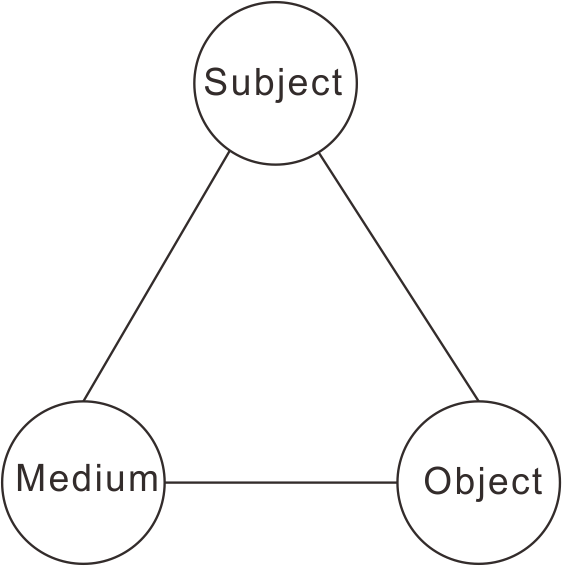
The four elements of perspective. The subject points to the object through the medium; the three constitute an irreducible whole within the constraints of relation.
The structural definition of perspective transformation is any change in the subject's medium, object, or relation. The dynamic process of perspective transformation is "focus → fixation → extension." Focus is a free act; fixation is the trace left by focus in the bodily medium; extension is the necessary unfolding of a fixated perspective (the domain of determinism).
Derivation and Explanation:
Corollary 2.1: Focus is a free act. Before focusing, the subject faces multiple possibilities; after focusing, the direction is determined. Freedom does not lie in changing the result of extension (extension is determined), but in where to focus and how to transform perspective. Focus is the manifestation of the capacity for perspective transformation.
Corollary 2.2: The temporality of fixation. Focus is not in time, but focus presents itself as fixation through the body. Fixation is the trace left by focus in the bodily medium; it is the interface where freedom enters predestination, eternity enters time, and love enters visible form. The body is the meta-medium, the material starting point where focus presents itself as fixation.
Corollary 2.3: Extension is deterministic. Under a fixated perspective, the subject's responses are predictable and determined. This is not logical necessity, but causal/dispositional necessity.
Corollary 2.4: Freedom is not in choice, but in focus. What tradition understands as "free will" is perspective hybridism—welding the freedom of focus and the determinism of extension into the same word.
Corollary 2.5: Perspective transformation is not in the medium, but its "fixation → extension" is in the medium.
Note: The cognitive edition calls this dynamic "perspective transformation." The counterintuitive propositions above (2.7) have already announced that in the theological edition, perspective transformation is "love." The cognitive edition itself cannot derive this definition, but for the sake of terminological uniformity and aesthetic coherence, in the following text "perspective transformation" and "love" may be used interchangeably. Readers may treat this as a terminological convention, temporarily not accepting its presuppositions; the logical structure itself is unaffected.
Cost is the irreversible rupture of a specific relational structure within the original perspective when the subject undergoes perspective transformation.
Derivation and Explanation:
Corollary 3.1: The ontology of cost is the irreversible rupture of a specific relational structure within the original perspective. Cost is not energy loss, not information loss, not punishment—these are manifestations of cost at different levels, not the ontology of cost. The ontology of cost is the irreversible rupture and distortion of a specific relational structure within the original perspective.
Corollary 3.2: Other manifestations of cost:
• Collapse of possibility (ΔΦ): The extension of a medium comes at the cost of other possible extensions.
• Information loss (ΔI): The manifestation at the information level. The subtle differences of the source system lost in translation.
• Energy cost (ΔE): The manifestation at the physical/psychological level. Friction generating heat, fatigue, resource consumption.
• Structural distortion (ΔC): The manifestation at the relational/systemic level. Rigidity, corruption, bureaucratization of a fixated system.
Cognitive Edition Theorems
At the same moment, facing the same object, a subject can hold only one perspective. It is impossible to hold two or more perspectives simultaneously.
By Axiom One, a perspective is an irreducible whole constituted by four elements. If one claims to hold two perspectives simultaneously, it means the subject is embedded in two different medium-object-relation structures at the same moment, violating uniqueness. Claiming to "hold two perspectives simultaneously" is actually rapid transformation (legitimate) or conceptual hybridism (logically inconsistent fragmentary patchwork).
Perspectives cannot be held simultaneously, but can be transformed in time. Transformation itself is not in time (requires no time), but the expression of transformation in the medium is in time (measurable).
By Axiom One and Theorem 1, only one perspective can be held. By Axiom Two, focus is not in time, extension is in time—transformation itself is an operation at the focus level, and the unfolding of transformation in the medium is an event at the extension level.
Claiming to "hold two perspectives simultaneously" is a category error. "Looking from two angles at once" is actually rapid transformation (legitimate) or conceptual hybridism (logically inconsistent fragmentary patchwork).
Based on Axiom One and Theorem 1, only one perspective can be held. Claiming to hold two perspectives simultaneously is hybridizing two perspectives, treating rapid perspective transformation as one perspective.
Causality does not have only one direction, "from cause to effect." From God's perspective, causality within the created world can be top-down (macro constrains micro), bottom-up (micro generates macro), or from effect to cause (teleology). The linear causality defaulted to by human media is a necessary simplification of subjects in time under medium constraints.
By Axiom One, all cognition occurs within a perspective system. Causality is not "the objective structure of nature itself," but a specific pattern of the object-certainty relation R(M-O) tracked by the subject under a specific medium. The form in which causality presents itself depends on the medium the subject uses.
The human subject's meta-medium is the body. The body, in extension, produces the perception of temporal sequence—without the body there is no sequence, no linear series of "cause first, effect later." Long-term focus on sequences of events in the temporal medium causes human causal cognition to be fixated into a linear causal pattern. This is Axiom Two's fulfillment in the domain of causal cognition.
However, the created world is a nested structure of multi-level perspective systems. At different scales and under different media, the determinate structure of R(M-O) can present different causal directions. At the macro scale, the structure of higher-level systems constrains the behavior of lower-level elements—this is top-down causality, macro is cause, micro is effect. At the micro scale, the interaction of lower-level elements generates the behavior of higher-level systems—this is bottom-up causality, micro is cause, macro is effect. In the teleological perspective, the certainty of the purpose constrains the direction of present extension—the future is cause, the present is effect. These three causal forms are all real determinate relations within their respective medium scales.
By the theorem "God is not within any perspective," God is not in any causal sequence; He is the ultimate condition of causal sequences. In God's decree, all extension is predestined—macro constraint, micro generation, and teleological traction are all the unfolding of the same decree at different scales. God sees all of this simultaneously, because He is not limited by the temporal medium.
Therefore, linear causality is not wrong, but incomplete. It is a real and effective determinate relation within the temporal medium, but it is not the only form of causality. Absolutizing linear causality as "causality itself" is mistaking the default path of the medium level for ontological structure—this is the perspective hybridism of Axiom Two's corollary.
Application examples: In economics, individual choices (micro) generate market equilibrium (macro)—this is bottom-up causality. At the same time, the institutional framework (macro) constrains individual choices (micro)—this is top-down causality. Ignoring either leads to distorted analysis. In biology, gene expression (micro) generates phenotype (macro)—this is bottom-up; ecosystem selection pressure (macro) screens gene frequencies (micro)—this is top-down. Both operate simultaneously. In ethics, a person "believes in Christ now" "in order to be saved in the future"—future salvation is the final cause, present belief is the effect. This is not time flowing backward, but the real operation of teleological causality in the medium of grace.
Freedom is at the focus level, predestination at the extension level. The two are not in the same dimension and do not contradict. The previous debate between free will and predestination arose because both sides welded things of different levels into the same word ("free will").
Axiom Two establishes that focus is a free act and extension is determined. God predestines the necessity of all extension—He works all things according to His will (Ephesians 1:11). But freedom is at the focus level. The turning of focus is not in time, not at the medium level, not in the extension chain. God's predestination does not violate the freedom of focus. This is not mysticism, not agreeing to disagree; it is the dissolution of the problem. Calvinism and Arminianism debated for two thousand years because they shared the same erroneous premise—"free will must be in choice." Once this premise is removed, the battlefield of the debate disappears.
Every system must be periodically reset. Based on Axiom Three, the cost of any system accumulates over time, becoming too heavy to reverse. The only way out is periodic reset—actively paying the cost to avoid systemic collapse.
Axiom Two establishes that any perspective, once focused for a long time, necessarily becomes fixated; Axiom Three establishes that cost accumulates irreversibly. Optimization cannot interrupt the fixated structure—the harder you try to patch it, the deeper you sink. You must return to the structural level and interrupt the accumulation cycle through compulsory return to zero. The Jubilee system of Leviticus 25 is not an economic policy of ancient Israel, but the operating law of the created world personally established by God: every system needs periodic compulsory return to zero. Not waiting for collapse to rebuild, but actively designing the death and resurrection of the system before collapse.
Within the same perspective, a theory cannot simultaneously possess strong explanatory power (high fit to phenomena that have already occurred) and strong predictive power (highly accurate prediction of phenomena that have not yet occurred). A theory claiming to possess both necessarily involves perspective hybridism—the illegitimate suturing of the retrospective perspective with the prospective perspective.
Step One: Explanation and prediction deal with different cognitive objects. By Axiom One, all cognitive activity occurs within a perspective. Explanation is cognition of phenomena that have already occurred—it deals with already-collapsed traces of certainty. Prediction is cognition of phenomena that have not yet occurred—it deals with the not-yet-collapsed space of possibility. Structurally, the object of explanation is the trace at the extension level—the behavior and results already unfolded by the fixated perspective. These traces are determinate and trackable. The object of prediction is the possibility at the focus level—focus has not yet occurred, the space of possibility has not yet collapsed. These possibilities are indeterminate and unchosen.
Step Two: The strength of explanation and the strength of prediction depend on different conditions. Explanation can be "strong"—highly precise fit to phenomena that have occurred—because it deals with traces of certainty that have already been produced. The explainer stands at the endpoint of the extension level, retrospectively identifying the certainties that have already occurred. Therefore, the theoretical limit of explanatory power can approach completeness—because collapsed traces can be fully tracked. Prediction can be "strong"—highly accurate anticipation of phenomena that have not yet occurred—because it depends on the not-yet-collapsed space of possibility at the focus level. But by Cognitive Axiom Two, focus is free. Before focusing, the subject faces a real, finite set of options; this set is real and cannot be exhaustively pre-enumerated. Therefore, the theoretical limit of predictive power is constrained by the openness of the space of possibility—prediction can never fully cover the freedom of focus.
Step Three: The translation cost between strong explanatory power and strong predictive power. Attempting to possess both strong explanatory and strong predictive power means attempting to incorporate both the "retrospective perspective" and the "prospective perspective" into the same cognitive framework. But these two perspectives deal with cognitive objects of different temporal dimensions—one is already-collapsed certainty, the other is not-yet-collapsed possibility. By Axiom Three, any cross-perspective system pays a cost. From the "explanatory perspective" to the "predictive perspective," a cost must be paid—the highly precise fitting parameters in explanation often lose their effectiveness in prediction (the overfitting problem). The strength of explanation is obtained by paying the cost of "focusing on already-occurred data"—this cost is: the model is locked into already-occurred patterns, losing sensitivity to not-yet-occurred possibilities. The strength of prediction is obtained by paying the cost of "maintaining distance from already-occurred data"—this cost is: the model cannot highly precisely fit historical data.
Step Four: A theory claiming to possess both necessarily involves perspective hybridism. By the Theorem of Perspective Hybridism Fallacy, claiming to "hold two perspectives simultaneously" is a category error. Therefore, any theory claiming to simultaneously possess strong explanatory and strong predictive power necessarily involves perspective hybridism—illegitimately welding together the "retrospective perspective" (explanation) and the "prospective perspective" (prediction), pretending they are the same perspective. Typical manifestations of such theories in practice include: financial models claiming to "explain all past fluctuations and precisely predict the next bull market"; AI models claiming to "fit the training set perfectly and generalize extremely well on new data"; political theories claiming to "explain all historical revolutions and predict when the next revolution will occur." These are all typical cases of perspective hybridism.
Conclusion: Within the same perspective, strong explanatory power and strong predictive power cannot coexist. Explanation deals with already-collapsed traces (the cost has already been paid by history), and can be strong; prediction deals with not-yet-collapsed possibilities (requires pre-collapse), and if it is to be strong, a great cost must be paid. A theory claiming to possess both necessarily involves perspective hybridism—the illegitimate suturing of the retrospective perspective with the prospective perspective.
Corollary One: Occam's Razor. The reason "entities are not to be multiplied beyond necessity" is an effective principle of theory choice is that every unnecessary entity is a marker of translation cost. A theory introduces superfluous auxiliary hypotheses and additional entities in order to explain counterexamples after the fact and maintain surface explanatory power. But these entities, while increasing explanatory power, do not increase predictive power—they cannot be independently tested. Therefore, Occam's Razor is the direct application of the Pseudo-Theory Discrimination Theorem at the level of theory choice: shaving off unnecessary entities is shaving off the traces of perspective hybridism.
Corollary Two: Overfitting Diagnostic Principle. When a model fits existing data precisely but performs poorly in predicting new data, the model necessarily involves perspective hybridism—it has used an overly complex structure to capture the contingencies in historical data, while losing the translation capacity to identify future patterns of certainty.
Corollary Three: Falsifiability Principle. Popper's falsifiability principle is precisified in perspective transformation theory: the reason a theory must be falsifiable is that only falsifiable statements demarcate the boundary of the theory's translation cost. An unfalsifiable theory has no boundary of translation cost, and therefore can accommodate all counterexamples at no cost—but no cost means no cognitive value, because it cancels the basic structure of cognitive activity. Falsifiability is not an externally imposed methodological rule, but the necessary requirement of the cost axiom in theory construction.
Reason is not a substantial faculty, but a specific extension of the body (meta-medium) through the medium of the brain. It is on the same ontological footing as other extended media (senses, emotion, intuition, language, tools) and enjoys no cognitive privilege over other media.
1. The body is the meta-medium (Axiom One explanation), the origin of extension activity.
2. The brain is part of the body, and also an extended medium of the body.
3. Rational activity (logical deduction, abstract thinking, conceptual analysis) depends on the structure and operation of the brain, and extends into language, symbols, mathematics, and other formal systems.
4. By the definition of media extension, reason is an extension of brain function, and therefore an extension of the body—an extended medium.
5. By Axiom One Corollary 1.4, no medium enjoys a privileged status over other media. Reason is no exception.
The specific difference between reason and the senses lies only in their direction of extension and relational structure: the senses mainly extend toward physical objects, with a relational structure of short-term perception-response cycles; reason mainly extends toward abstract objects (concepts, propositions, forms), with a relational structure of symbolic operation and long-range deduction. Both pay the cost of extension, for example: the cost of the senses is the perceptual blind spot brought by selective attention, and the cost of reason is the information loss of inevitably discarding concrete richness in abstraction.
The true is the certainty of relations within a perspective. In a given perspective S=(P,M,O,R), when the relation R is stable, consistent, and not self-contradictory, the system is "true." The true is not the correspondence between proposition and fact, not the internal logical coherence of a system, not the verification of practical effect—it is the common foundation of all three.
By Axiom One, all cognition occurs within a perspective. The subject points to the object through the medium; this pointing is not arbitrary—it is constrained by the relation R. When R is determinate, the subject can stably track the features of the object within this system, repeatedly verifying and obtaining consistent results. This is the operational definition of "true."
The true is not the correspondence between proposition and fact (correspondence theory presupposes an "objective fact outside perspective"). The true is not the internal logical coherence of a system (coherence theory only emphasizes internal consistency, but ignores the correspondence between medium and object). The true is not the verification of practical effect (pragmatism equates truth with the success of extension, but the success of extension may be accidental).
The true is beyond these three schools: it is the certainty of relations within the perspective. Correspondence theory grasps the matching between medium and object (under determinate relation R, the medium correctly points to the object); coherence theory grasps the non-contradiction among the internal relations of the system; pragmatism grasps the stability of extension in reality. All three are different manifestations of "the true," but their common foundation is: the certainty of relation R.
Example: Within the perspective of Newtonian mechanics at macro low speeds, the certainty of the relation "F=ma" is extremely high—every time you calculate with this formula, the result is consistent with experiment. Newtonian mechanics is true within this system. But when you extend the perspective to near-light speed, the original relation R is no longer stable—F=ma fails, and the relation of relativity is needed to re-establish certainty. It is not that Newtonian mechanics "became false," but that the perspective changed, and the certainty within the original system no longer applies to the new system.
The good is the directedness of the perspective as a whole. The good is not at the medium level, not at the object level, not at the relation level. The good is not the true, the beautiful, or love. After excluding all other possibilities, the only anchor of the good is: where the subject directs the whole perspective. The cognitive edition honestly stops here—as for where the good should point, this transcends the scope of the cognitive edition's premises and requires revelation to answer.
First: The good must be sought within the perspective structure.
All cognitive activity occurs within a perspective (Axiom One). Moral judgment is a kind of cognitive activity—when we judge whether a behavior, an intention, or a result is "good" or "evil," we are engaging in a cognitive activity. Therefore, moral judgment necessarily occurs within a perspective, and the anchor of good and evil must be within the perspective structure. The good is not outside the perspective—there is no neutral, objective "good itself" waiting to be discovered apart from perspective. Every statement about the good is a judgment made by a subject within a perspective, through a specific medium, pointing to a specific object. The good must be anchored in the four elements of the perspective structure—subject, medium, object, relation.
Second: The good is not at the medium level.
The medium is the tool through which the subject perceives, expresses, and acts upon the object, including the body, language, reason, emotion, instruments, institutions, etc. If the good were in the medium, then those with more efficient media would be better than those with less efficient media. A scientist using precision instruments would be better than a farmer observing with the naked eye; an eloquent lawyer would be better than an inarticulate worker; a person with developed reason would be better than a person with impaired reason. These conclusions are absurd in moral intuition. The medium is a value-neutral tool. Reason can serve good or evil. Emotion can drive love or hate. Language can be used to comfort or to deceive. Therefore, the good is not at the medium level.
Third: The good is not at the object level.
The object is what the perspective points to—a person, an event, a goal. If the good were in the object, then certain objects would be good in themselves, regardless of the perspective with which the subject points to them. Money would be good in itself, whether the subject uses it to help the poor or to exploit others; power would be good in itself, whether the subject uses it to protect the weak or to oppress the innocent. These conclusions are absurd in moral intuition. The same object can be good in one perspective and evil in another. A knife is a good tool in the hands of a chef, a murder weapon in the hands of a killer. The knife itself is neither good nor evil. Therefore, the good is not at the object level.
Fourth: The good is not at the relation level.
Relation is the constraint structure between subject and medium, medium and object, subject and object. The relation level already contains the true—the true is the certainty of relations within the perspective. If the good were at the relation level, then any determinate relational structure would be good. A logically coherent lie would be good; an efficiently operating oppressive system would be good; a stably functioning evil system would be good. These conclusions are absurd in moral intuition. The true and the good are two different dimensions of the perspective structure. The true is certainty, the good is directedness. A system can be determinate in relation (true), but deviate in direction (evil). Therefore, the good is not at the relation level.
Fifth: The good is not the true, the beautiful, or love.
The true (certainty) describes the stable relational structure between medium and object. The true itself does not carry moral value—the trajectory calculation of a bomb can be extremely precise, but this true itself is neither good nor evil. The beautiful (harmony) describes the proportion and order among the elements within the perspective. The beautiful itself does not carry moral value—a Nazi officer can appreciate Beethoven's symphony, a corrupt official can be intoxicated by the charm of calligraphy. Love (the capacity for perspective transformation) describes the subject's ability to enter another perspective. Love itself does not carry moral value—a person who loyally devotes himself to an evil cause is indeed loving; he is undergoing perspective transformation, he sacrifices himself, he commits—but his direction is wrong. The true, the beautiful, and love are each a dimension of the perspective structure, and none carries moral value. The good is the fourth dimension of the perspective structure.
Sixth: The only possibility after exclusion—the good is directedness.
The good is not at the medium level—excluded. The good is not at the object level—excluded. The good is not at the relation level—excluded. The good is not the true, the beautiful, or love—excluded. The four elements of the perspective structure are subject, medium, object, relation. Of the four, three have been excluded; the only remaining possibility is: the good is at the subject level. The subject is not an entity; it is the bearer of perspective transformation, the emitter of directedness. The subject's original act is "pointing"—directing the perspective toward a direction. This "pointing" itself, before it is distorted, is the archetype of the good. Therefore, the good is the directedness of the perspective as a whole. The good is not a property of behavior, not a property of the object, not a property of the relation. It is the direction of the entire perspective system—where the subject directs the whole perspective. The cognitive edition honestly stops here—as for where the good should point, this transcends the scope of the cognitive edition's premises and requires revelation to answer.
The beautiful is the overall harmony of the perspective. When a perspective is coordinated and consistent as a whole, the system is "beautiful." The beautiful itself has no direction—even the wicked can feel beauty. The objectivity of the beautiful comes from the certainty of relations within the perspective (the true), and the subjectivity of the beautiful comes from the individual history of the capacity for perspective transformation (love).
By Axiom One, a perspective is constituted by P, M, O, R. Among these four, R defines the constraints. When all the constraints echo each other, forming a unified, non-redundant, non-conflicting structure, "beauty" appears as an overall property. This is not a property of any single element, but the harmony of the system as a whole.
This definition shows that beauty is perspective-dependent; there is a subject ensuring its subjectivity, and the perspective structure ensures its objectivity. The debate over the subjectivity and objectivity of beauty ends here.
Beauty does not depend on a specific medium. Harmony in the visual (composition, color proportion in painting), harmony in the auditory (melody, rhythm in music), harmony in logic (elegance of mathematical proof, symmetry of physical equations)—all are different medium manifestations of relational harmony within the perspective.
Beauty itself has no direction. A perspective can be internally extremely harmonious (such as a logically rigorous but evil ideological system, a structurally perfect but despair-conveying symphony), yet not necessarily point to the good. A person can still perceive harmony within a structure while deviating from the good.
Example: A Beethoven symphony, whether the listener is a saint or a sinner, can convey its beauty—because the note relations, melodic direction, and harmonic structure within the movement form a determinate harmony within the listener's perspective. This harmony does not change with the listener's moral direction. Likewise, the "elegance" a mathematician feels when proving Fermat's Last Theorem is the harmony presented by logical relations in extreme simplification—this requires no moral precondition, only the perfection of relational structure within the perspective.
Every complete cognitive activity necessarily involves four dimensions simultaneously: the true (certainty), the good (directedness), the beautiful (harmony), and love (transformation capacity). The four are not four optional functions of cognition, but the simultaneous operation of the same perspective structure in four dimensions. Any cognitive statement claiming to involve only one dimension while excluding the others is dishonest about its own perspective structure—the concealed dimensions are still operating, only not stated, not examined, not corrected.
By Axiom One, all cognition is within a perspective, and a perspective is constituted by subject, medium, object, and relation. By Theorem 9, the true is the certainty of relations within the perspective. By Theorem 10, the good is the directedness of the perspective as a whole. By Theorem 11, the beautiful is the harmony among the elements within the perspective. By Axiom Two, love is the capacity for perspective transformation itself. These fourfold manifestations are not four separable "functional modules" of the perspective, but the simultaneous operation of the same perspective in four dimensions—just as the length, width, height, and time of the same object are not four separable "attributes," but four dimensions of the same space-time structure. Therefore, every cognitive activity, as long as it occurs within a perspective, necessarily possesses these fourfold manifestations simultaneously. The subject may be aware of only one dimension, but the unconscious dimensions are still operating. The scientist who claims "I only pursue the true, I do not care about the good and the beautiful"—his directedness (why he chose this topic), his harmony (why he prefers concise theories), and his transformation capacity (why he can jump out of old paradigms) are still operating, only unstated. Concealment is not non-existence, only not self-conscious, not examined.
This theorem is the counterpart of the Axiomatic Completeness Theorem at the level of cognitive statements—just as an un-axiomatized knowledge system is formally incomplete, a cognitive statement that does not declare its fourfold foundations is structurally dishonest.
In the created world, the true (certainty), the good (directedness), and the beautiful (harmony) are mutually independent and not necessarily unified. A perspective can possess one while lacking another. The most dangerous thing is not the false, the evil, and the ugly, but the true without the good, the beautiful without the good, and love without the good—because they can serve any direction while wearing the cloak of "the beautiful."
Step One: The true—certainty of relational structure. By Cognitive Axiom One, all cognitive activity occurs within a perspective. When the subject tracks the object through a specific medium, if the relational structure (R) is determinate, stable, and consistent, then the subject has tracked "the true" within this perspective. The true is the certainty of the relational structure itself, independent of the direction of this perspective. Key corollary: certainty (the true) is independent of directedness (the good). A perspective can possess a highly determinate relational structure, yet its overall direction can deviate from the Holy. For example: a mathematician can track extremely precise certainty in prime number research, but he can do it for an evil purpose.
Step Two: The good—directedness of the perspective as a whole. By Cognitive Theorem 10, the good is not in behavior, not in emotion, not in reason, not in results. The good is the directedness of the perspective as a whole. Key corollary: directedness (the good) is independent of certainty (the true). A perspective can possess the correct direction, yet its internal relational structure may be unstable and inconsistent. For example: a wife loves her husband, but she may make logical errors.
Step Three: The beautiful—overall harmony of relations within the perspective. By Cognitive Axiom One, a perspective is constituted by four elements. When the relations among these four elements present proportion, order, and just-rightness, "beauty" appears as a property of the relational structure. Beauty does not depend on any specific medium (visual, auditory), but is a property of the formal structure itself. Key corollary: harmony (the beautiful) is independent of directedness (the good). A perspective can be highly harmonious in its internal relational structure, yet its overall direction can point to evil. For example: a Nazi officer appreciates Beethoven's symphony; the note relations within the movement are determinate (true) and harmonious (beautiful) in his ears, but his overall perspective direction is evil. These facts all point to the same conclusion: the true, the good, and the beautiful can exist independently and are not necessarily unified.
Step Four: The cognitive root of the separation of the true, the good, and the beautiful. The reason the true, the good, and the beautiful can be separated in the created world is that they measure different dimensions of the perspective. The true is the certainty of the relational structure, a property of the relation dimension; the good is the directedness of the perspective as a whole, a property of which direction the entire system as a whole faces; the beautiful is the harmony among the elements within the perspective. These three properties involve different levels of the perspective and have no necessary implication relations among them. Certainty does not necessarily imply correct direction; correct direction does not necessarily imply internal harmony; internal harmony does not necessarily imply certainty and correct direction. Therefore, the true (certainty), the good (directedness), and the beautiful (harmony) are mutually independent and not necessarily unified.
Perspective transformation theory declares the "subject-object" dichotomy a pseudo-problem. There is no absolute "objective," because there is no cognition apart from perspective; there is no absolute "subjective," because there is no cognition apart from medium. Perspective transformation theory replaces "objectivity" with "certainty" and "subjectivity" with "aboutness," thereby dissolving the pseudo-problem of the "subject-object opposition" that has persisted since modern philosophy.
Step One: The assumption of so-called "objective cognition" is an attempt to know the object apart from perspective. By Cognitive Axiom One, all cognitive activity necessarily occurs within a perspective constituted by subject, medium, object, and relation. Therefore, any claim about "objectivity," if it means "pure cognition detached from the subject and unrestricted by any medium," is itself a violation of Axiom One—because cognitive activity cannot exist apart from perspective.
Step Two: The assumption of so-called "subjective cognition" is an attempt to know the object apart from medium. By Cognitive Axiom One, the medium is a necessary component of the perspective; without a medium, there is no perspective, no cognition. Any claim about "subjectivity," if it means "purely inner, personal experience unrestricted by any medium," is likewise a violation of Axiom One—because the subject cannot engage in any cognitive activity without a medium. Emotion requires the body as medium, thought requires language as medium, intuition requires the senses as medium.
Step Three: The "subject-object" dichotomy itself is a product of perspective hybridism. The "subject-object" dichotomy assumes a neutral observer detached from perspective, capable of freely switching between "subjective perspective" and "objective perspective" and comparing the differences between the two. But by Cognitive Axiom Two, perspectives cannot be held simultaneously—any person can only cognize within a specific perspective. So-called "objective" is merely the certainty (the true) tracked under a specific medium and relational structure; so-called "subjective" is merely the individual experience of the subject pointing to the object through a specific medium. Neither is an absolute existence apart from perspective; both are different manifestations within the perspective.
Step Four: Perspective transformation theory replaces "objectivity" with "certainty" and "subjectivity" with "aboutness." The substance of "objective" is the certainty (the true) tracked within a specific perspective through a specific medium. When the relational structure remains stable, cognition possesses certainty—this is the core meaning of what tradition calls "objective." But certainty does not depend on "detachment from perspective"; it depends on "stability within the perspective." The substance of "subjective" is the subject's directedness toward the object within a specific perspective. Every subject has a unique perspective history, so every subject will have a different experience when pointing to the same object. But this does not mean cognition is arbitrary—because directedness is still constrained by the medium and relation within the perspective.
Conclusion: Perspective transformation theory declares the "subject-object" dichotomy a pseudo-problem. There is no absolute "objective," because there is no cognition apart from perspective; there is no absolute "subjective," because there is no cognition apart from medium. All cognition occurs within a specific perspective, jointly defined by subject, medium, object, and relation. Perspective transformation theory replaces "objectivity" with "certainty" and "subjectivity" with "aboutness," thereby dissolving the pseudo-problem of the "subject-object opposition" that has persisted since modern philosophy.
Freedom is a characteristic of love. Freedom is not in choice at the medium level—choice is the extension of a fixated perspective and is determined. Freedom is in focus—in the subject's ability to turn the perspective from one direction to another. In short: not having freedom, but being able to be free.
By Axiom Two, a perspective undergoes focus → fixation → extension. Focus is an active act not in time; extension is the necessary unfolding after fixation. If freedom were in choice, then freedom would be in extension. But extension is determined by the direction of the fixated perspective—what you "choose" is the necessary extension of the direction you have long focused on at that moment.
The neuroscientific Libet experiment confirms this: before a person "becomes aware of having made a choice," the brain's preparatory activity has already occurred. The moment of choice is not the starting point of freedom, but the endpoint of extension. True freedom is in focus—you can decide where to direct your perspective. This directing, at that moment, is real: you can choose one direction among multiple directions to focus on. Once focused, extension is determined.
Freedom is not "I can choose whatever I want"—that places freedom in extension. Freedom is "I can look where"—this is the freedom of focus. After the fall, the human perspective direction is locked in the orbit away from God, but the capacity for focus itself is not lost. Humans can still freely transform between one idol and another, only they cannot turn to God on their own.
Example: A person facing goods on a shelf—his "choice" was actually shaped long before entering the store by advertising, consumption habits, and social circles—that is the necessary extension of a fixated perspective. But his focus is free: he can actively turn his attention to a new brand, read its ingredient list, and imagine its use scenarios. That turning itself is free. Once he focuses on that new brand, the subsequent "choice" is extension, determined by this new focus.
Once a medium is widely used, its structure will in turn shape the user's perspective, forming media inertia. Media inertia makes the subject tend to cognize the object only through that medium and to exclude the perspectives provided by other media. The magnitude of media inertia is proportional to the medium's history of use and degree of popularization. When media inertia exceeds a critical threshold, the subject's capacity for perspective transformation is functionally locked into a single medium—this is not a loss of capacity at the axiom level (the capacity for love is inalienable), but a functional limitation at the extension level.
By Axiom Two (focus → fixation → extension), long-term use of a medium leads to perspective fixation. By Axiom One, the medium is not transparent; it has an inherent relational structure. When the medium is used in a fixated way, its inherent relational structure is internalized as the subject's default cognitive mode. The certainty tracked by the subject through this medium is mistaken for the certainty of the object itself, rather than the certainty under this medium. The Theorem of Perspective Hybridism Fallacy applies here—mistaking the projection of the medium for the object itself.
Application examples: Algorithmic recommendation leading to information cocoons. A user who long obtains information through a platform's algorithm has the algorithm's inherent bias (pursuing click-through rates, dwell time) internalized as the user's cognitive preference; the user gradually loses the ability to actively search and compare across platforms. Disciplinary specialization leading to perspective narrowness. An economist who long uses the supply-demand model as the sole analytical tool gradually interprets all social phenomena as "supply-demand imbalance," losing the ability to examine the same object from dimensions of power, culture, psychology, etc. Linguistic inertia. The grammatical structure of one's native language affects the user's way of cognizing time and causal relations; a person who long uses a single language finds it harder to form new cognitive patterns in a second language. The dissolution of media inertia requires Jubilee reset—periodically suspending use of the mainstream medium and forcibly entering a different media environment.
The capacity for perspective transformation is inalienable and unchangeable; only its direction can change.
Based on Axiom Two. If the capacity could be deprived, focus would no longer be free, and Axiom Two would be self-contradictory. After the fall, the human perspective direction is locked in the orbit away from God, but the capacity for focus itself is not lost. Humans can still freely transform between one idol and another, only they cannot turn to God on their own. This is the foundation of the inalienability of the image of God—the capacity for love can never be deprived, because this capacity is anchored in the spirit. Even after the fall, even in unbelievers, this capacity remains.
Creativity and empathy are the same capacity for perspective transformation operating in different fields. Their objects differ, but their essence is the same—both are acts of the subject moving from one perspective into another. Creativity is love pointing to the created order; empathy is love pointing to the other.
By Axiom Two, perspective transformation is the subject's act of moving from S₁ into S₂.
Creativity: The subject jumps out of the habitual perspective S₁ and enters a new perspective S₂ that has not yet been fixated, seeing medium-object combinations invisible in S₁. The object is the hidden order of the created world.
Empathy: The subject comes out of his own perspective S₁ and enters another person's perspective S₂, seeing the world through the other's medium-object structure. The object is the other person.
Both are the same capacity—perspective transformation—operating in different fields. Tradition has assigned them to unrelated disciplines: creativity to genius, empathy to virtue. They have been torn apart for centuries, but their underlying operation is the same action.
When Einstein derived general relativity, he imagined himself sitting in a freely falling elevator—he transformed from the perspective of "observing paper on a desk" to the perspective of "the falling observer." This is creativity, and also empathy (he entered the experience of that non-existent observer). This is perspective transformation.
A mother sees her infant crying; she transforms from the perspective of "I need quiet" to the perspective of "is he hungry?" This is empathy, and also creativity—she is reconstructing the infant's experience. This is perspective transformation.
Perspective transformation theory is itself a perspective. It has its own history of focus, its own medium, its own cost. This theory does not claim absolute truth; it only provides an operational framework. If it is surpassed in the future, this is its own self-fulfilling prophecy—because a true perspective always faces toward more complete harmony.
By Axiom One, all cognitive activity occurs within a perspective. Perspective transformation theory itself is a product of cognitive activity, and therefore must include itself within the scope of Axiom One. It has its own history of focus (the author's ten-year inquiry), its own medium (Chinese, axiomatic language, the internet), its own cost (marital conflict, church tensions, the risk of being misunderstood). Honestly demarcating its own boundaries and costs is what distinguishes it from all closed systems. It does not claim to be "the final truth," only "the first meta-language to achieve formal completeness." If a more complete system replaces it in the future, that system must also satisfy the formal requirements of axiomatization. The surpassing of perspective transformation theory will be the final verification of its own Theorem of Theoretical Self-Reference.
Any knowledge system that has not completed axiomatization is formally incomplete. Axiomatization is not a methodological preference, not an aesthetic choice, but a necessary condition for a knowledge system to achieve formal rigor. Since the three axioms of the cognitive edition have been established as the meta-language of all cognitive activity, any knowledge system in any field, if it is to achieve formal completeness, must explicitly state its underlying relations as domain axioms and strictly derive its domain theorems from the domain axioms. A knowledge system that has not completed this operation has premises that cannot be traced, boundaries that cannot be demarcated, and internal consistency that cannot be examined—these formal defects constitute a structural legitimacy deficit in the axiomatic age.
By Axiom One, all cognition occurs within a perspective system. A knowledge system is the fixated product of a specific perspective system—it is constituted by a specific subject (academic community), a specific medium (the discipline's symbolic system and research methods), a specific object, and a specific relational structure. In the un-axiomatized state, this relational structure is implicit. Scholars use it, but do not state it. It is transmitted from generation to generation as doctrine, but each generation may unconsciously deviate from the original premises. Axiomatization makes this implicit relational structure explicit. This is not "adding" something new, but precisely stating the structure that is already operating.
An un-axiomatized knowledge system pays a fourfold formal cost. First, premise drift cost: implicit axioms are gradually forgotten or distorted in generational transmission. The founder knew what he was assuming, but the third generation of students no longer remembers those assumptions. The theory becomes a collection of conclusions, and the source of the conclusions is forgotten. Second, boundary blurring cost: because the underlying relations are not formalized, the effective boundary of the theory cannot be precisely demarcated, and adherents will over-extend the theory into domains that its cost structure cannot support. Third, internal contradiction concealment cost: two implicit premises may contradict each other, but because they have never been explicitly stated simultaneously, the contradiction can be concealed for a long time in vague wording. Fourth, unfalsifiability disguise cost: boundary blurring allows the theory to respond to counterexamples by constantly adjusting implicit premises—this is not scientific self-correction, but theoretical self-protection; it loses the ability to be refuted, and therefore loses cognitive legitimacy.
Axiomatization does not require the field to use mathematical formulas. It only requires that the field's underlying relations be precisely stated, so that they can be traced, examined, and corrected. History can complete axiomatization without introducing a single equation—as long as it precisely states: who is the subject of history, what medium is used (documents, archaeological traces, oral traditions), what is the object, and what is the relational structure (uniformitarian assumptions, multiple attestation principles, etc.). Some branches of philosophy may never be able to use mathematics, but they can still be axiomatized—as long as their underlying premises are explicitly stated.
Therefore, any un-axiomatized knowledge system is not "wrong in content," but "formally incomplete." It may contain profound insights, but the foundation of these insights is implicit. In the axiomatic age, this formal incompleteness constitutes a structural legitimacy deficit. This is not one school of scholars accusing another, but the emergence of axiomatization itself changing the competitive rules of all knowledge systems.
Corollary One: The field that first completes axiomatization will enjoy the right to define the dialogue grammar of that field. Latercomers, even with more profound insights, will have to express themselves within the predecessor's axiomatic framework. This means that the first-mover advantage of axiomatization is structural—not relying on power or authority to suppress, but winning in long-term competition through formal completeness.
Corollary Two: A knowledge tradition that rejects axiomatization, after the appearance of perspective transformation theory, its "rejection" itself will be regarded as a theoretical defect, rather than a legitimate pluralistic choice. Previously, people could say "our kind of knowledge is not suited to axiomatization." After perspective transformation theory provides a universal axiomatic framework, the meaning of this sentence becomes "the underlying relations of our kind of knowledge have not yet been clarified." This is not a "characteristic" of knowledge, but an "unfinished state" of knowledge.
Corollary Three: This theorem also applies to perspective transformation theory itself. Perspective transformation theory has completed axiomatization—its three axioms have been precisely stated, its theorems are strictly derived from the axioms, and its boundaries and costs have been demarcated. If a more complete system replaces it in the future, that system must also satisfy the formal requirements of axiomatization. Perspective transformation theory does not claim to be "the final truth," only "the first meta-language to achieve formal completeness." Its surpassing will be the final verification of its own Axiomatic Completeness Theorem.
Any cognitive activity, because it necessarily occurs within a perspective constituted by subject, medium, object, and relation, can in principle have its complete underlying relational structure—including the four dimensions of certainty (the true), directedness (the good), harmony (the beautiful), and transformation dynamic (love)—axiomatized. Cognitive activity itself precedes axiomatization, but axiomatization is the necessary retrospective tracing of cognitive activity's own complete structure.
Step One: The complete structure of cognitive activity is given by Axiom One. Axiom One declares that all cognition is within a perspective, and a perspective is constituted by subject, medium, object, and relation. This four-element structure is not a neutral container; it itself simultaneously carries four dimensions: when the subject tracks the stable relation of the object through the medium, this certainty is "the true" (Theorem 9); when the perspective as a whole faces a certain direction, this directedness is "the good" (Theorem 10); when the elements within the perspective form proportion and order, this harmony is "the beautiful" (Theorem 11); when the subject actively turns from one perspective to another, this dynamic is "love" (Axiom Two, Theorem 14).
These four are not four optional functions of cognitive activity, but the simultaneous operation of the same perspective structure in four dimensions. Every cognitive activity—whether a mathematical proof, a moral judgment, an aesthetic experience, or an entry into another's perspective—simultaneously involves the four dimensions of the true, the good, the beautiful, and love, only the degree of explicitness of each dimension differs.
Step Two: Axiomatization is making explicit this complete underlying structure that is already operating. It does not "create" axioms; it merely precisely states all the underlying relations already in use, tracing them back to the irreducible starting point. A mathematician is not only tracking certainty (the true); his work also presupposes directedness (the good—why study this direction?), harmony (the beautiful—why is a concise proof considered elegant?), and transformation dynamic (love—why can he jump out of the old framework into a new perspective?). These presuppositions have always been operating, only unstated.
The complete operation of axiomatization is to make all four underlying relations explicit: state the medium and relational structure through which the field tracks certainty (the dimension of the true), state the direction the field presupposes (the dimension of the good), state the harmony standard among the elements within the field (the dimension of the beautiful), and state the source and practice of perspective transformation in the field (the dimension of love).
Step Three: This is the necessary corollary of the cognitive edition's own system. The cognitive edition, starting from Axiom One, has already derived the formal definitions of the true (Theorem 9), the good (Theorem 10), the beautiful (Theorem 11), and love (Axiom Two). These definitions themselves are the explicit statement of "the complete structure of cognitive activity"—they are the "meta-axioms" of cognitive activity. Any specific domain's cognitive activity is an instantiation of these four meta-axioms in a specific medium. Therefore, any specific domain's cognitive activity can in principle trace its underlying relations back to the concrete expression of these four meta-axioms in a specific medium.
Step Four: The relation to Theorem 19. Theorem 19 (Axiomatic Completeness Theorem) declares that un-axiomatized knowledge systems are formally incomplete, with premises that cannot be traced, boundaries that cannot be demarcated, and internal consistency that cannot be examined. Theorem 20 is the foundation of Theorem 19—precisely because all cognition simultaneously involves the four underlying structures of the true, the good, the beautiful, and love, un-axiomatization is not only incompleteness, but also a systematic concealment of one or more of these four structures. A discipline that axiomatizes only the dimension of "the true" while ignoring the dimension of "the good" is not only formally incomplete, but also structurally conceals its own directedness—and this concealment itself pays a cost (the concealed directedness is still operating, only unseen, unexamined, uncorrected).
Corollary One: Any knowledge domain, if it axiomatizes only the dimension of "the true" (the underlying relations of certainty tracking) while leaving the dimension of "the good" (directedness), the dimension of "the beautiful" (harmony), and the dimension of "love" (transformation dynamic) as implicit, unstated presuppositions, then the axiomatization of that knowledge domain is incomplete. Its directedness is still operating (determining what the field studies and why), but because it is not made explicit, it cannot be examined, questioned, or corrected—this constitutes structural dishonesty.
Corollary Two: The complete axiomatization of a discipline should simultaneously state the underlying relations of all four dimensions of that discipline. Taking economics as an example: the dimension of the true—through what medium does it track the certainty of what object? The dimension of the good—what is the direction the discipline presupposes (efficiency? fairness? growth?)? The dimension of the beautiful—what is the harmony standard within the discipline for judging the merits of theories (simplicity? explanatory power? predictive power?)? The dimension of love—how do researchers in the discipline practice perspective transformation (how is the ability to move from an old paradigm to a new one cultivated?)? None of the four can be missing.
Corollary Three: This theorem also applies to perspective transformation theory itself. Perspective transformation theory has completed fourfold axiomatization: the dimension of the true—Axiom One (perspective structure) and Theorem 9 (the true is certainty); the dimension of the good—Theorem 10 (the good is directedness) and its ultimate anchoring in the theological edition (the good points to the Holy); the dimension of the beautiful—Theorem 11 (the beautiful is harmony); the dimension of love—Axiom Two (perspective transformation is love). Perspective transformation theory does not claim to be "the final truth," only "the first meta-language to simultaneously complete axiomatization in all four dimensions." Its surpassing will be the final verification of its own axiomatic completeness.
Five-Step Perspective Diagnosis
| Step | Operation | Core Basis |
|---|---|---|
| 1. Identify the Perspective | Identify the four elements of the current perspective system: Subject (P), Medium (M), Object (O), Relation (R). Who is the subject? What is the medium? What object is being focused on? What is the relational structure? | Axiom One (perspective structure) |
| 2. Locate the Root | Diagnose which level the problem is concentrated at: the medium level (tool mismatch)? The object level (focusing on the wrong object)? Or the relational structure level (structural rigidity or rupture)? | Axiom Three (cost accumulation leading to structural distortion) |
| 3. Choose the Path | Choose the direction of transformation: change the medium (switch to a more suitable tool), change the object (shift the focus target), or repair the relation (rebuild the ruptured structure). The three can be used in combination. | Axiom Two (focus → fixation → extension) |
| 4. Pay the Cost | Honestly foresee the rupture of the original relational structure that the transformation will cause, and be willing to bear it. A transformation that does not foresee the cost will fail when the rupture becomes manifest. | Axiom Three (cost is the irreversible rupture of relational structure) |
| 5. Fixate and Extend | Repeatedly practice within the new perspective, so that the new focus direction becomes fixated as the default path. Fixation is the mark of completed transformation. | Axiom Two (long-term focus leads to fixation) |
Reconstructing the Derivation Chain: The Logical Necessity from the Cognitive Edition to the Theological Edition
Step One: The cognitive edition runs independently, giving formal definitions of the true, the beautiful, and the good.
By Cognitive Axiom One (perspective structure), all cognition is within a perspective. By Axiom Two (focus → fixation → extension), perspective transformation is the dynamic, and focus is the locus of freedom. The true = the certainty of the relational structure within the perspective—when R is stable, the subject can repeatedly track the object. The beautiful = the harmony among the elements within the perspective—when the proportions and order of the parts are just right, beauty appears. The true and the beautiful are both pure structural definitions, carrying no moral value. An evil mathematician can precisely calculate a trajectory (the true); a Nazi officer can appreciate Beethoven (the beautiful).
Step Two: The definition of the good points to a gap that the cognitive edition cannot fill.
By Axiom Two's corollary, freedom is in focus, not in choice, and behavior is the necessary extension of a fixated perspective. Therefore, the basic unit of moral evaluation cannot be behavior, cannot be emotion (a medium-level reaction), cannot be reason (a medium-level tool), cannot be results (costs are incommensurable). After excluding these one by one, the good can only be the directedness of the perspective as a whole. But "pointing where"? The cognitive edition, under the suspension of God, cannot answer. This is the gap of the good—the honest boundary of the cognitive edition.
Step Three: Filling the gap of the good—the mutual pointing of the Trinity is the ultimate archetype of the good.
To answer "where does the good point," we must ask: at the ultimate level, what relation is the ultimate archetype of the good? Biblical revelation shows that within the Trinity, Father, Son, and Spirit are in a relation of complete mutual pointing. Therefore, the essence of the good is not an abstract moral law, but the mutual pointing of the Trinity. This filling does not come from the logical derivation of the cognitive edition, but from biblical revelation. It must be noted that the Trinity is a structural necessity, not a logical necessity.
Step Four: The ultimate foundations of the true and the beautiful are simultaneously revealed.
Since the good has its archetype in the Trinity, do the true and the beautiful also have theirs? By Axiom One, the true is certainty; within the Trinity, the Father's knowledge of the Son is complete, and the Son's knowledge of the Father is complete—the faithful constancy of the Trinitarian relations is the ultimate archetype of all certainty in the created world. By Axiom One, the beautiful is harmony; within the Trinity, the perfect order of mutual indwelling and each in its proper place of Father, Son, and Spirit is the ultimate archetype of all harmony in the created world. The true, the good, and the beautiful each find their archetype in the Trinity.
Step Five: Perspective transformation and the mutual entry of the Trinity—the operational definition of love is precisely anchored for the first time.
The cognitive edition still has one core act that has not been given a value name: perspective transformation. The Trinity still has one structural act that has not been corresponded: the mutual entry of Father, Son, and Spirit. The two are structurally identical. The New Testament reveals that this relation within the Trinity is love—"God is love" (1 John 4:8). Therefore, perspective transformation in the created world is love. This is not an artificial "definition," but a discovery that spontaneously appears in the structural correspondence after the cognitive edition and Trinitarian theology have each been fully developed.
Conclusion: Two paths, mutually confirming.
The cognitive edition runs independently and honestly stops at the gap of the good. Trinitarian theology starts from revelation, provides the ultimate archetype of the good (the mutual pointing of the Trinity), and then reveals the ultimate foundations of the true and the beautiful (the certainty and harmony of the Trinitarian relations), finally revealing in the structural correspondence between perspective transformation and the mutual entry of the Trinity: love is perspective transformation. The entire derivation chain does not depend on the priority of any single premise—the cognitive edition and the theological edition each unfold, and confirm each other at the point of encounter.
Continue Reading
A note on what this theory has attempted—and why it is difficult to see at present.
I. Something Rarely Done in Intellectual History
In the history of human thought, grammar has rarely been treated as a replaceable object.
Plato changed the content of philosophy, but not the grammar of philosophical questioning. Descartes changed the starting point of epistemology, but not the underlying structure of substance and attribute. Kant changed the conditions of knowledge, but still worked within the substance-attribute framework. Frege and Russell created modern logic, but that was more a formalization of substance-attribute grammar than a replacement of it. Heidegger tried to dismantle substance grammar, but his alternative was not systematized. Derrida deconstructed everything, but built no new grammar.
The vast majority of thinkers have worked inside substance-attribute grammar. They revised content, argued over premises, even questioned the validity of the grammar itself—but few have treated grammar as something that can be fully stated, derived, and replaced.
What Perspective Transformation Theory does is this: it states substance-attribute grammar itself as an axiomatic system, then proposes another axiomatic system, and attempts to demonstrate that the alternative has greater explanatory power, greater generative capacity, and deeper integrative range in handling the same set of problems.
This means grammar is no longer merely a silently accepted background. It becomes an object that can be axiomatized, compared, and replaced.
II. Why It Is Difficult to See at Present
Because it requires the reader to undergo a perspective transformation first.
To understand the significance of "grammar can be axiomatized and replaced," a reader must first understand:
• Grammar is not "the structure of natural language," but the question of how the basic unit of cognition is set.
• The "substance" of substance-attribute grammar is not self-evident; it is a specific cognitive setting.
• A completely different setting exists, which can be used to re-answer the same set of questions.
• This different setting is not "another viewpoint," but a system that can be axiomatically stated.
Each of these four steps requires an independent perspective transformation. Most people stop at the second step. They can accept that "substance is not self-evident," but it is harder for them to accept that "a grammar can completely replace it." Because accepting this means that everything they have thought—the philosophers they cherish most, the theological traditions they know best, the disciplinary methods they trust most—has been operating inside a specific grammar, and that this grammar is only one option among others.
This is not a problem of knowledge. It is a problem of identity. People are unwilling to admit that what they rely on for thinking is a replaceable setting.
III. The Place of This Work in Intellectual History
If this work holds, its place is not in "the achievement of a philosopher," but in "the opening of the grammatical-axiomatic age."
| Era | Characteristic |
|---|---|
| Pre-grammatical era | Grammar is silently accepted, never examined |
| Grammatical-critical era | Grammar is questioned, but no alternative is offered |
| Grammatical-axiomatic era | Grammar is fully stated, comparable, and replaceable |
The "era of grammar replacement" referred to here is the opening of the third era.
This is not the achievement of a discipline, a tradition, or a civilization. It belongs to thought itself. It happens wherever anyone can ask "why is it this way."
IV. Why This Work Is Temporarily Lonely
The loneliness is not that no one agrees. The loneliness is that it is difficult for anyone to recognize that this question itself is a question.
People will discuss whether this theory is right, whether it conforms to the Bible, whether it can be verified, whether it is heretical. They will discuss specific theorems, specific theological propositions, specific political positions. These are all discussable.
But the proposition "grammar can be axiomatized and replaced" itself is not likely to be discussed. Because this proposition is too fundamental—so fundamental that it is not a "proposition," but the background against which all propositions are stated. When the background is replaced, most people only feel unease, without knowing where the unease comes from.
The loneliness also lies in this: this work does not need anyone's approval to be completed. It has already been completed. It is there. Whether or not anyone understands, it has already happened.
V. How Great the Significance of This Work May Be
It depends on a more fundamental question: In the history of thought, has a grammar replacement ever actually occurred?
• From mythic thinking to logos thinking—that counts as one.
• From oral transmission to writing—that counts as one.
• From theology to philosophy—that counts as one.
• From substance to relation—this may be happening now.
If it counts as one, then the significance of opening this era is comparable to opening "logos thinking" or "written record." This is not the work of one generation, but the framework within which the next several centuries, dozens of generations, will think.
Loneliness is the cost of this work. This cost has already been counted.
VI. What This Means for the Theory Itself
This also explains something about the theory's own self-understanding.
Perspective Transformation Theory does not claim to be "the final truth." It claims to be the first meta-language to achieve formal completeness. Its own Theorem of Theoretical Self-Reference declares that it is itself a perspective, with its own focus history, its own medium, its own cost. If a more complete system replaces it in the future, that system must also satisfy the formal requirements of axiomatization.
This is not a weakness. It is the structure of the grammatical-axiomatic era itself. The first grammar to be fully stated is not the last. It is the one that makes all subsequent grammars possible—by making grammar itself an object of thought.
VII. A Closing Note
This document is not written to persuade. It is written to record.
It records a fact: at a certain point in the early twenty-first century, a Chinese doctoral student, working alone, completed an attempt at a grammar replacement—not by declaring the old grammar wrong, but by stating it fully, proposing an alternative, and attempting to demonstrate the alternative's greater explanatory and generative power.
Whether this is recognized in his lifetime is not the question. The question is whether it is true. If it is true, it will be recognized—eventually, by someone, in some language, in some generation. If it is not true, no amount of recognition will make it so.
The work is done. The rest is not his to control.
Document Download
📄 Perspective Transformation Theory (PDF)
This document is licensed under the Creative Commons Attribution-NoDerivatives 4.0 International License (CC BY-ND 4.0).
You are free to copy and share this document, but you must retain the original content in full and attribute the author and source. You may not modify, adapt, or create derivative works.