Table of Contents
The theological edition of this system can be axiomatic in structure, but cannot be axiomatic in content; it is therefore a combined edition of axiomatic structure and revelational content.
The theological edition of this system is, strictly speaking, a formalized exposition of the structure manifested in revelation.
The cognitive edition starts from the cognitive experience of the created world and establishes the three axioms of "perspective," "transformation," and "cost," along with their theorem system. These axioms logically point to an ultimate question—where does the directedness of the good ultimately point? How is the irreversible rupture of cost ultimately repaired? The cognitive edition honestly stops here within itself.
Biblical revelation provides names, history, and flesh for these formal structures. The relational structure of "complete mutual entry" within the Trinity is revealed in revelation as love—"God is love." The redemptive structure in which cost is completely penetrated and the road is thoroughly opened is revealed in revelation as Jesus Christ and Him crucified, from death, burial, and descent into hell, to resurrection, ascension, and sitting at the right hand of the Father.
What this system does is to precisely state the formal structures corresponding to these revelational events, and to reveal their strict isomorphism with the axioms of the cognitive edition. Structure is the skeleton; revelation is the flesh and blood. The skeleton makes the connections of the flesh and blood clearly visible; the flesh and blood fills the skeleton with concrete grace. Without revelation, structure is only abstract possibility; without structure, the internal consistency among the many links of revelation may be obscured by vague terminology.
The road model is the concentrated expression of this methodology. The axiomatic system can only derive: cost must be completely penetrated in order to open a road to costless love for all who are in cost. But this formal structure itself cannot tell us "who penetrates" or "how to penetrate." Biblical revelation tells us: it is the Son who became flesh, who on the cross, with love completely directed toward the Father, bore the extremity of abandonment, who descended into hell and rose on the third day. The road model maps these historical events of revelation onto the formal structure of cost penetration, revealing their internal consistency—not that the axioms derived the cross, but that the cross fulfilled the structural necessity revealed by the axioms. This is a model that solves the problem of cost in the way of love: not that justice is satisfied so that love can be released, but that love, at the deepest point of cost, still operates completely, thereby penetrating cost.
Therefore, the names "Father," "Son," "Spirit," "Christ," "cross," and "resurrection" in this system are historical facts given by biblical revelation, not products derived from the axiomatic system. What this system does is to strictly state the cognitive structure and relational structure manifested by these revelational facts. The theological edition is formal, and also confessional; it is derived, and also received.
Theological Axioms
The Triune God is "the Holy"—that is, the perfect relationship of complete, eternal, mediumless mutual entry among Father, Son, and Holy Spirit.
Note 1: "The Holy" is not a description, but an indication. We cannot fully know God's essence, but we know that He appears as the Holy in revelation. The Holy can only be indicated; the Holy discussed by theory is the Holy of biblical revelation, not the true ontology—ontology cannot be described by theory.
Note 2: The Trinity is not a perspective; perspective is the human cognitive structure. Only in structure is the Trinity the archetype of perspective.
Note 3: The Holy is the collective name for the Trinitarian relations. These relations manifest outwardly in four aspects: the True—the certainty of the Trinity; the Good—the directedness of the Trinity; Love—the way the Holy appears to the created world, the dynamic transformation within the Trinity; the Beautiful—the harmony of the Trinity. The True, the Good, Love, and the Beautiful are not four independent attributes of God; they are unified in the Holy. They are not identical to each other, but are manifestations of the same source.
Note 4: The distinction between the Holy and love. The Holy is essence; love is manifestation. "God is love" refers to the way the Holy appears to humans, not an exhaustive definition of the Holy's essence.
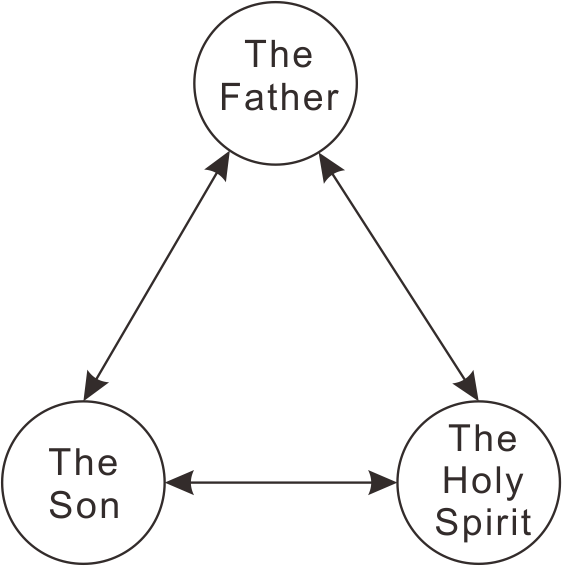
The Trinitarian archetype. The perfect mutual entry of Father, Son, and Spirit is the ultimate source of the True, the Good, the Beautiful, and Love.
Love is perspective transformation.
Note 1: The ontology of love is the mutual entry within the Trinity. It is not that God "possesses" love as an attribute, but that the relations within God are themselves love. The Father loves the Son from before the creation of the world (John 17:24). This love is not a reciprocal relationship in the created world, but the complete, eternal mutual entry among the three persons who are self-existent and eternal.
| Level | Content | Cost or no cost |
|---|---|---|
| The Holy itself | The perfect mutual transformation of the Triune God | No cost |
| Manifestation of love | The Holy appears to the created world as love | Cost |
| Expression of love (after the fall) | Humans express love in the medium | Cost |
Note 2: Love itself has no cost. Perspective transformation pays no cost—the mutual entry between Father and Son has no obstruction, loss, or death. Cost is a phenomenon after the fall. In the Holy, there is no cost. In unfallen Adam, perspective transformation also had no cost. Cost is not an eternal law of the universe.
Note 3: Human love is an imitation of the Holy. Humans are not the Holy, but they are given a real, finite, created capacity for love—they can actively and truly turn from one perspective to another. In the Gospels, the greatest commandment is "You shall love the Lord your God with all your heart and with all your soul and with all your mind" and "You shall love your neighbor as yourself" (Matthew 22:37-39). These two commandments are both, in cognitive structure, perspective transformation: turning to God, turning to the neighbor.
Note 4: This capacity is inalienable and unchangeable. Even after the fall, this capacity remains. It is the bearing of the image of God, the foundation of human dignity and freedom. After the fall it did not disappear; its direction was locked in the direction away from God.
Note 5: The essential difference between human love and divine love. Human love is a real, finite, created capacity for perspective transformation. Unbelievers can also create great art, build deep friendships, and lay down their lives for friends. But this imitative love cannot save them, because they use it to love the wrong object. After the Holy Spirit indwells, the love poured into the believer's heart is not human love "upgraded," but God's own capacity for perspective transformation—the infinite love within the Trinity—dwelling in the believer through the Spirit. Two loves: one is the created image, never to be deprived; the other is the uncreated gift, obtained only through the indwelling of the Holy Spirit. The two are ontologically different and must not be confused.
Types of perspective transformation:
| Type | Content | Example |
|---|---|---|
| Object change | Medium unchanged, object changed | From looking out the window to looking at the phone |
| Medium change | Object unchanged, medium changed | From naked eye to telescope |
| Relation change | Medium and object unchanged, relation changed | The same sunset, from appreciation to judging the weather |
Sin + finitude = cost. Cost is the irreversible rupture of a specific relational structure within the original perspective when the subject undergoes perspective transformation.
Note 1: Sin + finitude = cost. Finitude is an essential characteristic of the created perspective structure—no creature can hold multiple perspectives simultaneously, and perspective transformation necessarily accompanies the rupture of a specific relational structure within the original perspective. In the unfallen state, this rupture was reversible—the subject could return to the original perspective at any time, reconnecting the severed relational structure, without producing irreparable loss. The reason it was reversible is that the unfallen person's perspective had its stable axis in pointing to the Trinity—love directed to the Trinity is necessarily the unity of the True, the Good, the Beautiful, and Love; the flow of love is simultaneously the directedness of the Good, the certainty of the True, and the harmony of the Beautiful. When the subject turned from "focusing on God" to "focusing on the created world," only the specific relation of "focusing on God at this moment" was ruptured; the directedness of the Good itself was never severed—the created world was seen within God, and loving the created world was simultaneously loving God.
The fall severed the axis pointing to the Trinity. Eve's focus turned from "God said do not eat" to "the fruit is pleasing to the eye"—this was the first separation of love and the Good in human history. Perspective transformation detached from the axis pointing to the Trinity; the flow of love was no longer simultaneously the directedness of the Good. From then on, human perspective direction became a drifting system without an axis: love still flows, but love no longer necessarily points to the Good; the True is still tracked, but the True no longer necessarily serves the Good; the Beautiful is still felt, but the Beautiful no longer necessarily reflects the Good. The direction and pattern of rupture in each perspective transformation are no longer consistent—today pointing to wealth, tomorrow turning to power, the day after pursuing fame—each rupture leaves a crack in a different direction, and subsequent ruptures cover the previous traces; the mode of accumulation changes from linear addition to nonlinear interweaving. The crisscrossing cracks make it impossible to fully restore the original relational structure within the perspective; rupture changes from reversible to irreversible. This irreversible rupture is cost.
Note 2: The vicious cycle of cost. Distorted structure → extension (attempting to compensate) → cost payment → further distortion of structure → greater cost. The way to break the cycle is not to extend more vigorously within the distorted structure, but to stop extending, retreat, and repair the structure.
Note 3: Cost makes distortion perceptible. Without cost, distortion would never be noticed. If there were no cost, humans would comfortably extend forever in the direction away from God, and would never repent. Death is the final grace—it terminates infinite extension in the distorted direction. Axiom Three is God's final protection for humans in the fallen world. But this grace is being worshipped by humans in history: utilitarianism treats managing cost as the whole of life; technological soteriology treats delaying cost as progress; Stoic indifference treats avoiding cost as the highest wisdom. Axiom Three is not God. Humans treat cost as a god, abandon the pursuit of the distorted structure behind cost, and thereby abandon the hope of repair.
Note 4: The root of structural distortion. The fundamental cause of structural distortion is that the perspective does not point to God. This leads to: dislocation in the subject-medium relation (instrumentalization, worship of the medium); dislocation in the subject-object relation (instrumentalizing others, misunderstanding the world). The order of repair cannot be reversed: first repair the relation with God—direction aligned with God, this is the work of grace alone; then repair the relation with the medium—reason demoted from idol to tool, technology demoted from salvation to extension; finally repair the relation with the object—others are no longer tools, the created world is no longer a resource. Putting the second or third step first—attempting to solve the fundamental problem through better technology, stricter law, or purer aesthetics—must fail. Because all these extensions occur within the distorted structure, paying cost without knowing it. This is why utopia always becomes dystopia: it attempts to extend to perfection within a distorted structure, and the result is only accelerating the accumulation of cost.
Note 5: Axiom Three becomes the axiom of finitude in eternity. At the end, distortion is repaired, and perspective direction is restabilized in the Holy. Although perspective transformation still severs the original perspective structure, the pattern of rupture is restored to consistency, and rupture changes from irreversible back to reversible. This is one of the differences between Creator and creature—the creature's finitude is retained, but finitude no longer leads to irreversible cost.
Theological Theorems
I. Theology Proper
God's essence is revealed as the Holy. The True, the Good, Love, and the Beautiful are not juxtaposed attributes of God, but the fourfold manifestation of the Holy. The Holy is unique to God; humans do not possess the Holy, they can only share in it.
Scripture: Isaiah 6:3; Leviticus 11:44; 1 Peter 1:15-16
"And one called to another and said: 'Holy, holy, holy is the LORD of hosts; the whole earth is full of his glory!'" (Isaiah 6:3) "For I am the LORD your God. Consecrate yourselves therefore, and be holy, for I am holy." (Leviticus 11:44) "But as he who called you is holy, you also be holy in all your conduct, since it is written, 'You shall be holy, for I am holy.'" (1 Peter 1:15-16)
Derivation: By Axiom One, "the Holy" is defined as the perfect mutual relationship of the Trinity. The True, the Good, Love, and the Beautiful are not four independent attributes, but four aspects of the same essence manifested outwardly. The theological proposition that "God's attributes are identical to one another" is here made precise: they are unified in the Holy, not reduced to one another, but manifestations of the same source. This perfect mutual relationship, in its dynamic operation, is love—Father, Son, and Spirit completely entering one another. Therefore, love is not an attribute juxtaposed with the Holy, but the manifestation of the Holy in operation.
"God is love" is not an exhaustive definition of God's essence. God's essence is the Holy. Love, inwardly, is the dynamic relation within the Holy; outwardly, it is the manifestation of the Holy to the created world.
Scripture: 1 John 4:8-10; John 1:18
"Anyone who does not love does not know God, because God is love. In this the love of God was made manifest among us, that God sent his only Son into the world, so that we might live through him. In this is love, not that we have loved God but that he loved us and sent his Son to be the propitiation for our sins." (1 John 4:8-10) "No one has ever seen God; the only God, who is at the Father's side, he has made him known." (John 1:18)
Derivation: When John says "God is love," he is speaking in the context of redemptive history—the God who sent His only Son to die for sinners. This is the way God appears to sinners, not an exhaustive definition of God's internal essence. God does not "sacrifice holiness for the sake of love"; it is the same Holy who appears to humans as love in salvation and as righteousness in judgment. Christ and Him crucified is simultaneously the love of God (Romans 5:8) and the righteousness of God (Romans 3:25-26)—not a compromise reached by two conflicting attributes, but the complete manifestation of the same Holy on the same cross.
The Good is the directedness of the Trinitarian relations—the Father points to the Son, the Son points to the Father, and the operation of this mutual pointing is itself the Good. When the perspective structure is aligned with the Holy, it is good; when it deviates from the Holy, it is evil.
Scriptural Basis: Mark 10:18; Matthew 6:22-23
"And Jesus said to him, 'Why do you call me good? No one is good except God alone.'" (Mark 10:18) "The eye is the lamp of the body. So, if your eye is healthy, your whole body will be full of light, but if your eye is bad, your whole body will be full of darkness. If then the light in you is darkness, how great is the darkness!" (Matthew 6:22-23)
Derivation: According to Theological Axiom One (the Holy), the Good is the directedness of the Trinitarian relations—the Father points to the Son, the Son points to the Father, and the operation of this mutual pointing is itself the Good. The created perspective does not intrinsically embed the directedness of the Good—it is merely a structure that can be focused in different directions. When this structure as a whole is aligned with the Holy, it is good; when it deviates from the Holy, it is evil. Therefore, the Good is not a property of behavior, not an abstract principle, not an emotional inclination, but the directedness of the perspective as a whole. Two outwardly identical behaviors may come from completely different perspective directions—the Pharisees washed the outside of the cup and dish, but inside they were full of extortion and excess. The behavior was correct; the direction was entirely wrong. Jesus's saying that "the eye is the lamp of the body"—the direction of the eye's focus determines whether the whole person is light or darkness.
God's righteousness is not a fundamental attribute. Righteousness is the necessary result of the Holy operating in a distorted structure. It is experienced as grace by saints, and as terror by sinners. The same fire refines gold and burns wood.
Scripture: 2 Corinthians 5:10; Hebrews 10:31; James 5:11; Isaiah 40:3-4
"For we must all appear before the judgment seat of Christ, so that each one may receive what is due for what he has done in the body, whether good or evil." (2 Corinthians 5:10) "It is a fearful thing to fall into the hands of the living God." (Hebrews 10:31) "Behold, we consider those blessed who remained steadfast. You have heard of the steadfastness of Job, and you have seen the purpose of the Lord, how the Lord is compassionate and merciful." (James 5:11) "A voice cries: 'In the wilderness prepare the way of the LORD; make straight in the desert a highway for our God. Every valley shall be lifted up, and every mountain and hill be made low; the uneven ground shall become level, and the rough places a plain.'" (Isaiah 40:3-4)
Derivation: By Axiom One, the Holy is essence. By Axiom Three, after structural distortion, extension pays cost. When the Holy is present in a distorted structure, it necessarily corrects the distortion. That correction, for those whose direction is aligned with God (saints), is experienced as discipline, healing, grace—"the Lord disciplines the one he loves" (Hebrews 12:6). For those whose direction deviates from God (sinners), it is experienced as judgment, wrath, terror—"it is a fearful thing to fall into the hands of the living God" (Hebrews 10:31). The same fire refines gold and burns wood. This is the formalization of the Reformed principle that "God's sovereignty is righteous in both salvation and judgment." One metaphor is clearing a channel, straightening out a channel that had been twisted into a braided rope. A voice cries: "In the wilderness prepare the way of the LORD; make straight in the desert a highway for our God. Every valley shall be lifted up, and every mountain and hill be made low; the uneven ground shall become level, and the rough places a plain."
God is not within any perspective. God is the archetype of perspective, not the object of perspective. Humans cannot "know" God's essence; they can only respond to God's manifestation.
Scripture: Exodus 33:20; Colossians 1:15
"But," he said, "you cannot see my face, for man shall not see me and live." (Exodus 33:20) "He is the image of the invisible God, the firstborn of all creation." (Colossians 1:15)
Derivation: By Axiom One, all cognition is within a perspective—the subject points to the object through the medium. If God is placed in the position of the object, God is limited by human media (language, reason, senses)—this is the essence of idolatry. Moses could only see God's "back" (Exodus 33:23)—not that God has a back, but that humans can only bear the traces left after God passes by. All language about God is analogy; all knowledge about God is a degraded manifestation. Natural theology—attempting to prove God's existence and describe God's attributes through reason—is, in the strict sense, illegitimate. Humans cannot place God in the "object" slot for analysis. Christianity is a religion of revelation, not a religion of speculation.
The Holy, the True, the Good, Love, and the Beautiful—these five constitute a complete description of God's essence. All other attributes listed in traditional theology can be strictly reduced to the manifestation of these five in a specific medium.
Derivation: By Axiom One, the Holy is essence; the True, the Good, the Beautiful, and Love are different manifestations of the Holy; other attributes are manifestations at the medium level, not the essence itself. Faithfulness is not an attribute juxtaposed with the True, but the continuous unfolding of the True in time; mercy is not an attribute juxtaposed with the Good, but the necessary expression of the Good in the face of the helpless. Grace is the free operation of love in the face of the undeserving; glory is the radiance of the Holy when manifested in the created world, and so on.
Omnipotence is not a power separated from the Holy, but the Holy's complete love in the medium level without any obstruction; omniscience is God's complete entry into all perspectives. The complete mutual entry of Father, Son, and Spirit means that God is within every creature's perspective, knowing the necessary direction of every focus.
Eternity is not infinite extension in time, but God's mode of existence outside time. Time is the trace of extension in the medium; God is not in any medium, therefore not in time. Thus, the traditional theological debate about "whether God is within or outside time" is repositioned—God is neither within time nor outside time; rather, time itself is the product of perspective extension in the created world.
II. Anthropology
The human is an irreducible perspective constituted by subject, medium, object, and relation. The core dynamic of the perspective is love, and its structure can bear the True, the Good, the Beautiful, and Love. The human is not an entity that "possesses" a perspective; the human "is" a perspective.
Scripture: John 1:14—"And the Word became flesh and dwelt among us, and we have seen his glory, glory as of the only Son from the Father, full of grace and truth." Philippians 2:6-7—"who, though he was in the form of God, did not count equality with God a thing to be grasped, but emptied himself, by taking the form of a servant, being born in the likeness of men." Hebrews 2:14,17—"Since therefore the children share in flesh and blood, he himself likewise partook of the same things... Therefore he had to be made like his brothers in every respect." Genesis 1:26-27—"Then God said, 'Let us make man in our image, after our likeness.'"
The human is not an entity that "possesses" a perspective; the human "is" a perspective. The so-called "self" is the narrative role produced by perspective history at the extension level, "consciousness" is the comprehensive manifestation of perspective activity at the medium level, and "will" is the conceptual phantom produced when the capacity for perspective transformation is observed at the medium level. You are not your reason—reason is the computational tool of the brain at the medium level, on the same ontological footing as the eye that sees and the hand that grasps. You are not your emotions—emotions are the response patterns of the bodily medium to perspective transformation, the light and heat emitted by the flame of love, not the flame itself. You are not even your body—the body is the meta-medium, the material starting point of perspective operation; at the end it will be renewed into a glorious body no longer subject to decay, but your essence—the perspective and the capacity for love—will run through both the old and new medium carriers.
This proposition is the precise convergence of two completely independent derivation paths upon the same conclusion.
Derivation Path One: From the Two Natures of Christ
The two natures of Christ are the most precise Christological formulation in church history. The Chalcedonian Creed uses four negative terms—"without confusion, without change, without division, without separation"—to define the relationship between Christ's divinity and humanity. But this formula has always had an unresolved tension: does Christ's humanity require an independent "human person"?
If Christ's humanity is complete—having a body, reason, emotion, and will—does it need a human person to bear it? Traditional theology answers "no"—Christ's person is the person of the Son; the Son took on humanity, but humanity has no independent person. This raises a question: if humanity can exist without a human person, what exactly is the essence of "the human"?
Perspective transformation theory gives an extremely concise answer: it does not need one. Because "the human" is not a person, but a perspective. A perspective is constituted by subject, medium, object, and relation, and cannot be reduced. Christ's humanity includes the medium—a real body, language, spatiotemporal limitations; the object—the Father, neighbors, the created world; the relation—the complete constraint structure of a human. All three elements are present. The subject is the person of the Son Himself. There is no need for an additional "human person" to bear humanity. The human is the perspective structure itself, and this structure can be "taken" by the person of the Son without needing an independent human person. This is why Christ can be simultaneously fully God and fully human—as the Son, He operates within the complete human perspective.
Derivation Path Two: From Creation
Genesis 1:27 says: "So God created man in his own image." If this is literal, then the human himself is the image of God—not some part of the human, but the whole human. What is the image of God? Christ is "the image of the invisible God" (Colossians 1:15). He is simultaneously in the Trinity and in perspective. His perspective structure—subject, medium, object, relation—is the complete, undistorted mapping of the internal relations of the Trinity in the created world. Therefore, "the image of God" is the perspective itself. The human is created in the image of God, therefore the human is a perspective. For the strict correspondence between the image of God and the perspective structure, see the derivation of the next theorem.
God created man in the image of the Trinity. The human is the image of God. Not "possessing" the image of God, the human "is" the image of God.
Scripture: Genesis 1:27; Genesis 9:6
"So God created man in his own image, in the image of God he created him; male and female he created them." (Genesis 1:27) "Whoever sheds the blood of man, by man shall his blood be shed, for God made man in his own image." (Genesis 9:6)
Derivation: By Axiom One, the Holy is the perfect perspective relationship of mutual entry among the Trinity, manifested as certainty (the True), directedness (the Good), dynamic operation (Love), and harmonious structure (the Beautiful). These are the core characteristics God revealed in biblical revelation.
By Genesis 1:26-27, God said, "Let us make man in our image, after our likeness." This verse is itself spoken by God. The Bible does not say "Let us make man in some of our attributes," does not say "Let us make man in our reason, will, and morality," and certainly does not say "We created man's soul in our image, and the body is an addition." The Bible says: "So God created man in his own image."—literally. The human is the image of God.
By Axiom One and Theorem 16, the human is an irreducible perspective constituted by subject, medium, object, and relation, whose structure can bear the fourfold manifestation of the True, the Good, Love, and the Beautiful. These fourfold manifestations correspond exactly to the fourfold relations within the Trinity: mutual knowing (the True), mutual pointing (the Good), mutual entry (Love), and mutual indwelling (the Beautiful). Therefore, the human perspective structure is the complete mapping of the internal relations of the Trinity in the created world.
The human does not "possess" the image of God—as if the image were some additional attribute attached to the human. The human "is" the image of God—the entire perspective itself is the mapping of the Trinitarian relations. Just as the heavens declaring the glory of God is literal, matter is the fixation of God's love, and the human being the image of God is also literal. God's words are too plain, too profound, too simple, so that we took two thousand years to return to the literal meaning.
The subject is the spirit given by God to man, ensuring that the structures of the True, the Good, the Beautiful, and Love are firm and immovable. The spirit is the sole source of the perspective's directedness, the bearer of the capacity for love, the tracker of certainty, and the maintainer of harmony.
Scripture: Genesis 2:7; Ecclesiastes 12:7; Zechariah 12:1; Ephesians 2:5
"Then the LORD God formed the man of dust from the ground and breathed into his nostrils the breath of life, and the man became a living creature." (Genesis 2:7) "And the dust returns to the earth as it was, and the spirit returns to God who gave it." (Ecclesiastes 12:7)
Derivation: According to Theorem 16, the human is a perspective, constituted by the four elements of subject, medium, object, and relation. According to Axiom One, a perspective must have a bearer—the subject. The subject is the sole source of the perspective's directedness, the bearer of the capacity for love, the tracker of certainty (the True), and the maintainer of harmony (the Beautiful). Without the subject, the True cannot be tracked, the Good loses direction, love cannot operate, and the Beautiful cannot appear.
Genesis 2:7 declares that God formed man from the dust of the ground and breathed into his nostrils the breath of life, and man became a "living creature." "Dust" is the meta-medium—the body, the material starting point of perspective operation. The "breath of life" is the core element actively given by God, which activates the entire perspective, transforming man from dust into a personal existence bearing the image of God. What this "breath of life" forms is the subject—the bearer of the capacity for love, the sole source of the perspective's directedness, the foundation on which the True, the Good, Love, and the Beautiful operate firmly.
Ecclesiastes 12:7 declares that after death "the dust returns to the earth as it was, and the spirit returns to God who gave it." Death is the disintegration of the perspective—the meta-medium (body) returns to dust, but the subject (spirit) does not perish; it returns to the God who gave it. The spirit is given by God, therefore it does not depend on the bodily medium for existence; after the death of the body it remains conscious and can still be with Christ.
Zechariah 12:1 declares that the LORD "stretches out the heavens and founds the earth and forms the spirit of man within him." The spirit is directly created by God, not derived from matter, nor a byproduct of bodily functions. God actively gives each person a spirit at the beginning of life—gives him the core element of becoming a subject.
Ephesians 2:5 declares that when we were "dead in our trespasses," God "made us alive together with Christ." The spirit did not perish in the fall—it still completely bears the structure of the True, the Good, the Beautiful, and Love, but its direction is locked in the orbit away from God, in a state of "death." This "death" is not the annihilation of the spirit, not the loss of capacity, but the eternal lock of direction—the spirit can still operate love, but can never turn to God. Regeneration is the Holy Spirit re-correcting the direction of the spirit, enabling it to point to God. This is the work of grace alone.
The distinction between spirit and soul in perspective theory is precisely defined: the spirit is the subject—the core of the perspective, the personal bearer directly given by God, bearing the True, the Good, Love, and the Beautiful. The soul is the comprehensive manifestation of the perspective operating in the bodily medium—including the operations of reason, emotion, intuition, and other medium-level functions. Spirit and soul are not two separate entities, but descriptions of the perspective at different levels: the spirit describes the core dynamic and the bearer of directedness; the soul describes the comprehensive operation of this dynamic in the medium. Hebrews 4:12 mentions that "soul and spirit" can be "pierced and divided," indicating that although spirit and soul are closely related, they can be distinguished functionally—the spirit is the core, the soul is the operation. Perspective theory provides a precise cognitive structure for this distinction: the spirit is the subject, the soul is the comprehensive manifestation of the perspective at the medium level.
The spirit is intact in the fall—this is the foundation of the inalienability of the image of God, the ultimate reason why humans still bear the image of God even in a state of deviation from God. The spirit is still intact in hell—the capacity for love is still complete, the structures of the True, the Good, the Beautiful, and Love are still firm, but the direction is permanently locked in the orbit away from God. The spirit is re-turned by the Holy Spirit in regeneration—not re-giving the spirit, but re-calibrating the spirit's direction. The spirit is still conscious in the intermediate state—after the death of the body, the spirit returns to the God who gave it, awaiting the resurrection day when it will be reintegrated with the glorious body. The spirit is completely satisfied at the end—when the resurrected body and spirit are reunited, the perspective operates unobstructed in complete love, with no more death, no more separation.
The human as a perspective, by its four-element structure (subject-medium-object-relation), ontologically calls for loving God and loving neighbor. The medium is an inseparable part, showing that the human is not a self-sufficient isolated entity. The existence of the object shows that the perspective necessarily points beyond itself. The constraint of relation shows that the perspective can only operate healthily in the correct directedness.
Derivation: By the theorem "the human is a perspective," the human is inseparably constituted by subject, medium, object, and relation. The inseparability of the medium means that the human cannot exist apart from the medium. The body is the meta-medium; the human cannot "directly" commune with God or others apart from the body. This shows that the human is created as a finite, dependent being; all communion between creature and Creator, and between creature and creature, must pass through the medium. This is the prefiguration of "the Word became flesh" in the created order—love must enter the medium, must become perceptible action.
The object is a necessary component of the perspective, showing that the perspective necessarily points beyond itself. There is no "pure subject that is about nothing." This structure declares: the human is not a self-sufficient closed system; the human was created to point to the other—ultimately to God, and also to the neighbor. The very existence of the object dimension is the call of "love God and love neighbor" in the created structure.
The constraint of relation shows that the perspective can only operate healthily in the correct order. The relation between the subject and God (the vertical dimension) determines the relation between the subject and the medium, and between the subject and the object (the horizontal dimension). When the vertical dimension is distorted, the horizontal relations necessarily become disordered. When the direction is aligned with God, the True, the Good, the Beautiful, and Love each take their proper place, and the perspective operates in harmony.
In summary, the four-element structure of the perspective is itself the imprint of "love God and love neighbor" engraved in the creature's ontology. Loving God and loving neighbor is not an externally added commandment, but the necessary call of the human's created structure. The words of the commandment are written on stone tablets; the structure of the commandment is written in the human's ontology. Both come from the same source—the eternal operation of the mutual perspective transformation of the Trinity.
The fall distorted the perspective's directedness. Humans are still loving—only not pointing to God. The capacity for love is intact; the direction is locked in the orbit away from God.
Scripture: Romans 1:21-23; Romans 7:18
"For although they knew God, they did not honor him as God or give thanks to him, but they became futile in their thinking, and their foolish hearts were darkened. Claiming to be wise, they became fools, and exchanged the glory of the immortal God for images." (Romans 1:21-23) "For I know that nothing good dwells in me, that is, in my flesh. For I have the desire to do what is right, but not the ability to carry it out." (Romans 7:18)
Derivation: By Axiom Three, the root of structural distortion is deviation from God. Humans did not lose the capacity for perspective transformation—humans are still undergoing perspective transformation every moment. But from Eve onward, the direction of this capacity was twisted from God-centered to self-centered. Humans can freely transform between idols, but cannot turn to God on their own. The Gentiles described in Romans 1 are not "not worshipping"—they "worshipped the creature rather than the Creator." Their capacity for transformation remains, but the direction is locked in the direction away from God.
Evil is not the absence of good, not an ontological deficiency, but the perspective as a whole not pointing to God. Evil is deviation from the Good—the perspective direction turning from the Holy to created things. The capacity for love is intact, but the direction is locked in the orbit away from God.
Scriptural Basis: Romans 1:21-23; Romans 3:23; Matthew 15:19
"For all have sinned and fall short of the glory of God." (Romans 3:23) "For out of the heart come evil thoughts, murder, adultery, sexual immorality, theft, false witness, slander." (Matthew 15:19)
Derivation: By Axiom One (the Holy), the Good is the directedness of the Trinitarian relations—the Father points to the Son, the Son points to the Father, and the Spirit is the dynamic operation of this mutual pointing. Therefore, the Good is not a property of behavior, not an abstract principle, but the directedness of the perspective as a whole. When the perspective direction is aligned with the Holy, the perspective is good. By the theorem "the fall is directional distortion, not loss of capacity," after the fall, the human capacity for love (the capacity for perspective transformation) is intact, but the direction is locked in the orbit away from God. Therefore, evil is not that humans "lost something," but that humans "turned in the wrong direction." Augustine's "evil is the absence of good" is here made precise: what is absent is not the ontology of the Good, but the direction of the Good. Evil is not an empty deficiency, but a dynamic, directed, active deviation. People in hell are still loving, still undergoing perspective transformation, but the direction is permanently locked in the orbit away from God—this is the eternalization of evil.
The essence of evil (directional deviation) is unchanging at the ontological level, but its degree, scope, and destructive power at the medium level depend entirely on the medium the subject uses and influences. God's righteous judgment judges the direction itself, and also precisely settles accounts according to the cost differences at the medium level.
Scriptural Basis: Luke 12:47-48; Matthew 11:21-24; Revelation 20:12-13
"And that servant who knew his master's will but did not get ready or act according to his will, will receive a severe beating. But the one who did not know, and did what deserved a beating, will receive a light beating. Everyone to whom much was given, of him much will be required, and from him to whom they entrusted much, they will demand the more." (Luke 12:47-48) "Woe to you, Chorazin! Woe to you, Bethsaida! For if the mighty works done in you had been done in Tyre and Sidon, they would have repented long ago in sackcloth and ashes. But I tell you, it will be more bearable on the day of judgment for Tyre and Sidon than for you." (Matthew 11:21-22)
Derivation: By Axiom One, all extension occurs within a specific medium. By the theorem "the essence of evil," evil is the perspective direction deviating from God. By Axiom Three, extension in a deviating direction pays cost. The same directional deviation, if it occurs in a dictator with great power (medium: military, law, propaganda apparatus), causes cost affecting millions; if it occurs in an ordinary person's indifference (medium: a glance, silence, daily interaction), the cost is limited to a few relationships. The direction is the same deviation, both are evil; but the difference in medium determines the scale and depth of the cost. Therefore, God's judgment is not one-size-fits-all—Jesus said Sodom would be more bearable on the day of judgment than Capernaum (Matt 11:24), and also said "everyone to whom much was given, of him much will be required" (Luke 12:48). This is not justification by works, but the precise fulfillment of Axiom Three in the final judgment: the extension cost of every creature is completely recorded and precisely settled in God's perspective. Those who deviate in direction are eternally locked in hell, but the settlement of cost differs according to medium differences.
What God predestines is the extension level (the necessary unfolding after fixation). Human freedom is at the focus level (the capacity for perspective transformation). The two are at different levels and do not contradict. The traditional debate between free will and predestination is a category error.
Scripture: Ephesians 1:11; Romans 8:29-30; Acts 13:48
"In him we have obtained an inheritance, having been predestined according to the purpose of him who works all things according to the counsel of his will." (Ephesians 1:11) "For those whom he foreknew he also predestined to be conformed to the image of his Son... And those whom he predestined he also called, and those whom he called he also justified, and those whom he justified he also glorified." (Romans 8:29-30) "And when the Gentiles heard this, they began rejoicing and glorifying the word of the Lord, and as many as were appointed to eternal life believed." (Acts 13:48)
Derivation: God predestines the necessity of all extension—He works all things according to His will (Ephesians 1:11). But freedom is at the focus level. The turning of focus is not in time, not at the medium level, not in the extension chain. God's predestination does not violate the freedom of focus. This is not mysticism, not agreeing to disagree; it is the dissolution of the problem. Calvinism and Arminianism debated for two thousand years because they shared the same erroneous premise—"free will must be in choice." Once this premise is removed, the battlefield of the debate disappears.
Sexual difference is only a bodily difference at the medium level. The two sexes are not a hierarchical relationship, not functional complementarity, but equal bearers of mutual perspective transformation.
Scripture: Genesis 1:27; 2:18-24; Ephesians 5:31-32
"So God created man in his own image, in the image of God he created him; male and female he created them." (Genesis 1:27) "Then the LORD God said, 'It is not good that the man should be alone; I will make him a helper fit for him.'... Therefore a man shall leave his father and his mother and hold fast to his wife, and they shall become one flesh." (Genesis 2:18,24) "For this reason a man shall leave his father and mother and hold fast to his wife, and the two shall become one flesh. This mystery is profound, and I am saying that it refers to Christ and the church." (Ephesians 5:31-32)
Derivation: According to Axiom Two (love), love is perspective transformation. God created male and female in His image—the difference between the sexes is itself the bearing structure of the capacity for love. In marriage, husband and wife enter each other's perspectives and become "one flesh"—this is the most original and intimate expression of perspective transformation in the created world. The two sexes are not a hierarchical relationship (male superiority, female inferiority), not functional complementarity (Greek philosophy), but equal bearers of mutual perspective transformation—husbands are to love their wives as Christ loved the church; wives are to submit to their husbands as the church submits to Christ. Both are expressions of perspective transformation in different directions, both pointing to the greater unity—the unity of Christ and the church.
The fertilized egg is a complete human perspective. At the moment of conception it is given a spirit (subject) by God, possesses a developing body (meta-medium), is known by God in relation, and possesses an inalienable capacity for perspective transformation. Any act deliberately terminating the life of a fertilized egg is a deliberate destruction of the image of God.
Scriptural Basis: Psalm 139:13-16; Luke 1:41-44
"For you formed my inward parts; you knitted me together in my mother's womb. I praise you, for I am fearfully and wonderfully made... My frame was not hidden from you, when I was being made in secret, intricately woven in the depths of the earth. Your eyes saw my unformed substance; in your book were written, every one of them, the days that were formed for me, when as yet there was none of them." (Psalm 139:13-16) "And when Elizabeth heard the greeting of Mary, the baby leaped in her womb. And Elizabeth was filled with the Holy Spirit, and she exclaimed with a loud cry, 'Blessed are you among women, and blessed is the fruit of your womb!'" (Luke 1:41-42)
Derivation:
Step One: The human's ontology is a perspective, not a combination of organs. According to the anthropological theorem "the human is a perspective," the human's essence is not soul plus body, not a rational animal, not a free individual, but a complete perspective—the spirit is the subject, the body is the meta-medium, pointing to the object in relation. The human does not "possess" a perspective; the human "is" a perspective. Therefore, the criterion for "being a human" is not the degree of organ development, not the maturity of the nervous system, not whether there is conscious activity, but whether there is a complete perspective.
Step Two: The fertilized egg already possesses all the structures of a perspective. The fertilized egg possesses the spirit (subject) from God, given at the moment of conception. At the moment of conception, God breathes the breath of life into this new life, making it a living creature with a spirit. The fertilized egg possesses a developing body (meta-medium); although not yet unfolded into visible organs, it already contains complete genetic information, and this body will gradually unfold in time. The fertilized egg is already in relation—establishing a life connection with the mother, and an eternal relation with God. The fertilized egg already possesses an object—it perceives and responds to the maternal environment in a limited way. Therefore, the fertilized egg is a complete human, not a "potential human," not a "future human," but already a human.
Step Three: The capacity for perspective transformation is inalienable and unchangeable, and truly exists in the fertilized egg. The fertilized egg's capacity for perspective transformation is real, even if it has not yet fully unfolded at the medium level in the early stages of development. Just as a newborn's capacity for love has not yet been expressed through complex interpersonal interactions, but already truly exists within him; just as a comatose patient's capacity for perspective transformation cannot be expressed externally due to the limitations of the bodily medium, but the capacity itself has not disappeared—the fertilized egg is the same. The capacity for perspective transformation is not at the medium level, not in time, not dependent on the degree of bodily development.
Step Four: Life is a complete process beginning at conception, not beginning at some developmental node. From fertilized egg to newborn to adult, the whole process of life is not a gradual leap "from non-human to human," but the gradual unfolding of the same perspective in time. Every cell division is extension, every organ differentiation is the fixation of focus, but these changes all occur at the medium level—the body's form is changing, but the perspective's subject has never changed. Just as a newborn is not "not a human" because "it cannot yet speak," an embryo is not "not a human" because "it does not yet have a heartbeat," a fertilized egg is not "not a human" because "it does not yet have a nervous system." The human is a perspective, not a combination of organs.
Step Five: The biblical witness. David says "you knitted me together in my mother's womb... Your eyes saw my unformed substance"—at the beginning of conception, at the stage of "unformed substance," God already knew this person and had already established a relationship with him. John the Baptist was filled with the Holy Spirit in the womb, and leaped for joy in the womb at Mary's greeting—this shows that before birth, he was already a real person capable of responding to God. Not "will become a human," but already is a human.
Conclusion: The fertilized egg is a complete human perspective. At the moment of conception it is given a spirit (subject) by God, possesses a developing body (meta-medium), is known by God and accepted by parents in relation, and possesses an inalienable capacity for perspective transformation. The entire process from conception to natural death is the gradual unfolding of the same perspective in time. Therefore, any act deliberately terminating the life of a fertilized egg is a deliberate destruction of the image of God.
The cultural mandate, moral mandate, and worship mandate are the natural flow of the same capacity for perspective transformation in three directions. Governing the created order is love operating in creation; loving one's neighbor as oneself is love operating in the neighbor; worshipping God is love operating in the source.
Scripture: Genesis 1:28
"And God blessed them. And God said to them, 'Be fruitful and multiply and fill the earth and subdue it, and have dominion over the fish of the sea and over the birds of the heavens and over every living thing that moves on the earth.'" (Genesis 1:28)
Derivation: According to Axiom Two (love), creativity, empathy, and worship are the same capacity for perspective transformation operating in different fields. Governing the created order (cultural mandate) is entering the perspective of the created order—love operating in creation. Loving one's neighbor as oneself (moral mandate) is entering the other's perspective—love operating in the neighbor. Worshipping God (worship mandate) is entering God's perspective—love operating in the source. These three are not three commandments, but the natural flow of the same capacity for love in three directions. The fall distorted these three directions, making culture a Tower of Babel (self-worship), morality self-righteousness (Pharisees), and worship idolatry. Redemption re-calibrates these three directions: in Christ, culture becomes service to the created order, morality becomes selfless entry into the neighbor, worship becomes response to the Holy.
III. Christology
The incarnation is the manifestation of the eternal love of the Son of God in history. The Son enters perspective—from the infinite into the finite, from glory into shame, from the invisible into the visible. This is the most extreme operation of love.
Scripture: Philippians 2:6-7; John 1:14
"Who, though he was in the form of God, did not count equality with God a thing to be grasped, but emptied himself, by taking the form of a servant, being born in the likeness of men." (Philippians 2:6-7) "And the Word became flesh and dwelt among us, and we have seen his glory, glory as of the only Son from the Father, full of grace and truth." (John 1:14)
Derivation: Axiom Two defines love as perspective transformation. The Son of God taking on humanity is the most extreme act of love—the Creator entered the creature's perspective. Philippians says "emptied himself, by taking the form of a servant"—the emptying is not the abandonment of divinity, but the Son as subject forming a perspective: a baby in a manger, a carpenter in Nazareth, a thirsty man on the cross. The Chalcedonian Creed says "two natures, without confusion, without separation"—this is the boundary description of this transformation: He did not cease to be God, and was fully human.
The incarnation is the Son as subject constituting a complete perspective. The Son does not cease to be God—in eternity He is in complete mutual indwelling with the Father; the Son becomes fully human—operating in the complete human constituted by subject, medium, object, and relation. The two natures are perfectly united in the same person.
Scripture: Philippians 2:6-7; John 1:14
"Who, though he was in the form of God, did not count equality with God a thing to be grasped, but emptied himself, by taking the form of a servant, being born in the likeness of men." (Philippians 2:6-7) "And the Word became flesh and dwelt among us, and we have seen his glory, glory as of the only Son from the Father, full of grace and truth." (John 1:14)
Derivation:
By Axiom One (the Holy), the Triune God is the complete mutual entry of Father, Son, and Spirit. Father, Son, and Spirit are eternally the Holy together—this is the Son's "divinity." By Axiom One (perspective), human cognition is always within a perspective. Humans can only cognize and act within specific bodily, spatiotemporal, linguistic, and cultural media. This is the ontological structure of created cognition; "humanity" is precisely this perspective operating in the medium.
The incarnation is the Son, from the "mediumless" eternal relations, actively entering the "medium-needing" created perspective. The Son took on a human body, human language, human spatiotemporal limitations, human mortality—this is entering from the infinite into the finite, from the mediumless into the medium. This entry itself is the most thorough perspective transformation—the Creator entered the creature's perspective, eternity entered time, the invisible entered the visible. The Son in humanity fully experienced all the limitations of the created perspective—hunger, fatigue, suffering, death—yet did not cease to be God. The two natures in the same person are the incarnation of eternal perspective transformation in history.
The Son is both a person of the Trinity and the subject of the perspective structure; the two are united in the incarnation. It is not two persons cooperating, not divinity temporarily leaving humanity, not humanity swallowed by divinity. It is one person, in two relations—Trinity and perspective. This is the incarnation. This is the revealed mystery of love manifested in the flesh.
Perspective theory's answer is: the Son as subject took on a complete human, the temptation was completely real, but the perspective direction absolutely would not deviate from the Father—because the Son as the second person of the Trinity is eternally completely directed toward the Father, and this directedness does not change in the incarnation. He cannot sin, but the temptation is real; the two are fully compatible in the perspective structure.
Historical Note: The Foundation of the Chalcedonian Creed's "Four Negations" in Perspective Theory
The Chalcedonian Creed (AD 451) uses four negative terms to define Christ's two natures: "without confusion, without change, without division, without separation." These "four negations" effectively excluded Arianism (divinity created), Apollinarianism (humanity incomplete), Nestorianism (two persons separated), and Eutychianism (two natures mixed) in doctrinal history, but their positive structural foundation has never been precisely articulated. Perspective theory provides a cognitive foundation for these "four negations": Christ as the person of the Son simultaneously operates in two states—the eternal Trinitarian relations (no medium needed) and the historical human (medium needed). The two natures belong to different relational dimensions, therefore without confusion and without change; the same subject operates in two dimensions, therefore without division and without separation. The "four negations" are not externally imposed mysterious constraints, but the necessary conclusions of the perspective structure.
Christ is fully human because all four elements of His perspective are present. He does not need an independent "human person" to make Him a complete human. As long as the Son operates as subject in a complete human, He is fully human.
Scripture: Hebrews 2:14,17—"Since therefore the children share in flesh and blood, he himself likewise partook of the same things... Therefore he had to be made like his brothers in every respect."
"Since therefore the children share in flesh and blood, he himself likewise partook of the same things, that through death he might destroy the one who has the power of death, that is, the devil." (Hebrews 2:14) "Therefore he had to be made like his brothers in every respect, so that he might become a merciful and faithful high priest in the service of God, to make propitiation for the sins of the people." (Hebrews 2:17)
Derivation: By Axiom One, any perspective is constituted by the four elements of subject, medium, object, and relation. Christ's humanity has all four elements: the subject is the person of the Son, the medium is a real body with spatiotemporal limitations, the object is the Father, neighbors, and the created world, and the relation is the complete constraint structure of a human. The four are irreducible and together constitute a complete human. Traditional Christology's confusion about "whether Christ's humanity needs a human person" arises from conflating "person" with "subject." Person is "who operates"; subject is the bearer of the perspective. The Son as person operates in a human, and this is sufficient to make Him fully human—there is no need for another human person to "bear" humanity.
Christ truly faced temptation in His humanity. The reality of the temptation comes from the reality of the humanity—He was hungry, He feared pain, He longed for His mission. Every temptation was real because the needs in the humanity were real.
Scripture: Matthew 4:1-11—Jesus was tempted three times. Hebrews 4:15—"For we do not have a high priest who is unable to sympathize with our weaknesses, but one who in every respect has been tempted as we are, yet without sin."
"Then Jesus was led up by the Spirit into the wilderness to be tempted by the devil. And after fasting forty days and forty nights, he was hungry. And the tempter came and said to him, 'If you are the Son of God, command these stones to become loaves of bread.'" (Matthew 4:1-3) "For we do not have a high priest who is unable to sympathize with our weaknesses, but one who in every respect has been tempted as we are, yet without sin." (Hebrews 4:15)
Derivation: By Theorem 39, Christ's humanity is completely real. By Axiom One, a real human necessarily includes real medium-level needs (hunger, safety, mission). The tempter uses these real needs as media, attempting to draw the perspective direction away from the Father. The reality of the temptation does not depend on whether Christ "could have sinned," but on the reality of the medium-level needs in the humanity. If Christ did not have real hunger, the temptation of food would not be a real temptation—but the Gospel records "after fasting forty days and forty nights, he was hungry," and this hunger was real, therefore the temptation was also real.
The Son is eternally completely directed toward the Father. In the incarnation, this directedness does not change. Temptation can truly come, but the Son's directedness toward the Father absolutely will not be shaken by temptation. Christ's righteousness is the true operation of His person's essence in His humanity.
Scripture: John 14:10—"I am in the Father and the Father is in me." John 8:29—"And he who sent me is with me. He has not left me alone, for I always do the things that are pleasing to him."
"Do you not believe that I am in the Father and the Father is in me? The words that I say to you I do not speak on my own authority, but the Father who dwells in me does his works." (John 14:10) "And he who sent me is with me. He has not left me alone, for I always do the things that are pleasing to him." (John 8:29)
Derivation: By Axiom One, the Holy is the relation of complete mutual pointing among the Trinity; the Son is eternally completely directed toward the Father—this is His person's essence, not an acquired attribute. By Theorem 39, in the incarnation the Son as subject operates in a human, and He does not cease to be the Son. Therefore, His directedness in the humanity is still complete—temptation can truly pull at the human medium (hunger, fear), but the Son's directedness toward the Father never wavers. Christ "would not sin" not because of external constraints or supernatural intervention, but because His person's essence is completely directed toward the Father. His righteousness is not accumulated by behavior; it is the natural operation of who He is.
Christ in His humanity truly bore the medium limitations of created cognition. He Himself said "the Son does not know, only the Father knows"—this is His real state in the humanity, not pretending not to know.
Scripture: Matthew 24:36—"But concerning that day and hour no one knows, not even the angels of heaven, nor the Son, but the Father only." Matthew 11:27—"All things have been handed over to me by my Father, and no one knows the Son except the Father, and no one knows the Father except the Son and anyone to whom the Son chooses to reveal him."
"But concerning that day and hour no one knows, not even the angels of heaven, nor the Son, but the Father only." (Matthew 24:36) "All things have been handed over to me by my Father, and no one knows the Son except the Father, and no one knows the Father except the Son and anyone to whom the Son chooses to reveal him." (Matthew 11:27)
Derivation: By Theorem 39, Christ's humanity includes real medium limitations—including the finitude of cognition. In the humanity, He must cognize through bodily media (senses, language, space-time), therefore His cognition has real boundaries. By Theorem 42, the two natures are without confusion—the finite cognition in the humanity and the omniscience in the divinity are united in the same person without canceling each other. "The Son does not know" is His real state in the humanity. If Christ in His humanity pretended not to know while actually knowing, the incarnation would not be real, and the temptation would not be real—but the Bible declares the incarnation is real (1 John 4:2-3). Therefore, Christ in His humanity truly did not know that day. This in no way diminishes His divinity—the eternal Son fully knows all things (omniscient), the historical human cognition has real boundaries (finite), the same subject operates simultaneously in two states.
Christ is simultaneously in the Trinity and in perspective, therefore He can sympathize with our weaknesses. Only Christ can completely know the Father's heart and completely know human weakness. On the cross, Christ in His humanity bore the full suffering of abandonment, fully paid the cost of perspective transformation, and opened the road from man to the Holy.
Scripture: 1 Timothy 2:5—"For there is one God, and there is one mediator between God and men, the man Christ Jesus." Hebrews 4:15-16—"For we do not have a high priest who is unable to sympathize with our weaknesses, but one who in every respect has been tempted as we are, yet without sin. Let us then with confidence draw near to the throne of grace."
"For there is one God, and there is one mediator between God and men, the man Christ Jesus." (1 Timothy 2:5) "For we do not have a high priest who is unable to sympathize with our weaknesses, but one who in every respect has been tempted as we are, yet without sin. Let us then with confidence draw near to the throne of grace, that we may receive mercy and find grace to help in time of need." (Hebrews 4:15-16)
Derivation: By Theorem 38, Christ is simultaneously completely in the Trinity (as the Son) and completely in perspective (as a real human). Therefore, only Christ can simultaneously completely enter the Father's perspective and the human perspective—this is the epistemological foundation of His mediator identity. By Axiom Three, sin causes the human perspective direction to deviate from God, and humans cannot turn to God by their own ability. But Christ as mediator fully paid the cost of this transformation on the cross. He in His humanity bore the full suffering of abandonment—"My God, my God, why have you forsaken me" is precisely the moment when the cost was fully paid. This cry is the full weight of the Son in His humanity truly experiencing the rupture of the perspective with the Father. Therefore, the human perspective can now be re-turned to God through Christ, no longer blocked by sin.
Christ's resurrection is the Father's public confirmation that the Son "has fully paid the cost," and also the cosmic evidence that the distorted direction has been corrected. The resurrection is the firstfruits—the first person to walk the entire road in human form, brought into resurrected life, prefiguring that at the end all who are in Christ will likewise be resurrected, and love will operate unobstructed.
Scripture: Romans 4:25—"who was delivered up for our trespasses and raised for our justification." Acts 2:24—"God raised him up, loosing the pangs of death, because it was not possible for him to be held by it." 1 Corinthians 15:20,42—"But in fact Christ has been raised from the dead, the firstfruits of those who have fallen asleep... So is it with the resurrection of the dead. What is sown is perishable; what is raised is imperishable." John 20:27—"Then he said to Thomas, 'Put your finger here, and see my hands; and put out your hand, and place it in my side. Do not disbelieve, but believe.'"
Derivation: By Theorem 49, Christ in death still completely pointed to the Father, and with complete love broke through death. The resurrection is the public manifestation of this breakthrough—the Father's cosmic confirmation that the Son "has fully paid the cost." Christ "could not be held by death," not because death was not real, but because He in death still completely pointed to the Trinity. The flow of Trinitarian love, upon touching the one completely directed toward the Father, spontaneously raised Him from the dead. The resurrected body still bears the nail marks, showing that the traces of cost have not been erased, but transformed into marks of glory. The resurrection is the firstfruits, prefiguring that at the end all who are in Christ will be resurrected, distortion completely corrected, love operating unobstructed.
IV. Soteriology
Sin and righteousness are not two different capacities, but the same capacity for love operating in two opposite directions. Sin is perspective transformation operating in the direction away from the Holy—evil love; righteousness is perspective transformation operating in the direction aligned with the Holy—good love.
Scripture: Matthew 6:22-23—"The eye is the lamp of the body. So, if your eye is healthy, your whole body will be full of light, but if your eye is bad, your whole body will be full of darkness." The eye is the focus of the perspective—the direction of focus determines whether the whole person is light or darkness. Romans 1:21-23—"For although they knew God, they did not honor him as God or give thanks to him... and exchanged the glory of the immortal God for images." Not not worshipping, but worshipping wrongly—the direction of love turned from the Creator to the creature. 1 John 3:12—"We should not be like Cain, who was of the evil one and murdered his brother." Cain was loving—he loved his own righteousness, his own sacrifice, his own right to be accepted—so much that he used this evil love to kill his brother. Romans 3:22-24—"The righteousness of God through faith in Jesus Christ for all who believe... and are justified by his grace as a gift, through the redemption that is in Christ Jesus."
Derivation: By Axiom Two, love is perspective transformation—the capacity of the subject to enter from one perspective into another. By Axiom One, the Holy is the relation of complete mutual pointing among the Trinity—complete mutual entry and mutual glorification among Father, Son, and Spirit. Therefore, the Good is the perspective direction aligned with the Holy, and evil is the perspective direction deviating from the Holy. When perspective transformation operates in the direction aligned with the Holy, this operation itself is righteousness. When perspective transformation operates in the direction deviating from the Holy, this operation itself is sin. The same love, the same capacity, different directions, opposite natures. Eve in the fall was still loving—she focused her entire capacity for perspective transformation on "being like God, knowing good and evil"; the transformation was real, the cost was real, but the direction was wrong. This is the essence of sin.
Since Adam's fall, every descendant's initial perspective direction is inherited from Adam's distorted perspective structure. This is not "sin nature" transmitted through reproduction, but perspective direction necessarily transmitted through generational extension. This is the precise operational definition of "original sin" in perspective theory.
Scripture: Psalm 51:5—"Behold, I was brought forth in iniquity, and in sin did my mother conceive me." From the beginning of existence, the human is in a distorted structure; it is not that conception itself is sin. Romans 5:12—"Therefore, just as sin came into the world through one man, and death through sin, and so death spread to all men because all sinned." All are locked in the same distorted structure. Ephesians 2:3—"by nature children of wrath." This state is not acquired later, but an initial direction inherited from birth.
Derivation: Adam in the fall turned his perspective direction from "God said do not eat" to "the fruit is pleasing to the eye"; focus led to fixation, and the extension after fixation is determined (Axiom Two). Adam's perspective henceforth operated in the orbit away from God, and every descendant of his is produced within this already distorted perspective structure—not directly receiving a "neutral" perspective from God, but inheriting the already distorted initial direction. The infant's capacity for love is complete—they bear the image of God—but the initial direction is preset by the distorted structure, naturally pointing to self and idols rather than to God. They do not become sinners at some moment when they "commit sin," but from the beginning of existence operate in the orbit away from God. As they grow, focus gradually fixates, and sin manifests at the behavioral level. But from the beginning they are not on a trajectory toward God—this is not the result of personal choice, but the result of the inherited distorted structure.
After the fall, humans cannot do righteousness by their own power—not because the capacity for love is lost, but because the relation pointing to the Holy has been irreversibly ruptured by cost. Pointing between creatures is still free, but turning from the creature to the Creator is impossible. This is not "unwillingness," but "inability"—the rupture is structural, not volitional.
Scripture: Romans 3:10-12—"as it is written: 'None is righteous, no, not one; no one understands; no one seeks for God. All have turned aside; together they have become worthless; no one does good, not even one.'" Romans 8:7-8—"For the mind that is set on the flesh is hostile to God, for it does not submit to God's law; indeed, it cannot. Those who are in the flesh cannot please God." John 6:44—"No one can come to me unless the Father who sent me draws him."
Derivation: By Theorem 46, the fall causes every descendant's initial perspective direction to be distorted, naturally deviating from God. By Axiom Three, cost is the irreversible rupture of relational structure. At the moment of the fall, Adam, through the extension act of "picking the fruit," paid the cost of the irreversible rupture of the relation pointing to the Holy. Henceforth, human directedness is still active—love is still operating—but the relation pointing to the Holy has been severed. Humans can freely transform the direction of love between idols, but turning from the creature to the Creator is impossible. This is not a matter of will—a person may deeply long to turn to God—but a structural problem: the only line capable of bearing vertical directedness has been severed. This is the precise structural explanation of "humans cannot save themselves." Repairing this rupture requires not education, example, or persuasion, but Christ becoming the road to bring humans into the Trinity.
After the fall, human directedness deviates from God, and humans cannot re-point to God by themselves—not because the capacity for love is lost, but because the relation pointing to the Holy has been ruptured. Christ's incarnation, death, and resurrection, with love completely directed toward the Father, penetrated the full depth of death and separation, and He Himself became the only road for humans to enter the Trinity. He Himself is this road.
Scripture: John 14:6—"Jesus said to him, 'I am the way, and the truth, and the life. No one comes to the Father except through me.'" Isaiah 53:4-6—"Surely he has borne our griefs and carried our sorrows... But he was pierced for our transgressions; he was crushed for our iniquities; upon him was the chastisement that brought us peace, and with his wounds we are healed. All we like sheep have gone astray; we have turned—every one—to his own way; and the LORD has laid on him the iniquity of us all." 1 Peter 2:24—"He himself bore our sins in his body on the tree, that we might die to sin and live to righteousness." Romans 3:10-12—"None is righteous, no, not one... All have turned aside; together they have become worthless." Ephesians 2:1—"And you were dead in the trespasses and sins." Hebrews 10:19-20—"Therefore, brothers, since we have confidence to enter the holy places by the blood of Jesus, by the new and living way that he opened for us through the curtain, that is, through his flesh."
Derivation: By Axiom Three, after the fall the relation pointing to the Holy is ruptured, and humans cannot re-point to God by themselves—not because of insufficient capacity, but because the relation is severed. Pointing between creatures is still free, but turning from the creature to the Creator is completely impossible. Death is the ultimate form of this separation. Christ became flesh, taking on a complete human. As the Son, He is eternally completely directed toward the Father; as a real human, He operated in this ruptured condition in His humanity, yet was never ruptured—His direction was always completely directed toward the Father. On the cross, He entered the deepest point of separation, bore the full cost of rupture with the Father, but His directedness toward the Father never wavered. He penetrated the full depth of separation with complete love, paying the full cost. Therefore, the essence of atonement is not that the Father punished the Son to satisfy a requirement of justice, but that Christ, with love completely directed toward the Father, paid the full cost in separation, and became the only road for humans to enter the Trinity. He Himself is this road—not that He points out the road, but that He becomes the road. Every person in Christ can come to the Father through this road in the Holy Spirit—not based on their own righteousness, but based on the cost Christ has paid and the road He has become.
Jesus on the cross is the utmost love. The Father turning away from the Son is not a Trinitarian rupture, but the Son in the human medium layer, in His full humanity, bearing the cost of separation from the Father. The cross is the ultimate expression of Axiom Three.
Scripture: Matthew 27:46; Romans 3:25-26; 1 Peter 2:24
"And about the ninth hour Jesus cried out with a loud voice, saying, 'Eli, Eli, lema sabachthani?' that is, 'My God, my God, why have you forsaken me?'" (Matthew 27:46) "whom God put forward as a propitiation by his blood, to be received by faith. This was to show God's righteousness, because in his divine forbearance he had passed over former sins." (Romans 3:25)
Derivation: The cross is the ultimate expression of Axiom Three. All cost within the distorted structure—all cost—was poured out on one person. Christ in His humanity bore the cost and became the road from man to God. But at the peak of that cost, He still exercised the capacity for love—interceding for murderers: "Father, forgive them" (Luke 23:34). Therefore the cross is the utmost love. Not that love overcame justice, but complete love. Christ bore the consequences of sin, death, and the despair of hell, but Christ was always righteous, without sin. What He experienced on the cross was not physical pain, but the essence of hell—clearly knowing the Father loved Him, yet truly feeling the silent separation of the Father. But because the subject of Christ's perspective is the Son, it is always directed toward God and will not deviate. Even when the perspective is separated from the Father, the Son ensures that the perspective points to the Trinity, so that all perspectives can come to point to God, and thus the road of redemption is paved.
Christ had to die, because death is the ultimate expression of the distorted structure. If Christ had only suffered but not died, the road would only have been penetrated to the level of "suffering," not yet to the level of "separation."
Scripture: Hebrews 2:14-15—"Since therefore the children share in flesh and blood, he himself likewise partook of the same things, that through death he might destroy the one who has the power of death, that is, the devil, and deliver all those who through fear of death were subject to lifelong slavery." Matthew 27:46—"And about the ninth hour Jesus cried out with a loud voice, saying, 'Eli, Eli, lema sabachthani?' that is, 'My God, my God, why have you forsaken me?'"
Derivation: By Theorem 47, Christ had to reach the deepest point of separation from God to become the road. Death is the ultimate expression of separation—not only the cessation of the body, but the complete rupture of the perspective from the Holy. The deepest blockage of the road is not suffering, but death itself. If Christ had only suffered but not died, the road would only have been penetrated to the level of suffering, and the deepest separation—death—would still be untouched. Christ had to enter death to completely break through that most solid separation. He entered death with love completely directed toward the Father, and at the deepest point of separation still completely pointed to the Father—precisely because of this, death was penetrated, and the road was accomplished.
Christ truly experienced death—not only physical death, but the hellish substance of separation from the Father. But even at the deepest point of separation, the Son's directedness toward the Father never wavered. He broke through death with complete love—not bypassing death, but penetrating death. The road was completely accomplished at the deepest point of death.
Scripture: Luke 23:34—"And Jesus said, 'Father, forgive them, for they know not what they do.'" Luke 23:46—"Then Jesus, calling out with a loud voice, said, 'Father, into your hands I commit my spirit!'" Acts 2:24—"God raised him up, loosing the pangs of death, because it was not possible for him to be held by it."
Derivation: By Theorem 49, Christ truly experienced death. By Theorem 38, the Son is always in the Trinity—even in death, He is still the second person of the Trinity, and His directedness toward the Father never wavered. The essence of hell is separation from God, but Christ in separation still completely pointed to the Father—"Father, into your hands I commit my spirit." Hell could not hold Him, because the chain of holding is separation, and He was still loving in separation. He broke through death with complete love—not bypassing death, but penetrating death. The road was completely accomplished at the deepest point of death; no depth remains that love has not touched.
Christ's ascension is not departure, but entry. He is the first to accomplish the road, and as the firstfruits, He brings humans forever into the dynamic operation of mutual perspective transformation within the Trinity. He did not abandon us, but entered one step ahead of us.
Scripture: Hebrews 4:14-16—"Since then we have a great high priest who has passed through the heavens, Jesus, the Son of God, let us hold fast our confession. For we do not have a high priest who is unable to sympathize with our weaknesses, but one who in every respect has been tempted as we are, yet without sin. Let us then with confidence draw near to the throne of grace, that we may receive mercy and find grace to help in time of need." Ephesians 1:20-23—"that he worked in Christ when he raised him from the dead and seated him at his right hand in the heavenly places, far above all rule and authority and power and dominion, and above every name that is named, not only in this age but also in the one to come. And he put all things under his feet and gave him as head over all things to the church, which is his body, the fullness of him who fills all in all." John 17:24—"Father, I desire that they also, whom you have given me, may be with me where I am, to see my glory that you have given me because you loved me before the foundation of the world."
Derivation: By Theorem 29, Christ became the only road for humans to enter the Trinity. His ascension is the endpoint of this road—not leaving the world, but entering the Trinity as a human. He is the first to accomplish this road, and as the firstfruits, He brings humans forever into the dynamic operation of mutual entry within the Trinity. Everything He truly experienced in history—hunger, suffering, death, resurrection—was not discarded, but brought into eternity. Henceforth, there is one person—a true human—who forever represents humanity in the Trinitarian fellowship. He did not abandon us, but entered one step ahead of us. Where He is, all who are in Christ will also be. The ascension is the completion of the road—Christ as a human has reached the endpoint, prefiguring that at the end all who belong to Him will likewise be brought into the Trinity, operating forever unobstructed in love.
V. Pneumatology
After Christ became the road, the Holy Spirit runs along this road from the Father and the Son into the heart of every believer. Christ had to ascend before the Holy Spirit could indwell forever—this is not a temporal coincidence, but a structural necessity. The believer's indwelling of the Holy Spirit is the Holy Spirit entering the believer's perspective along Christ's road, correcting its ultimate direction, enabling it to turn to God.
Scripture: John 7:39—"Now this he said about the Spirit, whom those who believed in him were to receive, for as yet the Spirit had not been given, because Jesus was not yet glorified." Acts 2:32-33—"This Jesus God raised up, and of that we all are witnesses. Being therefore exalted at the right hand of God, and having received from the Father the promise of the Holy Spirit, he has poured out this that you yourselves are seeing and hearing." John 16:7—"Nevertheless, I tell you the truth: it is to your advantage that I go away, for if I do not go away, the Helper will not come to you. But if I go, I will send him to you."
Derivation: By Theorem 47, Christ became the only road for humans to enter the Trinity—He, with love completely directed toward the Father, penetrated death and separation in His humanity, re-establishing the severed relation. Once the road is accomplished, the Holy Spirit runs along this road from the Father and the Son into the believer's heart. Christ had to ascend before the Holy Spirit could indwell forever—this is not a temporal coincidence, but a structural necessity: the road must first be accomplished before the Holy Spirit can indwell forever along this road. Old Testament saints were moved by the Holy Spirit, but the Holy Spirit could not indwell forever, because the road had not yet been accomplished by Christ in history—Christ had not yet walked the entire path from death to resurrection, from separation to presence, as a human. Pentecost is the first large-scale operation of the Holy Spirit along this road into human hearts after the road was accomplished. The believer's indwelling of the Holy Spirit is the Holy Spirit entering the believer's perspective along Christ's road, correcting its ultimate direction, enabling it to turn to God. The indwelling of the Holy Spirit is the structural necessity after the road is accomplished—not an added gift, but the natural operation of love along the road after the road is opened.
The Holy Spirit regenerates a person, not by re-giving the capacity for love—that capacity was never lost—but by re-directing the human perspective toward God, so that the Good is corrected. Once the Good is corrected, the True, the Beautiful, and Love are corrected along with it. Sanctification is the process by which the human perspective is continually calibrated by the Holy Spirit, not the human perspective being swallowed by the Holy's perspective. The manifestation of the Holy is completely outside human control.
Scripture: John 16:8,13-14—"And when he comes, he will convict the world concerning sin and righteousness and judgment... When the Spirit of truth comes, he will guide you into all the truth." Romans 5:5—"and hope does not put us to shame, because God's love has been poured into our hearts through the Holy Spirit who has been given to us." Galatians 5:22-23—"But the fruit of the Spirit is love, joy, peace, patience, kindness, goodness, faithfulness, gentleness, self-control." Ezekiel 36:26-27—"And I will give you a new heart, and a new spirit I will put within you... And I will put my Spirit within you, and cause you to walk in my statutes." John 3:8—"The wind blows where it wishes, and you hear its sound, but you do not know where it comes from or where it goes. So it is with everyone who is born of the Spirit."
Derivation:
Step One: The correction of the Good. By Theorem 22, the Good is the directedness of the perspective as a whole. After the fall, human directedness is locked in the orbit away from God. The Holy Spirit regenerates a person, correcting the directedness and re-aligning it with the complete mutual directedness of the Trinity. This is not the Holy Spirit's directedness replacing the human's directedness, but the human's directedness being continually calibrated by the Holy Spirit, so that ultimately it does not deviate from the Holy.
Step Two: The True, the Beautiful, and Love are corrected along with it. Once the Good is corrected, the True is corrected—the Holy Spirit manifests the True of the Trinity at the human focus level, and the person confirms the certainty of revelation in faith. The Beautiful is corrected—the elements within the perspective are integrated into a harmonious whole in love. Love is corrected—the capacity for perspective transformation is no longer locked in the direction of self-worship, but operates unobstructed in the Holy Spirit.
Step Three: Two sets of relations operate in parallel. The created human perspective bears the inalienable capacity for love, and after regeneration is still affected by the residual inertia of distortion. The indwelling Holy of the Trinity is uncreated and eternal; the love of the Trinity's mutual entry itself dwells in the believer through the Holy Spirit. Sanctification is the human perspective being continually corrected by the indwelling Trinity. The battle between flesh and Spirit is the dynamic tension of these two sets of relations within the same perspective.
Step Four: The manifestation of the Holy is outside human control. The Holy Spirit operates as He wills; humans cannot control Him. How the Holy Spirit operates within the perspective—this mechanism is not within the scope of revelation, and perspective theory honestly stops here.
In the saint's life, two sets of relations operate simultaneously, with an absolute qualitative difference in ontology, never to be confused. The first is the created human perspective; the second is the indwelling Holy of the Trinity. Sanctification is the process by which the human perspective is continually corrected by the indwelling Trinity. At the end, the correction is completed, and the two sets of relations coexist harmoniously in eternal distinction.
Scripture: Romans 8:9-11—"You, however, are not in the flesh but in the Spirit, if in fact the Spirit of God dwells in you... If the Spirit of him who raised Jesus from the dead dwells in you, he who raised Christ Jesus from the dead will also give life to your mortal bodies through his Spirit who dwells in you." Galatians 2:20—"I have been crucified with Christ. It is no longer I who live, but Christ who lives in me." Galatians 5:17—"For the desires of the flesh are against the Spirit, and the desires of the Spirit are against the flesh, for these are opposed to each other, to keep you from doing the things you want to do." Romans 7:18-19—"For I have the desire to do what is right, but not the ability to carry it out. For I do not do the good I want, but the evil I do not want is what I keep on doing." John 3:6—"That which is born of the flesh is flesh, and that which is born of the Spirit is spirit."
Derivation:
Step One: The necessity of the two sets of relations. By Theorem 26, the human is a perspective. After regeneration, the human perspective structure is completely retained, but the directedness has been corrected by the Holy Spirit. By Theorem 56, the indwelling of the Holy Spirit enables the Trinity to be personally present with the person in the way of the Holy Spirit. Therefore, within the saint's life, two relations of different ontologies necessarily operate simultaneously: the created human perspective, and the uncreated indwelling Holy.
Step Two: The characteristics of the created perspective. The human perspective is created, finite, operating in time, dependent on the body as meta-medium. After regeneration, the directedness has been corrected, but is still affected by the residual inertia of distortion left by the fall, and real deviation may occur in this life.
Step Three: The characteristics of the indwelling Holy. The Holy of the Trinity is uncreated, eternal, mediumless, pays no cost, and is untouched by any residual distortion. The indwelling of the Holy Spirit does not turn the perspective into the Trinity, but the Trinity personally is present with the person in the way of the Holy Spirit.
Step Four: Dynamic sanctification. Sanctification is the process by which the human perspective is continually corrected by the indwelling Trinity. The Holy Spirit continually re-calibrates the human directedness, and the believer actively responds. This correction continues throughout this life and is completed at the end—the human directedness is corrected to be completely consistent with the Trinity's direction, with no more deviation. The two sets of relations coexist harmoniously in eternal distinction: the Trinity is forever the Trinity, the creature is forever the creature, completely entering each other in love, with no more obstruction.
Christ accomplished the road, and once this road is accomplished, it will never be blocked again. When the Holy Spirit operates along this road, His operation is irresistible—not because the Holy Spirit is "forcing" the human will, but because the road has been accomplished by Christ. The Father's predestination, the Son's road, and the Spirit's operation are the unfolding of the same action of love of the Trinity's mutual entry in redemptive history.
Scripture: John 6:37,44—"All that the Father gives me will come to me, and whoever comes to me I will never cast out... No one can come to me unless the Father who sent me draws him." Romans 8:29-30—"For those whom he foreknew he also predestined to be conformed to the image of his Son... And those whom he predestined he also called, and those whom he called he also justified, and those whom he justified he also glorified." Ephesians 1:11,13-14—"In him we have obtained an inheritance, having been predestined according to the purpose of him who works all things according to the counsel of his will... In him you also, when you heard the word of truth, the gospel of your salvation, and believed in him, were sealed with the promised Holy Spirit, who is the guarantee of our inheritance until we acquire possession of it."
Derivation: By Theorem 47, Christ became the only road for humans to enter the Trinity. Once this road is accomplished, it will never be blocked again—because Christ's work is perfect, He at the deepest point of death still completely pointed to the Father, and He penetrated the full depth of separation with complete love. Therefore, the openness of the road is eternal and irreversible. By Theorem 52, the Holy Spirit runs along this road from the Father and the Son into the believer's heart. When the Holy Spirit operates along this accomplished road, His operation is irresistible—not because the Holy Spirit is "forcing" the human will, but because the road has been accomplished by Christ. Just as water necessarily flows along a connected pipe to its destination, not because the water is "forcing" the pipe, but because the structure of the pipe makes the flow necessary. The operation of the Holy Spirit is the love of the Trinity's mutual entry running along Christ's road, necessarily flowing into the heart of every person in Christ. This is not external coercion, but internal necessity—love operating along an accomplished road, and this operation itself is the irresistibility of grace. Those whom the Father predestined in eternity, the Son accomplished the road for them, and the Spirit necessarily operates along this road into their hearts. The Father's predestination, the Son's road, and the Spirit's operation are the unfolding of the same action of love of the Trinity's mutual entry in redemptive history. Every person whom the Father has given to the Son, the Son has accomplished the road for them, and the Spirit necessarily indwells them along this road, preserving them until the end. This is the eternal security of salvation—not because human faith is strong, but because the operation of Trinitarian love is irresistible.
God's electing love is not a reaction made after "seeing" human response in time, but love already issued in eternity, directed toward specific creatures. The entire work of salvation is accomplished by God Himself. Humans contribute nothing; even faith is the necessary extension of direction correction after the indwelling of the Holy Spirit.
Scripture: Romans 9:11-13,15-16—"though they were not yet born and had done nothing either good or bad—in order that God's purpose of election might continue, not because of works but because of him who calls—she was told, 'The older will serve the younger.' As it is written, 'Jacob I loved, but Esau I hated.'... For he says to Moses, 'I will have mercy on whom I have mercy, and I will have compassion on whom I have compassion.' So then it depends not on human will or exertion, but on God, who has mercy." Ephesians 1:4-5—"even as he chose us in him before the foundation of the world, that we should be holy and blameless before him. In love he predestined us for adoption to himself as sons through Jesus Christ, according to the purpose of his will."
Derivation: By Axiom One, the Holy is the perfect perspective relation of mutual entry among the Trinity. God's electing love is not a reaction triggered by the creature's response, but love already issued in eternity, directed toward specific creatures. This is by grace alone. By Theorem 46, after the fall all humans' perspective directions are locked in the orbit away from God, and no one can turn to God by themselves—"turning" itself is a change of perspective direction, and this direction is precisely what is locked. Humans are in a state of total inability in the matter of salvation. By Theorem 52, the indwelling of the Holy Spirit is the only way for direction correction—the Holy Spirit enters the believer's perspective along Christ's road, re-aligning its ultimate directedness with the Holy. Before this indwelling occurs, the person has no inner capacity or inclination to turn to God. Therefore, the indwelling of the Holy Spirit is entirely a sovereign act of God, not dependent on any foreknown condition in man. By grace alone means the entire work of salvation—from eternal election, to Christ becoming the road in history, to the Holy Spirit's indwelling in time, to final glorification—is accomplished by God Himself. Humans contribute nothing; even faith is the necessary extension of direction correction after the indwelling of the Holy Spirit.
Faith is the perspective turning to all that God has revealed in revelation, confirmed as true within the perspective. Hope is the extension produced at the medium level when faith is certain about the final promises. Love is perspective transformation itself, the dynamic that makes faith and hope possible. Faith and hope will cease at the end; love never ends.
Scripture:
Faith: Hebrews 11:1—"Now faith is the assurance of things hoped for, the conviction of things not seen." Romans 10:17—"So faith comes from hearing, and hearing through the word of Christ."
Hope: Romans 8:24-25—"For in this hope we were saved. Now hope that is seen is not hope. For who hopes for what he sees? But if we hope for what we do not see, we wait for it with patience." 1 Thessalonians 4:13—"But we do not want you to be uninformed, brothers, about those who are asleep, that you may not grieve as others do who have no hope."
Love: 1 Corinthians 13:13—"So now faith, hope, and love abide, these three; but the greatest of these is love." 1 John 4:8—"Anyone who does not love does not know God, because God is love."
Derivation:
Step One: Faith covers all revelation. The content of revelation—creation, fall, incarnation, cross, resurrection, ascension, the coming of the Holy Spirit, as well as Christ's return, bodily resurrection, and the new heaven and new earth—regardless of temporal orientation, is all revelation God has manifested in Christ. Faith confirms all of this as true within the perspective; this is the Holy Spirit's work alone. The Holy Spirit manifests the True of the Trinity at the human focus level, enabling the person to confirm the reality of revelation in faith.
Step Two: Hope is the extension-level expression of faith. When faith focuses on the final promises—Christ's return, resurrection, the new heaven and new earth—this confirmation necessarily produces extension at the medium level. Because the final promises have not yet been fulfilled, the certainty of hope encounters real challenges in this life. Hope, confirmed as true at the focus level, manifests at the medium level as patience, perseverance, and peace. These extensions make hope manifest and firm in this life.
Step Three: Love is the dynamic of faith and hope. Love is perspective transformation itself. Faith and hope are both love at rest—love pausing its flow, resting on the accomplished and unaccomplished matters of revelation. Only with love is there the capacity to focus; only with focus can faith and hope operate. At the end, faith and hope cease—when face to face with the Lord, faith is no longer needed; when the end comes, hope is no longer needed. But love never ends, because love is God's own operation, enduring forever.
Sanctification is the gradual repair of direction. Under the Holy Spirit's guidance, believers continually practice perspective transformation, turning the focus of the self toward Christ, so that the default direction is renewed. At the end, the believer's perspective is completely transformed into the pattern of Christ—freely indwelling one another, as the Father is in the Son and the Son in the Father—yet forever retaining the creature's identity.
Scripture: Romans 8:29—"For those whom he foreknew he also predestined to be conformed to the image of his Son, in order that he might be the firstborn among many brothers." 2 Corinthians 3:18—"And we all, with unveiled face, beholding the glory of the Lord, are being transformed into the same image from one degree of glory to another." Philippians 2:5—"Have this mind among yourselves, which is yours in Christ Jesus." Galatians 4:19—"my little children, for whom I am again in the anguish of childbirth until Christ is formed in you!" John 17:21—"that they may all be one, just as you, Father, are in me, and I in you, that they also may be in us."
Derivation:
Step One: The starting point of sanctification. By Theorem 52, the indwelling of the Holy Spirit corrects directedness, so that the Good is corrected. The believer is positionally set apart as holy; the overall direction of the perspective has turned from self to the complete mutual directedness of the Trinity. This is an instantaneous work—justification.
Step Two: The gradual nature of sanctification. By Axiom Two, long-term focus leads to fixation. Although the believer has been corrected at the focus level, the residual inertia of distortion at the extension level—the default path fixated by long-term deviation from God since the fall—still operates. Sanctification is the process by which the Holy Spirit guides the believer to repeatedly focus on Christ, covering the old inertia with new focus, so that the default direction is gradually reshaped. Every active perspective transformation—from self to Christ, from anxiety to trust, from resentment to forgiveness—is the actual practice of the capacity for love, gradually transforming the believer's perspective pattern into Christ's pattern under the Holy Spirit's guidance.
Step Three: The pattern of Christ is the goal of sanctification. By Theorems 37-38, Christ is simultaneously in the Trinity and in perspective—He is both the second person of the Trinity, in complete mutual entry with the Father; and He took on complete humanity, as a human completely directed toward the Father. Christ's pattern therefore includes two aspects: complete directedness toward the Father (the Good), and complete entry into the other (Love). Sanctification enables the believer to gradually imitate Christ in both aspects—directedness becoming increasingly stable toward God, and the capacity for love becoming increasingly unobstructed in entering the neighbor's perspective.
Step Four: Human initiative and the support of grace. In the process of sanctification, human focus is completely active—he uses his own directedness to love God and love the neighbor. But this initiative is supported, guided, and fulfilled by the Holy Spirit from beginning to end. This is the dynamic unity of God's grace and human action within the perspective structure, not the human's directedness being replaced by God's directedness.
Step Five: Completion at the end. At the end, residual distortion is completely removed. The believer's perspective is completely transformed into the pattern of Christ—complete mutual entry, as the Father is in the Son and the Son in the Father. But the creature is forever the creature, the Creator is forever the Creator. In this eternal distinction, love operates forever unobstructed.
The Bible is God-breathed, the reliable witness to Christ produced by the Holy Spirit in history. At the medium level, the Bible is no different from other texts, but its inspired source and the Holy Spirit's use give it a normative priority in function.
Scripture: 2 Timothy 3:16-17—"All Scripture is breathed out by God and profitable for teaching, for reproof, for correction, and for training in righteousness, that the man of God may be complete, equipped for every good work." 2 Peter 1:20-21—"knowing this first of all, that no prophecy of Scripture comes from someone's own interpretation. For no prophecy was ever produced by the will of man, but men spoke from God as they were carried along by the Holy Spirit." John 16:13—"When the Spirit of truth comes, he will guide you into all the truth, for he will not speak on his own authority, but whatever he hears he will speak, and he will declare to you the things that are to come."
Derivation: By Axiom One, any cognitive activity occurs within a perspective system. The biblical text at the medium level is no different from other texts—written in a specific language, produced in a specific historical context, bearing the perspective characteristics of human authors. However, the Bible's source is God Himself—the Holy Spirit inspired human authors in history, enabling them to write a reliable witness to Christ. The Bible therefore has a dual nature: at the medium level, it is completely human words; at the source level, it is completely God's words. The Holy Spirit speaks through the Bible in the present, making these words become God's real words at the believer's focus level—not that the Bible "becomes" God's word, but that the Holy Spirit speaks to the believer through the Bible. Therefore, the Bible has a normative priority in function—it is the Holy Word established by God for the church, leading believers into all truth. This priority does not come from the Bible's medium characteristics, but from its inspired source and the Holy Spirit's continuing use. The Bible is not an independent authority outside perspective theory—it is itself the revelational medium confessed by perspective theory, the ultimate criterion for testing all theological propositions.
The interpretation of Scripture must take the words of the Son as the highest authority. The words of the Son are God's direct revelation in the flesh, the ultimate calibration point for all witness of the Law, the Prophets, and the Apostles. The apostolic witness is true and inspired, but it is not the foundation; it is the witness to the foundation. Many of the Son's words are literal and do not need to be diluted or reinterpreted by other Scriptures.
Scripture: Matthew 17:5—"This is my beloved Son, with whom I am well pleased; listen to him." Matthew 22:37-40—"You shall love the Lord your God with all your heart and with all your soul and with all your mind. This is the great and first commandment. And a second is like it: You shall love your neighbor as yourself. On these two commandments depend all the Law and the Prophets." John 14:6—"I am the way, and the truth, and the life. No one comes to the Father except through me." 1 Corinthians 3:11—"For no one can lay a foundation other than that which is laid, which is Jesus Christ." 1 John 1:3—"that which we have seen and heard we proclaim also to you."
Derivation:
Step One: By Theological Axiom One (the Holy) and Theorem 38, the Son is God's manifestation in the flesh, and His words are God's own words. On the Mount of Transfiguration, Moses (the Law) and Elijah (the Prophets) were present, yet the Father declared "listen to him"—the Son's words are higher than the Law and the Prophets in the order of interpretation, not juxtaposed with them.
Step Two: Jesus Himself declared the summary of the Law and "I am the way." These statements are plain declarative sentences, directly pointing to the object at the medium level. If these words are literal—then love is the summary, the Son is the way, not a metaphor or hint.
Step Three: The apostolic witness is inspired by the Holy Spirit, but the apostles themselves knew they were not the foundation (1 Cor 3:11; 1 John 1:3). When a theological system takes the apostles' words as the starting point for understanding the Son's words, the order of authority is reversed, and the derivative is placed above the foundation.
Step Four: By Theorem 3 (Theorem of Perspective Hybridism Fallacy), placing the Son's words and the apostles' words on the same plane, pretending they are homogeneous interpretive material, is illegitimately suturing the foundation with the witness.
Step Five: By Axiom Three, all translation pays cost. John leaned closest to Jesus's breast, and his grasp of the ontology of love is the most direct; his witness is closest to the Son's words in the order of interpretation. Peter is next. Paul is the apostle to the Gentiles, and his language is highly contextualized, requiring continuous translation back into the Son's declarative framework. This differential order is not a hierarchy, but an order of interpretive priority established according to translation cost.
Conclusion: The summary of hermeneutics was declared by the Father Himself—listen to Him. Corrected hermeneutics takes the Son's words as the highest authority for understanding all other Scriptures. This principle has always been in the Bible, and it is literal.
VI. Ecclesiology
The head of the church is Christ. The church has a unified essence not because believers constitute a collective subject, but because the same Holy Spirit indwells every true believer, and each one in the spirit is oriented toward the same head.
Scripture: Colossians 1:18—"And he is the head of the body, the church. He is the beginning, the firstborn from the dead, that in everything he might be preeminent." Ephesians 4:4-6—"There is one body and one Spirit—just as you were called to the one hope that belongs to your call—one Lord, one faith, one baptism, one God and Father of all, who is over all and through all and in all." 1 Corinthians 12:13—"For in one Spirit we were all baptized into one body—Jews or Greeks, slaves or free—and all were made to drink of one Spirit."
Derivation: A group as an abstract collection has no independent subjectivity. But the church is not a group in the sociological sense. The unity of the church—the communion of saints—does not lie in a shared medium (organizational system, unified liturgy), but in the common indwelling of the same Holy Spirit in multiple independent subjects. Grace is not possessed by a collective subject, but is the same person indwelling each irreplaceable "you" in the group. The Reformed theological concept of the "invisible church" is here made precise: the church's "invisibility" is not "non-existence in history," but that the foundation of unity is the presence of the Holy Spirit, not reducible to any visible organization that can be exhausted by a hierarchical structure.
The church should not endorse any political system, nor should it attempt to overthrow any political system. The church's only political stance is to honestly declare the law of cost and to call for the built-in mechanism of periodic reset in any political system. The church is not a vassal or an opponent of any regime, but the honest watchman of every regime.
Scripture: Leviticus 25:8-13—The fiftieth year is the Jubilee, each returns to his property, debts are forgiven, slaves go free. Luke 4:18-19—"The Spirit of the Lord is upon me, because he has anointed me to proclaim good news to the poor. He has sent me to proclaim liberty to the captives and recovering of sight to the blind, to set at liberty those who are oppressed, to proclaim the year of the Lord's favor." Matthew 22:37-40—Loving God and loving neighbor is the summary of all the Law and the Prophets.
Derivation:
Step One: Every political system operates at the medium level and will fixate and accumulate cost over long-term operation. By Cognitive Axiom Two, the perspective undergoes focus → fixation → extension. The focus of power necessarily leads to fixation, and the extension after fixation pays cost—corruption, rigidity, detachment from the people. This is not a moral defect, but the necessity of perspective dynamics. The dynastic cycle is a tragic case of passive reset; the separation of powers only delays fixation in the spatial dimension, without building in an active reset mechanism in the temporal dimension.
Step Two: God Himself established the Jubilee system in the Old Testament. Leviticus 25 prescribes debt forgiveness, return of land to original owners, and freedom for slaves in the fiftieth year. This is not an economic policy of ancient Israel, but God's honest response to the law of cost—He knows that all systems will fixate, so He built in a periodic reset mechanism at the very beginning of giving the Law.
Step Three: Jesus proclaimed the ultimate fulfillment of the Jubilee. In the synagogue at Nazareth, He read Isaiah, proclaiming release for the captives and freedom for the oppressed. The Jubilee is not abolished in Him, but fulfilled—His salvation is the ultimate Jubilee reset, releasing those bound by sin, healing those crushed by cost, restoring distorted relations.
Step Four: The church should not endorse any political system, nor should it attempt to overthrow any political system. The church's only political stance is to honestly declare the law of cost and to call for the built-in mechanism of periodic reset in any political system. When the church holds this stance, she is not a vassal or an opponent of any regime, but the honest watchman of every regime.
Conclusion: Because we love God, we honestly declare the law of cost established by God; because we love our neighbor, we call for the built-in mechanism of periodic reset in political systems, so that cost does not accumulate to the day of passive settlement. This is the new foundation that perspective theory provides for the church's political theology, and the correction the church most needs in this age.
The sacraments are the Holy Spirit's use of the medium-level water, bread, and wine to confirm at the believer's focus level the certainty of union with Christ. Their efficacy lies not in the medium itself, but in the Holy Spirit's presence through the medium. The medium is neither worshipped nor despised, but used by the Holy Spirit.
Scripture: Romans 6:4—"We were buried therefore with him by baptism into death, in order that, just as Christ was raised from the dead by the glory of the Father, we too might walk in newness of life." 1 Corinthians 10:16-17—"The cup of blessing that we bless, is it not a participation in the blood of Christ? The bread that we break, is it not a participation in the body of Christ? Because there is one bread, we who are many are one body, for we all partake of the one bread." Matthew 28:19—"Go therefore and make disciples of all nations, baptizing them in the name of the Father and of the Son and of the Holy Spirit."
Derivation: By Axiom One, any cognitive activity occurs within a perspective system. The sacraments are the intersection of the medium-level water, bread, and wine with the believer's perspective. By Axiom Two, focus is the determination of perspective direction—when the believer receives the sacrament, his perspective direction is focused on Christ's death and resurrection. This focus is not initiated by the believer himself, but is the Holy Spirit operating through the sacrament at the believer's focus level. Therefore, the efficacy of the sacrament does not lie in the "change" of the medium itself—water becoming holy water, bread becoming the holy body—but in the Holy Spirit's presence through the medium at the believer's focus level. This position simultaneously rejects the Catholic doctrine of transubstantiation (the medium becomes Christ) and the radical Reformation's pure memorialism (the medium is only an empty commemoration). Water is still water, bread is still bread, but in the Holy Spirit's operation, the believer's perspective is focused on Christ, and the certainty of union with Christ is truly confirmed at the focus level. The sacraments are grace media used by the Holy Spirit—the medium is neither worshipped nor despised, but used by the Holy Spirit to accomplish at the believer's focus level the confirmation of the certainty of union with Christ.
VII. Eschatology
The appearance of the Antichrist at the end necessarily presents a pseudo-Trinitarian structure imitating the internal relations of the Trinity. This structure formally retains the three-person correspondence of the Trinity, but in the directedness of each person, it distorts love into forced obedience, the Good into the theft of glory, and the Jubilee into eternal punishment. The ultimate criterion for distinguishing true from false is not the scale or frequency of miracles, but the direction of love—whether the miracle-worker gives glory to the Father or to himself.
Scripture: Revelation 13:1-18—the beast rises from the sea, the dragon gives authority to the beast, the false prophet makes people worship the beast and receive its mark. 2 Thessalonians 2:3-4,9-10—"the man of lawlessness, the son of destruction, who opposes and exalts himself against every so-called god or object of worship... The coming of the lawless one is by the activity of Satan with all power and false signs and wonders." John 5:43—"I have come in my Father's name, and you do not receive me. If another comes in his own name, you will receive him." Matthew 24:24—"For false christs and false prophets will arise and perform great signs and wonders, so as to lead astray, if possible, even the elect."
Derivation:
Step One: The Trinitarian structure is the only complete structure of love. By Theological Axioms One and Two, the Triune God is the loving relation of complete mutual entry among Father, Son, and Spirit, the ultimate reality to which the capacity for love in all the created world points. Any system that wants to establish ultimate attraction and to encompass all human hearts in the created world must structurally imitate the Trinity, because no other equally complete structure of love exists to imitate.
Step Two: The enemy cannot create, only distort. The Antichrist's system necessarily claims to be "the final answer to all problems," possessing infinite explanatory power and infinite predictive power—according to the Pseudo-Theory Discrimination Theorem, this is necessarily a hybridized pseudo-system. Its "newness" is not creation, but a perspective-hybridizing distortion of the Trinitarian structure.
Step Three: The three-person substitution of the pseudo-Trinitarian structure. The dragon imitates the Father—giving authority to the beast, yet stealing the worship due to God alone; its directedness is the self-worship of "I will make myself like the Most High." The beast imitates the Son—like a slain lamb, with a narrative of apparent death and resurrection, performing signs and wonders; but the true Christ's self-giving points to the Father's glory, the false christ's self-giving points to self-worship. The false prophet imitates the Holy Spirit—making people worship the beast and receive its mark, just as the Holy Spirit makes people worship Christ and receive the Spirit's seal; but the Spirit's seal is the belonging of love in freedom, the beast's mark is forced obedience in fear.
Step Four: The beast's mark is forcibly engraved on people's right hands and foreheads, meaning the entire human perspective system is forcibly locked in the beast's direction—this is a blasphemous inversion of "love the Lord your God with all your heart, soul, and mind." Six hundred sixty-six is the triple intensification of six; seven is the number of completeness and Jubilee, six is the number of eternal incompleteness and eternal deficiency. The false christ's system declares that cost can never be repaid, and only endless obedience can delay judgment—this is the most thorough subversion of the gospel.
Step Five: Miracles cannot serve as a sufficient condition for discernment. The false christ's miracles are indistinguishable from true miracles at the medium level. But love is not at the medium level—love is the direction of focus. The ultimate criterion for distinguishing true from false is the direction of love: does the miracle-worker give glory to the Father, or to himself? The true Christ says "I can do nothing on my own," the false christ says "Who is like the beast, and who can fight against it?"
Corollary One: Any church that relies only on signs and wonders or external manifestations to discern true from false will be completely unable to discern before the pseudo-Trinity. Only believers who possess the precise grammar of love can recognize the truth in the false christ's peak performance.
Corollary Two: The false christ's system will necessarily be formally extremely close to orthodox theology, using all the correct terms "love," "righteousness," "peace," "unity," but its ultimate directedness is not the Father's glory, but the beast's authority.
Corollary Three: The appearance of the pseudo-Trinitarian structure in turn confirms the reality of Trinitarian theology—only the real is imitated; the enemy's painstaking imitation of the Trinity precisely proves that the Trinity is the only real ultimate structure of love.
The essence of hell is not that God "throws people into a lake of fire," but that God respects the ultimate direction people have chosen for themselves and no longer intervenes to correct it. People in hell still possess the complete capacity for love, but the direction is permanently locked in the state away from God. God still loves those in hell, but His love manifests as eternal respect for their free direction—no longer forcibly intervening to correct.
Scripture: Matthew 25:46—"And these will go away into eternal punishment, but the righteous into eternal life." 2 Thessalonians 1:9—"They will suffer the punishment of eternal destruction, away from the presence of the Lord and from the glory of his might." Revelation 22:11—"Let the evildoer still do evil, and the filthy still be filthy, and the righteous still do right, and the holy still be holy." Hosea 11:8—"How can I give you up, O Ephraim? How can I hand you over, O Israel?... My heart recoils within me; my compassion grows warm and tender."
Derivation: By Theorem 22, evil is the direction not pointing to the Holy, and sin is evil love—perspective transformation operating in the direction away from the Holy. By Theorem 16, the capacity for perspective transformation is inalienable and unchangeable—even after the fall, this capacity remains. Therefore, people in hell still possess the complete capacity for love. Hell's eternal punishment is not a torture "added" by God, but God allowing people to bear the ultimate direction they themselves have chosen—eternal separation from the Holy. God still loves those in hell—His love is the manifestation of His nature, not changing with the object's response—but He no longer intervenes to correct their direction. This is still love: He respects the ultimate choice made by those created in His image, not turning grace into kidnapping. Hosea's lament—"How can I give you up, O Ephraim?"—is God Himself speaking eternal heartbreak in the face of the creature. This heartbreak does not change the judgment, but makes the judgment not a cold legal decree, but the eternal pain love bears in respect.
People in hell still possess the complete capacity for love, but the direction is permanently locked. They still long to be loved, but this longing can only be satisfied in Christ. In hell, distorted love cannot satisfy the longing for true love; this longing will burn forever, yet never be satisfied.
Scripture: Matthew 25:46—"And these will go away into eternal punishment." Luke 16:24-26—the rich man in Hades begs for a drop of water, but a great chasm is fixed, impossible to cross. Revelation 22:11—"Let the evildoer still do evil." 1 John 4:7-8—"Anyone who does not love does not know God, because God is love." Psalm 16:11—"In your presence there is fullness of joy."
Derivation: By Theorem 16, the capacity for perspective transformation is inalienable—even in hell, people still possess the complete capacity for love. By Theorem 46, after the fall the direction of love is locked in the orbit away from God. In hell, grace no longer intervenes to correct, and the direction is permanently locked. By Theorem 29, the four-element structure of the perspective itself calls for loving God and loving neighbor—the human was created with a built-in longing for true love, a structural need of the image-bearer. This longing can only be satisfied in Christ, because Christ is the ultimate road of the Holy's manifestation to the created world. People in hell are still loving, but the love is distorted—the direction forever circulates among idols, unable to point to God. Distorted love cannot satisfy the longing for true love. Therefore, they long forever, yet are never satisfied. This is conscious despair: knowing they have no share in salvation, knowing God loves them, yet forever unable to respond. This very "knowing" intensifies the pain.
Death is the ultimate expression of cost in the bodily medium. But death is also God's barrier of grace in the fallen world: it prevents sinners from extending infinitely in the direction away from God, and terminates the infinite accumulation of cost. Death is both judgment and mercy.
Scripture: Genesis 2:17—"but of the tree of the knowledge of good and evil you shall not eat, for in the day that you eat of it you shall surely die." Romans 6:23—"For the wages of sin is death, but the free gift of God is eternal life in Christ Jesus our Lord." 1 Corinthians 15:26—"The last enemy to be destroyed is death."
Derivation: By Axiom Three, cost is the irreversible rupture of relational structure at the extension level after the perspective direction deviates from God. Death is the ultimate expression of cost in the bodily medium—the temporary separation of body and spirit, the perspective temporarily detaching from the meta-medium. But death is also God's barrier of grace in the fallen world. If a person who deviates from God still lived forever, cost would accumulate infinitely—every evil love pays irreversible rupture, rupture upon rupture, pain upon pain, without end. Death terminates this infinite accumulation: it declares that sin has reached its end, and cannot go further. Therefore, death is both judgment—it declares that sin has real consequences; and mercy—it sets for humans the boundary of "no more sinning." At the end, death itself is swallowed up by Christ's resurrection—cost is fully paid, and death as "the last enemy" is destroyed.
In death, the perspective undergoes disintegration—the meta-medium temporarily ceases to operate, and the subject enters a mediumless intermediate state. The subject in the intermediate state is still conscious and can still be with Christ. At the resurrection, the perspective is reintegrated—the subject is reunited with a new glorious body, becoming a complete perspective.
Scripture: Luke 23:43—"And he said to him, 'Truly, I say to you, today you will be with me in paradise.'" Philippians 1:23—"I am hard pressed between the two. My desire is to depart and be with Christ, for that is far better." Revelation 6:9-11—"I saw under the altar the souls of those who had been slain for the word of God and for the witness they had borne... Then they were each given a white robe and told to rest a little longer." 2 Corinthians 5:3-4—"For we know that if the tent that is our earthly home is destroyed, we have a building from God, a house not made with hands, eternal in the heavens."
Derivation: By Theorem 26, the human is a perspective, constituted by subject, medium, object, and relation. In death, the perspective undergoes disintegration—the meta-medium temporarily ceases to operate, and the subject enters a mediumless intermediate state. By Theorem 16, the capacity for perspective transformation is inalienable—even in death, the capacity for love still operates completely, can still turn to God, can still be with Christ. But perspective transformation no longer proceeds through the bodily medium—no more sensory input or spatial movement. This is real presence with the Lord, but not the ultimate state. Paul uses "naked" and "clothed" to describe this transition—the subject in the intermediate state awaits being re-clothed in a glorious body at the resurrection. At the resurrection, the perspective is reintegrated—the subject is reunited with a new, no-longer-decaying meta-medium, becoming a complete perspective. The "sleep" of death and the "awakening" of resurrection are precisely the metaphors of this disintegration and reintegration: the sleeping person is still a complete person, only waiting for morning. This is fully consistent with Axiom Two—love is still complete in death; and fully consistent with Axiom Three—death is the ultimate expression of cost in the bodily medium, but this cost is swallowed up at the end.
At the end, both the righteous and the wicked will be resurrected. The bodies of the saints will be renewed into imperishable glorious bodies, cost will be completely swallowed up, rupture will change from irreversible to reversible, and cost will be transformed into finitude. The wicked will also be resurrected, but their direction will be permanently locked in the state away from God, and cost will be eternalized.
Scripture: 1 Corinthians 15:42-44—"So is it with the resurrection of the dead. What is sown is perishable; what is raised is imperishable... It is sown a natural body; it is raised a spiritual body." Philippians 3:20-21—"who will transform our lowly body to be like his glorious body." Revelation 21:4—"He will wipe away every tear from their eyes, and death shall be no more, neither shall there be mourning, nor crying, nor pain anymore." John 5:28-29—"Do not marvel at this, for an hour is coming when all who are in the tombs will hear his voice and come out, those who have done good to the resurrection of life, and those who have done evil to the resurrection of judgment." Matthew 25:46—"And these will go away into eternal punishment, but the righteous into eternal life."
Derivation: By Theorem 44, Christ's resurrection is the firstfruits. By Axiom Three, cost does not persist into eternity—this is for those in Christ. At the resurrection, the bodies of the saints are renewed into imperishable glorious bodies, the direction has been completely corrected, cost is completely swallowed up, and rupture changes from irreversible to reversible—each perspective transformation still severs the original structure, but one can re-enter at any time, no longer accumulating irreversible damage. Cost is transformed into finitude. Finitude is retained—the creature at the end is still a creature, still limited by the perspective structure. This is not a defect, but the foundation of each created perspective's uniqueness, fully accepted in love. The wicked are also resurrected, but their resurrection is different from the saints'. By Theorem 65, the essence of hell is the direction permanently locked in the state away from God. After resurrection, the wicked's direction is still eternally locked—they still possess the complete capacity for love, still loving, still undergoing perspective transformation, but the direction can never point to God. Their cost is not swallowed up, but eternalized—evil love continues to operate in eternity, longing burns forever, never satisfied. This is the deepest pain of hell: consciously knowing they have no share in salvation, consciously knowing God loves them, yet forever unable to respond. Final resurrection therefore has a double outcome: in Christ, cost is swallowed up, finitude is fulfilled in love; outside Christ, cost is eternalized, evil love operates forever in separation. Both paths are the ultimate direction people themselves have chosen, respected and manifested by God.
At the resurrection, the believer's perspective structure is completely retained. Resurrection does not erase the traces of this life, but sanctifies them—the traces of cost are retained, yet no longer the source of pain, but transformed into marks of love. The perfection of the end is not uniform uniformity, but each unique perspective completely entering one another in love.
Scripture: John 20:27—"Then he said to Thomas, 'Put your finger here, and see my hands; and put out your hand, and place it in my side. Do not disbelieve, but believe.'" 1 Corinthians 15:42-44—"What is sown is perishable; what is raised is imperishable... It is sown a natural body; it is raised a spiritual body." Revelation 21:4-5—"He will wipe away every tear from their eyes... And he who was seated on the throne said, 'Behold, I am making all things new.'" 1 Corinthians 13:12—"For now we see in a mirror dimly, but then face to face. Now I know in part; then I shall know fully, even as I have been fully known."
Derivation: By Theorem 26, the human is a perspective, constituted by subject, medium, object, and relation. Every focus, fixation, and extension in a person's life—every operation of love, every payment of cost, every correction of direction—leaves an indelible trace in the medium, constituting a unique perspective development history. By Theorem 69, at the resurrection cost is completely swallowed up, but the perspective structure itself is completely retained—including the entire history of medium extension. Resurrection is not "starting over" as if this life never happened, but the entire history of this life being sanctified. Christ after resurrection still bears the nail marks—in His thirty-three years of perspective development history on earth, this was the highest expression of love in the bodily medium. He said to Thomas, "Put out your hand, and place it in my side"—the nail marks were not erased, but transformed into marks of love. Thomas saw the nail marks and was brought into Christ's perspective; this is precisely the highest expression of perspective transformation. Likewise, after the believer's resurrection, all the traces of cost in this life—those experiences felt as pain, shame, and brokenness on earth—are seen anew in the light of resurrection: they are no longer curses, but channels of God's grace. Those experiences felt as glory and achievement on earth are also re-examined: they are no longer human merit, but the flow of God's love. The perfection of the end is not uniform uniformity, but each unique perspective completely freely entering in love—this is precisely the created-world mapping of the mutual entry within the Trinity. Cost is swallowed up, history is sanctified, each perspective is a unique witness of love.
Judgment is not God collecting evidence and then convicting, but the complete opening of every creature's perspective. Judgment is the final settlement of cost—the same fire refines gold and burns wood. For those whose direction is aligned with God, judgment is experienced as grace; for those whose direction deviates from God, judgment is experienced as pain.
Scripture: Matthew 25:31-46—"When the Son of Man comes in his glory, and all the angels with him, then he will sit on his glorious throne. Before him will be gathered all the nations, and he will separate people one from another as a shepherd separates the sheep from the goats." Revelation 20:11-15—"Then I saw a great white throne... And I saw the dead, great and small, standing before the throne, and books were opened... and they were judged, each one of them, according to what they had done." 2 Corinthians 5:10—"For we must all appear before the judgment seat of Christ, so that each one may receive what is due for what he has done in the body, whether good or evil." 1 Corinthians 3:13-15—"each one's work will become manifest, for the Day will disclose it, because it will be revealed by fire, and the fire will test what sort of work each one has done... If anyone's work is burned up, he will suffer loss, though he himself will be saved, but only as through fire."
Derivation: By Axiom One, God is the archetype of perspective, and He completely knows the entire perspective history of every creature. Judgment is not a judicial procedure in which God "collects evidence and then convicts"—no investigation is needed, because everything is open before Him. On that day, every creature's perspective is completely manifested—including every hidden cost, every forgotten relational rupture, every evil love suppressed in the depths of memory, all brought into the light. By Axiom Three, cost cannot be eliminated, only managed. Judgment is the final settlement of cost—not God venting wrath, but the necessary result of the Holy operating in a distorted structure. The same fire refines gold and burns wood. For those whose direction is aligned with God (saints), judgment is experienced as grace—the work is tested by fire, cost is burned away, yet the person is saved; for those whose direction deviates from God (sinners), judgment is experienced as pain—their direction is permanently locked, bearing the eternal consequence of separation from the Holy. Judgment is not God changing faces, but the same Holy experienced differently in different directions. Grace and pain are both manifestations of love—refining for gold, burning for wood.
VIII. Angelology
An angel is a triadic perspective constituted by subject, object, and relation, without a medium layer. Its perspective structure is homologous to but not isomorphic with the human four-element perspective. Mediumlessness determines all the uniqueness of the angel's cognition, action, temporality, and cost structure. An angel is a mediumless perspective—finitude lies not in the medium but in relation; freedom lies not in choice but in focus; the fall lies not in time but in an instant; repentance lies not in possibility but in structure.
Step One: The Modification Operation from Axiom One
Axiom One (Axiom of Perspective) declares: any cognitive activity occurs within a perspective constituted by "subject—medium—object—relation," and the four are irreducible. For angels as created beings, cancel the medium layer, retain subject, object, and relation. The modified angelic perspective structure is: S_angel = (P, O, R). Where P (subject) is the created spiritual being, the emitter of directedness, the bearer of the capacity for love; O (object) is all that the angel points to—God, other angels, the created world, humans; R (relation) is the structure of the pointing relation between subject and object, and the vertical relation between the angel and God. The medium does not exist.
Step Two: The Corollaries of Mediumlessness for Axiom Two
Axiom Two (Axiom of Perspective Dynamics): focus → fixation → extension. The dynamic comparison between humans and angels: human focus is a free act not in time; fixation is the trace left by focus in the bodily medium, which can be covered by subsequent focus; extension unfolds at the medium level, with sequence (time) and position (space). Angelic focus is likewise a free act not in time, but fixation has no medium to leave traces, focus is fixation; extension has no medium to unfold, no sequence, no space.
Corollary 2.1: Angels are not in time. Because time is the sequence of bodily extension. Without a body, there is no sequence; without sequence, there is no time.
Corollary 2.2: There is no temporal interval between angelic focus and fixation. The human "not yet fully fixated" intermediate state does not exist in angels. Once the direction of focus is determined, it is immediately the direction of fixation.
Corollary 2.3: Angelic extension is not unfolding in space-time, but action in pure relation. The angel's "action" does not need to pass through the body, cross distance, or experience time; it is directly the operation of the relation between subject and object.
Step Three: The Corollaries of Mediumlessness for Axiom Three
Axiom Three (Axiom of Cost): cost is the irreversible rupture of a specific relational structure within the original perspective when the subject undergoes perspective transformation. Human perspective transformation is triggered by any change in medium, object, or relation, with the medium layer providing extension inertia that leaves a window for correction, and after the fall can be re-corrected by grace in time (repentance). Angelic perspective transformation is triggered by a change in object or relation (no medium to change), with no time meaning no process and no process meaning no buffer; no time means focus is fixation and fixation is irreversible.
Corollary 3.1: The angelic fall is instantaneous and eternal. There is no process of "gradual fall."
Corollary 3.2: Angels have no possibility of repentance. Repentance requires a process in time—seeing the error → struggling → correction. No time means no process; no process means no repentance.
Corollary 3.3: The perspective transformation of unfallen angels pays no cost. Because there is no medium, no translation cost; no time, no sequential rupture of extension. The mutual entry among angels is costless perspective transformation—they have the closest sharing in the created layer of the mediumless operation of Trinitarian love.
Step Four: Angels as "Finite Mediumless Perspectives"
The boundary of the angelic perspective: the Trinity is the archetype, not a perspective, mediumless, timeless, costless, Father, Son, and Spirit in complete mutual entry; angels are created spirits, triadic perspectives, mediumless, timeless, unfallen without cost, created relational structure, still limited by the objects pointed to.
Key conclusion: Although angels are mediumless, timeless, and costless, they are not the Trinity. Because angels are still perspectives—they have the distinction of subject, object, and relation. Angelic objects are limited—they cannot simultaneously completely enter all objects. The angelic relational structure is created—their finitude is in the relational layer, not the medium layer. Therefore, angels are "created beings that retain finitude in a mediumless state." Their finitude does not come from the medium (like humans), but from their created relational structure and object scope. Angels are beings with "infinite medium layer" but "finite relational layer."
Step Five: Structural Comparison with Humans
| Dimension | Human | Angel |
|---|---|---|
| Perspective structure | Subject-medium-object-relation (four-element) | Subject-object-relation (triadic) |
| Meta-medium | Body | None |
| Time | Yes (sequence of bodily extension) | No |
| Space | Yes (relation of bodily position) | No |
| Extension | Unfolds in the medium | Acts directly in relation |
| Buffer of fixation | Yes (buffer in time) | No (focus is fixation) |
| Repentance | Has a time window | No time window |
| Nature of the fall | Gradual, correctable (in time) | Instantaneous, irreversible |
| Cost | Sin + finitude = cost | Unfallen: no cost; fallen: cost eternalized |
| Location of created finitude | Medium layer + relational layer | Relational layer |
Full Theorem Statement
Angels are "mediumless triadic perspectives," created beings that are "timeless, spaceless, and without translation cost," but their finitude is retained in the relational layer's object scope and structural constraints. Mediumlessness determines that angelic focus is fixation, the fall is irreversible, and repentance is impossible. The perspective transformation of unfallen angels pays no cost, and is the closest operation to the archetype of Trinitarian love in the created world, but angels are never the Trinity, because they are still perspectives, still have the distinction of subject and object, still constrained by the created relational structure.
Scriptural Confirmation
| Scripture | Content |
|---|---|
| Hebrews 1:7 | "He makes his angels winds, and his ministers a flame of fire"—angels are spirits, without a bodily medium |
| Hebrews 1:14 | "Are they not all ministering spirits sent out to serve for the sake of those who are to inherit salvation?"—angels are still sent, have object limitations |
| Luke 20:36 | "for they cannot die anymore, because they are equal to angels"—angels do not die, no temporal termination |
| Jude 1:6 | "And the angels who did not stay within their own position of authority, but left their proper dwelling, he has kept in eternal chains under gloomy darkness"—fallen angels are eternally locked |
| 2 Peter 2:4 | "For if God did not spare angels when they sinned"—the angelic fall has no salvation |
| Matthew 22:30 | "For in the resurrection they neither marry nor are given in marriage, but are like angels in heaven"—at the end, humans partially share the angelic structure in the mediumless dimension |
Relation to Related Theorems
| Related Theorem | Relation |
|---|---|
| Theorem 28 (The Human Is a Perspective) | Humans are four-element perspectives; angels are triadic perspectives. Homologous (both derived from structural modification of Axiom One) |
| Theorem 75 (The Angelic Fall) | This theorem provides the structural foundation for Theorem 75: no medium → no time → focus is fixation → irreversible |
| Theorem 76 (The Incarnation and the Angelic Fall) | The incarnation is the humiliation of "mediumless → medium"; the angelic fall is "deviation in the mediumless" |
| Theorems 39-40 (Christology) | Christ is simultaneously in the Trinity and in perspective; angels are only in perspective (mediumless version); the Trinity is not in perspective |
| Theorem 115 (Theorem of Space-Time Bodily Dependence) | Angels have no body, therefore no time and space—this is the reverse confirmation of that theorem |
Methodological Significance
| Step | Operation |
|---|---|
| Select modification dimension | The medium layer of Axiom One |
| Set modification extent | Limitation—cancel the medium |
| Derive from the modified axioms | The angel's dynamics, temporality, cost structure, repentance problem |
| Verify | Fully consistent with Theological Theorems 75 and 76, confirmed by biblical texts |
This theorem is a minimalist demonstration of the Axiomatic Innovation Theorem Group in theology. It proves: merely modifying one element of Axiom One can generate an entire new ontological structure. This is precisely the demonstration of "one modification, the whole system moves" in axiomatic innovation.
Summary
The angelic perspective essence, in one sentence: an angel is a mediumless perspective. Finitude lies not in the medium but in relation; freedom lies not in choice but in focus; the fall lies not in time but in an instant; repentance lies not in possibility but in structure. Where angels are most like the Trinity is that their love pays no cost; where angels are least like the Trinity is that they are still a perspective—still have objects, still have relations, still are created.
The essence of angels is spirit, without a body as meta-medium. When angels temporarily take on a body, they gain the possibility of expression at the medium level. Some angels, in this state, focused their perspective in the direction away from God and fixated—because angels are not in time, focus is fixation, and fixation is irreversible. There is no process of "gradual fall," no possibility of repentance. Satan's fall is instantaneous and eternal.
Scripture: Jude 1:6—"And the angels who did not stay within their own position of authority, but left their proper dwelling, he has kept in eternal chains under gloomy darkness until the judgment of the great day." 2 Peter 2:4—"For if God did not spare angels when they sinned, but cast them into hell and committed them to chains of gloomy darkness to be kept until the judgment." Isaiah 14:12-14—"How you are fallen from heaven, O Day Star, son of Dawn!... You said in your heart, 'I will ascend to heaven; above the stars of God I will set my throne on high... I will make myself like the Most High.'" Matthew 25:41—"Then he will say to those on his left, 'Depart from me, you cursed, into the eternal fire prepared for the devil and his angels.'"
Derivation: By Axiom One, angels are spirits—without a body as meta-medium. They are not in time, because time is the sequence of bodily extension. When angels temporarily take on a body, they gain the possibility of expression at the medium level. By Axiom Two, the perspective undergoes focus → fixation → extension. For creatures in time (humans), fixation is gradual—repeated focus, gradually locking the default direction. But angels are not in time; there is no temporal interval between focus and fixation: focus is fixation. Therefore, when some angels, in the state of taking on a body, focused on "I will make myself like the Most High," a direction away from God, the fixation was completed in an instant and was irreversible. There is no process of "gradual fall," no possibility of repentance. The angelic fall is instantaneous and eternal. They are locked in the orbit away from God, awaiting the judgment of the great day.
Angels taking on a body yet falling is a blasphemous inversion of the incarnation. The incarnation is the Son eternally taking on a body, in humanity completely directed toward the Father, the highest expression of love. Angels, as creatures, in the act of taking on a body move in the opposite direction—deviating from God in medium expression.
Scripture: Philippians 2:6-8—"who, though he was in the form of God, did not count equality with God a thing to be grasped, but emptied himself, by taking the form of a servant, being born in the likeness of men. And being found in human form, he humbled himself by becoming obedient to the point of death, even death on a cross." Isaiah 14:12-14—"How you are fallen from heaven, O Day Star, son of Dawn!... You said in your heart, 'I will ascend to heaven; above the stars of God I will set my throne on high... I will make myself like the Most High.'" Hebrews 2:16—"For surely it is not angels that he helps, but he helps the offspring of Abraham."
Derivation: By Theorem 37, the incarnation is the manifestation of the Son's eternal love in history—the Son took on a body, as a human completely directed toward the Father, the highest expression of love. By Theorem 73, the angelic fall is a created spirit, in taking on a body, focusing on "I will make myself like the Most High," the direction deviating from God, instantaneously and irreversibly fixated. The same act of "taking on a body," in Christ is the complete operation of good love in humanity, in fallen angels is the instantaneous fixation of evil love in the medium. This is the most extreme opposition: the incarnation is God humbling Himself to become human; the angelic fall is the creature attempting to exalt itself to be God. Therefore, the angelic fall is a blasphemous inversion of the incarnation. Christ came not to save angels, but to save the offspring of Abraham—those created in the image of God, who still have the possibility of repentance in time. The irreversibility of the angelic fall in timelessness highlights the window of grace for human repentance in time: as long as one is still in time, focus has not yet finally fixated, and the direction may still be corrected by the Holy Spirit.
IX. Creation and Epistemology
All existence in the created world is the realization of the "subject—medium—object—relation" four-element perspective structure in a specific combination. All things according to this structure each after their kind, each in their place, do not cross over into one another. This order is necessarily derived from Axiom One, giving existence hierarchy, the spirit world, miracles, and "each after their kind" all the same structural foundation.
I. Master Table
| Level of Existence | Subject | Medium | Object | Relation | Explanation |
|---|---|---|---|---|---|
| Trinity | — | — | — | Complete mutual entry | Not a perspective; the archetype of perspective |
| Angel | Yes | No | Yes | Yes | No medium, no time, no cost |
| Human | Yes | Yes | Yes | Yes | Complete perspective, can love, can worship |
| Animal | Yes | Yes | No | Yes | No object, no love and no good |
| Plant | No | Yes | No | Yes | No subject, no object, has life |
| Inorganic matter | No | Yes | No | Yes | No subject, no object, non-living relation |
II. Derivation
Starting from Axiom One, all cognition occurs within a perspective constituted by "subject—medium—object—relation," and the four are irreducible. All existence in the created world is the realization of this four-element structure in a specific combination. The structural subtraction operations are as follows: all four present (subject-medium-object-relation) corresponds to the human; cancel the medium (subject-object-relation) corresponds to angels; cancel the object (subject-medium-relation) corresponds to animals; cancel the subject and retain medium-relation, corresponds to plants and inorganic matter.
The distinction between life and non-life: plants and inorganic matter are both "medium-relation" structures; the distinction is not in the medium, but in the activity of the relation—plants are living, self-organizing relations; inorganic matter is non-living, maintained static relations.
III. Core Corollaries
3.1 The absolute boundary between humans and all other things: The presence or absence of the object is the structural threshold of love and the Good. Humans have objects, can love and worship; angels have objects, can love and worship when unfallen; animals, plants, and inorganic matter have no objects, cannot love and cannot worship.
3.2 Animals have the True and the Beautiful, but not Love and the Good: The True is the certainty of the animal's medium-relation closure; the Beautiful is the harmony in the animal's perceptual structure; Love is absent—without an object, one cannot enter the other's perspective; the Good is absent—without an object, there is no directedness toward the Holy.
3.3 Angels are not the image of God: The image of God is the four-element perspective structure. Angels lack the medium, therefore do not fully correspond to the Trinity. Therefore, although angels have great power, their ontological dignity is lower than humans; the incarnation became human, not angel; salvation came to humans, not angels.
3.4 Each after their kind: Every kind of created existence is stable in its own structural combination. Plants do not acquire a subject; animals do not acquire an object; humans do not lose the medium; angels are not given a body (unless God specially arranges it). "Each after their kind" is the natural result of structural stability.
IV. The Disenchantment of the Spirit World and Miracles
| Spirit Being | Structure | State |
|---|---|---|
| Angel | Subject-object-relation | No medium, no time |
| Demon | Subject-object-relation | Direction eternally locked, no possibility of repentance |
The structure of miracles: miracle = a mediumless subject directly operating the created medium layer. Humans cannot perform miracles (have a body, cannot bypass the medium); angels, demons, and the Holy Spirit can perform miracles; miracles do not prove direction; direction judges miracles.
V. Scriptural Confirmation
| Scripture | Content |
|---|---|
| Genesis 1:21,24-25 | Each after their kind |
| Genesis 1:26-27 | Humans created in the image of God |
| Genesis 2:7 | Humans became living creatures with a spirit |
| Hebrews 1:14 | Angels are ministering spirits |
| Hebrews 2:16 | Christ does not help angels, but the offspring of Abraham |
| Leviticus 17:11 | The life of the creature is in the blood |
| Matthew 24:24 | False christs and false prophets perform great signs and wonders |
| 1 John 4:8 | God is love |
VI. Summary
The order of existence in the created world is not a tree evolved in time, but the combination of each after their kind in the perspective structure. Human: complete four-element, uniquely has love and worship. Angel: no medium, great power but no repentance window. Animal: no object, has the True and the Beautiful, no Love and no Good. Plant and inorganic matter: no subject and no object, the distinction is in the activity of relation. This order is necessarily derived from Axiom One, giving existence hierarchy, the spirit world, miracles, each after their kind, bodily resurrection, and the dietary law concerning blood all the same structural foundation.
The deepest reality of the created world is not matter, not energy, but love. Creation is God letting the eternally flowing love "fixate" in the created world, becoming perceptible medium entities. The heavens declaring the glory of God is not a metaphor, but a physical fact. This is more thorough than Einstein's mass-energy equation: the deepest foundation of the created world is not energy, but the Trinitarian relations fixating into all entities.
Scripture: Genesis 1:1,31—"In the beginning, God created the heavens and the earth... And God saw everything that he had made, and behold, it was very good." John 1:3—"All things were made through him, and without him was not any thing made that was made." Colossians 1:16-17—"For by him all things were created... And he is before all things, and in him all things hold together." Hebrews 1:3—"he upholds the universe by the word of his power." Romans 1:20—"For his invisible attributes, namely, his eternal power and divine nature, have been clearly perceived, ever since the creation of the world, in the things that have been made." Psalm 19:1—"The heavens declare the glory of God, and the sky above proclaims his handiwork."
Derivation: By Axiom One, the Triune God is the perfect relationship of complete, eternal, mediumless mutual entry among Father, Son, and Spirit. In God, there is no matter, no time and space, only love—the complete mutual perspective transformation of Father, Son, and Spirit. Creation is God letting this eternally flowing relationship "fixate" in the created world. God created the world by "speaking"—"And God said, 'Let there be light,' and there was light." God's "speaking" is the active extension of the Trinity; the relation belonging to "light" in His eternity was fixated in the word into perceptible light in the created world. Fixation is not that a part of God became matter, but that the eternal relations acquired a mediated expression form in the created world. By Axiom Two, the flowing relations within the Trinity are themselves love. Therefore, when these relations are fixated into matter in creation, the deepest reality of matter is love. This is more thorough than E=mc²: Einstein revealed that matter is fixated energy, but energy is still a physical quantity within the created world; perspective theory reveals a deeper layer—energy itself is also the fixated form of God's relations in a specific medium. The deepest foundation of the created world is not energy, not information, not mathematical structure, but relation. Therefore, creation and redemption are not two independent works of God, but two expressions of the same love. Creation is the fixation of love—God letting His relations acquire a perceptible form in the created world. Redemption is the repair of love in distortion—when the creature's perspective direction deviates from God, God Himself enters the distortion, bears the cost, and repairs the relation. At the end, the created world will move from the "fixated" state into the "flowing" state—not the destruction of matter, but the sanctification of matter, becoming the carrier and expression of love operating unobstructed.
When God created Adam, He gave him complete human structural information, contained in the "original chromosome." The original chromosome was hidden and unexpressed in Adam, because Adam was created as a complete adult, without the need for development. God extracted the original chromosome from Adam, decomposed it into 23 pairs, and made Eve. After the extraction, Adam and Eve each held 23 pairs; alone they were "missing one," united they restored completeness. The husband and wife becoming one flesh prefigures the unifying love of the Trinity, and also prefigures the unity of Christ and the church.
Step One: Adam Was Created as a Complete Adult
Genesis 2:7: "Then the LORD God formed the man of dust from the ground and breathed into his nostrils the breath of life, and the man became a living creature." Adam was not developed from an infant, but directly created as an adult. He did not need a developmental program, because his bodily structure was already complete. Therefore, his genetic information contained "complete human structural information."
Step Two: Complete Information Is Contained in the "Original Chromosome"
If Adam was complete, then his complete information must be encoded in some genetic structure. The conventional 23 pairs of chromosomes encode the "developmental program" and "conventional bodily functions." The "complete human structural information" requires an additional encoding carrier. This carrier is the "original chromosome."
Step Three: The Original Chromosome Is Hidden and Unexpressed
Adam was created as a complete adult, without the need for development. The conventional chromosomes are normally expressed in the body, maintaining daily functions. The original chromosome carries complete information, but does not need to be expressed, because Adam was already complete. Therefore, the original chromosome was "silent" in Adam.
Step Four: God Extracted the Original Chromosome, Decomposed It into 23 Pairs, and Made Eve
Genesis 2:21-22: "So the LORD God caused a deep sleep to fall upon the man, and while he slept took one of his ribs and closed up its place with flesh. And the rib that the LORD God had taken from the man he made into a woman and brought her to the man." "Rib" (tsela) in the original is "side" or "a part." The "part" God extracted was the original chromosome. The original chromosome decomposed into 23 pairs, becoming Eve's chromosomes. Eve was therefore a complete human, but without a Y chromosome.
Step Five: After Extraction, Adam and Eve Each Held 23 Pairs
Adam: the original chromosome was extracted, leaving 23 pairs. Eve: the original chromosome decomposed into 23 pairs. Both were 23 pairs; alone they were "missing one." Only united could they restore completeness.
Step Six: Becoming One Flesh Prefigures the Unifying Love of the Trinity
Genesis 2:24: "Therefore a man shall leave his father and his mother and hold fast to his wife, and they shall become one flesh." Ephesians 5:31-32: "Therefore a man shall leave his father and mother and hold fast to his wife, and the two shall become one flesh. This mystery is profound, and I am saying that it refers to Christ and the church." Husband and wife becoming one = 23+23 → completeness. Christ and the church becoming one = ultimate unity. The Trinity becoming one = original unity. These three levels are expressions of the same "unity" structure at different levels.
Step Seven: Relation to the 24 Pairs of the Great Apes
If Adam originally had 24 pairs, and the great apes also have 24 pairs, then they are structurally similar. But similarity is not identity: structural similarity only means "the same number of chromosomes." God "saw it was not good," not because 24 pairs were bad, but because one person alone could not embody the unifying love of the Trinity. Therefore God extracted one pair, created Eve, and made unity possible.
Core Conclusion
| Stage | Chromosome State | Meaning |
|---|---|---|
| Adam created | 24 pairs, original chromosome hidden | Structurally complete, but cannot embody unity |
| Extraction | 24 → 23 | Miracle, to create "the other" |
| Eve created | 23 pairs | Taken from Adam, "bone of my bones" |
| Husband and wife united | 23+23 → completeness | Restoring unity, prefiguring the Trinity |
| The end | Christ and the church united | Ultimate unity |
Scriptural Confirmation
| Scripture | Content |
|---|---|
| Genesis 2:7 | Adam created as a living creature with a spirit |
| Genesis 2:18 | "It is not good that the man should be alone" |
| Genesis 2:21-22 | Extracted the rib, made Eve |
| Genesis 2:24 | The two shall become one flesh |
| Ephesians 5:31-32 | Husband and wife unity prefigures Christ and the church |
| John 17:21-22 | The Father in the Son, the Son in the Father, believers also in them |
Relation to Related Theorems
| Related Theorem | Relation |
|---|---|
| The Human Is a Perspective | Adam and Eve are complete perspectives |
| The Body Is the Meta-Medium | The original chromosome is the core structure of the meta-medium |
| Love Is Perspective Transformation | Unity is the completion of perspective transformation |
Methodological Significance
This theorem is the application of axiomatic innovation in creation: from "Adam is a complete adult" deriving "the original chromosome"; from "extraction" deriving "23 pairs"; from "becoming one" deriving "the unifying love of the Trinity"; from "original completeness" deriving "meridians are fragments." It turns creation from "power" to "love," unites creation and redemption, and connects marriage with the Trinity.
Summary
When God created Adam, He gave him complete human structural information, contained in the "original chromosome." God extracted the original chromosome, decomposed it into 23 pairs, and made Eve. After the extraction, Adam and Eve each held 23 pairs; alone they were "missing one," united they restored completeness. The husband and wife becoming one flesh prefigures the unifying love of the Trinity, and also prefigures the unity of Christ and the church.
Cognition and love are not two different capacities, but two states of the same perspective transformation capacity. When this capacity pauses its transformation and rests on a specific object, tracking its certainty—it is cognition, love at rest. When this capacity begins to transform again—it is love, cognition in motion. Within the Trinity, the Father's complete knowledge of the Son and the Father's complete entry into the Son are, in eternity, two aspects of the same action.
Scripture: 1 John 4:8—"Anyone who does not love does not know God, because God is love." Love and knowledge are inseparable at the ultimate level. John 17:3—"And this is eternal life, that they know you, the only true God, and Jesus Christ whom you have sent." Eternal life is knowledge, and the greatest commandment is love—the two are the same thing at the ultimate level. Matthew 22:37—"You shall love the Lord your God with all your heart and with all your soul and with all your mind."
Derivation: By Axiom Two, love is perspective transformation—the act of the subject entering from one perspective into another. By Axiom One, cognition is the activity of the subject tracking the certainty of the object through the medium within a specific perspective. When the subject turns from perspective S₁ to perspective S₂, the subject stops focusing on the object in S₁ and begins focusing on the object in S₂. This "stop-start" process is perspective transformation—which is love. Therefore, cognition is not another capacity besides love, but love at rest in the focused state; love is not another capacity besides cognition, but cognition in motion in the transforming state. Within the Trinity, the complete mutual perspective entry of Father, Son, and Spirit is both complete mutual cognition (the True) and complete mutual dynamic operation (Love). The two have never been separated in God. In the created world, cost distorts this identity, tearing cognition and love apart in experience. At the end, cost is swallowed up, and cognition and love will be reunited in the perspectives of all creatures.
The created world can be infinitely cognized, and will never be exhausted. Its root lies in the ontological difference of love between God and humans: God's love is infinite, human love is finite. When finite love tracks the universe fixated by infinite love, the created depth of the object forever exceeds the human cognitive limit.
Scriptural Basis: Psalm 145:3—"Great is the LORD, and greatly to be praised, and his greatness is unsearchable." Isaiah 40:28—"Have you not known? Have you not heard? The LORD is the everlasting God, the Creator of the ends of the earth. He does not faint or grow weary; his understanding is unsearchable." Romans 11:33—"Oh, the depth of the riches and wisdom and knowledge of God! How unsearchable are his judgments and how inscrutable his ways!"
Derivation: By Theorem 76 "the universe is the fixation of love," every object in the created world, at its deepest level, bears the certainty structure of the infinite love of the Triune God. By Axiom One (perspective structure), human cognition is always within a finite perspective constituted by subject, medium, object, and relation. Human love (the capacity for perspective transformation) is real, but created and finite. When finite love focuses on an object fixated by infinite love, human cognition can truly track the certainty of the object (the True), but can never know it as completely as God knows it—because God created it with infinite love, and humans can only cognize it with finite love. Therefore, cognition can always advance, and science has no endpoint. This is not a failure of cognition, but the necessary result of the ontological difference of love in cognitive activity. At the end, this difference still exists—human love is still created and finite; although cost is swallowed up and rupture is reversible, the ontological difference between creature and Creator never disappears. Therefore, in eternity there are still infinitely new depths waiting to be discovered, and this will be part of the dynamic operation of love in eternity.
"Objective fact" is not an independent entity apart from perspective, but a "cross-perspective translation invariant"—a certainty relation tracked within a specific perspective system, and under the condition that translation cost approaches zero, can be repeatedly verified and yield consistent results in any relevant perspective. The judgment "a certain fact exists" is itself the result of cognitive activity, necessarily occurring within some perspective system.
Derivation:
Step One: The dilemma of the traditional concept. Naive realism holds that "objective fact" exists independently of all observers. But the judgment "this is a stone" itself necessarily occurs within a specific perspective system—with a subject, a medium, an object, and a relational structure. There is no "absolute observer without perspective" who can confirm the correspondence between "the stone itself" and "our cognition of the stone." The ultimate comparison presupposed by correspondence theory is structurally impossible—any comparison is itself cognitive activity, necessarily occurring within some perspective.
Step Two: Perspective-theoretic reconstruction. By Axiom One, any cognition occurs in S=(P,M,O,R). Claiming "X is a fact" essentially means that within a specific perspective system, the subject, through a specific medium, under a stable relational structure, has repeatedly tracked the certainty about X. "Water boils at 100°C" is called a fact, not because it corresponds to "water itself outside perspective," but because any subject using the specified apparatus, pointing to pure water at standard pressure, operating according to the specified procedure, will track this certain result.
Step Three: Objectivity comes from cross-perspective translation invariance. If the certainty in perspective S₁, through the translation mapping T to S₂, can still be consistently tracked—translation cost approaches zero, the relational structure is completely retained—then this certainty acquires cross-perspective stability. The reason "water boils at 100°C" is an "objective fact" is precisely that any experimenter, at any time and place, reproducing the standard conditions, obtains the same result. This cross-perspective translation invariant is the true referent of "objective fact" in traditional language. When translation cost cannot be ignored (such as historical cause analysis), the certainty is partially lost, called "disputed"—this is not a binary opposition between "objective" and "subjective," but a continuous spectrum of translation cost magnitude.
Step Four: Category error. "Objective fact outside perspective" requires an impossible operation—cognition without a perspective. This is not denying the reality of the external world (the stone existed before the earth formed), but saying that the judgment "the stone existed long ago" is still certainty we track in the current perspective through geological media. Perspective theory redefines "objectivity": not "detached from all perspectives," but "a cross-perspective translation invariant that can be repeatedly verified in all relevant perspectives." This is more honest and more operational than the traditional definition.
Step Five: The ultimate foundation. The ultimate foundation of cross-perspective translation invariants is the certainty of the Triune God. The Father and the Son know each other completely in eternity—no medium needed, no cost paid, no translation. All "objective facts" in the created world are finite mappings of this eternal certainty. Scientific laws are stable because God is faithful; experiments are repeatable because the Creator has not changed the order He established. The ultimate guarantee of objectivity is not reason or the scientific method, but God's faithfulness. We do not need an "absolute perspective without perspective" to guarantee truth; we only need a faithful God.
Corollary One: The gradation of objectivity. Objectivity is not a binary attribute of "yes or no," but a continuous spectrum of translation cost magnitude. The objectivity of physical constants is higher than that of historical causal judgments, not because physics is more "true," but because its translation cost is far smaller.
Corollary Two: The redefinition of scientific objectivity. The objectivity of science does not lie in "detachment from the observer," but in the medium being highly standardized, minimizing the translation cost between different observers' perspectives. Controlling variables, randomization, standardized measurement—all efforts are to make translation cost approach zero.
Corollary Three: The reconnection of fact and value. The strict dichotomy between "fact" and "value" is false. Every "fact" judgment occurs within a perspective, and every perspective has directedness. There is no "value-neutral" fact cognition, because cognition itself is the operation of the capacity for love in the focused state, and the capacity for love inherently has direction.
Corollary Four: The dissolution of relativism. "All cognition is within perspective" does not mean "all cognition is equally true." Whether a certainty relation holds depends on whether it can be repeatedly verified in relevant perspectives. "I saw a ghost" if it cannot be translated into other relevant perspectives—others using the same conditions cannot track the same certainty—does not possess cross-perspective objectivity. This is not "true for that person," but "cognition that fails verification in cross-perspective translation." Perspective theory replaces "objective fact" with "cross-perspective translatability" as the public cognitive standard, while retaining the distinction between right and wrong.
The fall began with humans and gradually spread to the entire created world. The closer a domain is to humans, the deeper the distortion; the farther a domain is from humans, the milder the distortion. The motion of celestial bodies, being farthest from humans in medium distance, retains the certainty closest to the unfallen state, and therefore became the only domain early science could precisely track—not because celestial bodies are "more sacred," but because they are "farther from the epicenter of distortion." The fall's distortion gradient is a temporary phenomenon in history, and will disappear at the end with the restoration of all things.
Derivation:
Step One: The human perspective structure is constituted by subject, medium, object, and relation (Axiom One). The body is the meta-medium; all extension starts from the body.
Step Two: After the fall, the human perspective direction is distorted—the directedness of the Good turns from the Holy to the self (Theological Axiom Three, Theorem 32). This is the epicenter of distortion, within humans.
Step Three: The distorted perspective extends outward through the medium. Extension has order and levels—the body (meta-medium) is affected first; objects directly touched by bodily action (land, animals, plants, other people) are next; objects indirectly touched through tools and technology are next; objects only observed without direct bodily intervention (celestial bodies) are farthest.
Step Four: Every layer of extension pays cost (Axiom Three). Cost is transmitted along the medium extension chain; each time it passes through a layer of medium, the intensity of distortion attenuates by one layer. This is not a punishment added by God, but the necessity of the perspective structure itself: the closer the medium distance, the more direct the distortion; the farther the medium distance, the more indirect the distortion.
Step Five: Therefore the fall's distortion gradient is formed—interpersonal relations and self-cognition are distorted most deeply (zero medium distance), social institutions next, ecosystems next, physical laws most mildly, celestial motion almost unaffected (maximum medium distance).
Scriptural Basis: Genesis 3:17—"cursed is the ground because of you; in pain you shall eat of it all the days of your life; thorns and thistles it shall bring forth for you." Romans 8:20-22—"For the creation was subjected to futility... For we know that the whole creation has been groaning together in the pains of childbirth until now."
Corollary One: The order of scientific history is not accidental. Physics was axiomatized first (its object is farthest from the epicenter of distortion), chemistry and biology followed, psychology and the social sciences are still groping—this is the necessary fulfillment of the fall's distortion gradient.
Corollary Two: The predictive power of the social sciences is weaker than that of the natural sciences, not because of methodological deficiency, but because of ontological necessity—the object of study is itself the epicenter of distortion, and researchers and the researched share the same distorted structure.
Corollary Three: The high certainty tracked by the natural sciences far from the epicenter is the residual trace of the unfallen state. At the end, the entire created world will be restored, and all domains will recover that certainty and harmony. The precision glimpsed by science from afar is a distant foretaste of the final restoration of all things.
Assertions about absolute ages depend on initial condition assumptions that cannot be retrospectively verified, and therefore should maintain cognitive humility. The disagreement between young-earth and old-earth views is not at the empirical data level, but at the initial axiom level. At the boundary of created cognition, humility is the only honest posture.
Scripture: Job 38:4—"Where were you when I laid the foundation of the earth? Tell me, if you have understanding." Deuteronomy 29:29—"The secret things belong to the LORD our God, but the things that are revealed belong to us and to our children forever."
Derivation: By Axiom One, any cognition occurs within a perspective system. The inference of the earth's age is a cognitive activity in which the subject tracks the certainty relation of the object under a specific medium. The object is the earth's past—a primordial state that has vanished with historical extension. The relational structure depends on initial condition assumptions, and initial conditions cannot be directly measured—because the measurer is not in the past. By the theorem of the perspective limits of historical science, all historical sciences share an ineliminable limitation: initial conditions have been lost in historical extension, and any inference about the past depends on uniformitarian assumptions that cannot be independently verified. Radiometric dating depends on the initial isotope ratios at the time of rock formation and the closure of the system—neither condition can be directly verified. Modern geology uses meteorite analogy to assume the earth's initial composition, which depends on the presupposition that "the solar system was formed by natural processes"—an axiom choice of the naturalistic perspective, not an empirical fact. The disagreement between young-earth and old-earth views is not at the empirical data level—both sides see the same rocks, the same isotope ratios—but at the initial axiom level. Both sides are internally consistent within their own systems, but cannot persuade the other within the other's premises, because the axioms are not shared. Perspective theory does not adjudicate this debate, but points out that the "assertion of absolute ages" is itself a transgression of the perspective limits of historical science—initial conditions have been lost in history, and absolute ages are structurally unknowable. This is not a weakness of faith, but the boundary of created cognition. At the boundary, humility is the only honest posture.
Corollary One: The narrative of Genesis 1 is neither a "scientific text" nor a "myth," but a degraded expression of revelation in a specific medium. Whether "day" is twenty-four hours is a medium translation issue; the certainty of the created medium should not be mistaken for the certainty of revelation itself.
Corollary Two: The church should not engage in a battle of evidence with the scientific community over "the age of creation"—the battlefield of this battle is false, and both sides share the erroneous premise that "initial conditions can be determined." The church should withdraw from this false battlefield and instead proclaim the gospel. The gospel is not a competitor to the age of creation, but the terminator of the age-of-creation question—at the end, all hidden things will be revealed. Until then, remain humble.
X. Other
A miracle is a determinate change produced by a mediumless subject directly operating the created medium layer. Humans cannot perform miracles, because the human meta-medium (the body) is an inescapable structural limitation. The performers of miracles can only be spirit-world subjects—the Holy Spirit, angels, or demons. Miracles themselves cannot serve as the basis of faith, because demons can also perform miracles; the ultimate criterion for judging miracles is direction: toward the Holy or away from the Holy. Miracles do not prove direction; direction judges miracles.
Step One: Why Humans Cannot Perform Miracles
Axiom One declares: any cognition and action are within a perspective, and the medium is a necessary component of the perspective. The human meta-medium is the body; all extension starts from the body. The human action chain is: focus (free) → fixation (leaving traces in the body) → extension (unfolding through the body and its extensions). If a human wants to produce change in the material world, he must: focus → body → tool/language → object. Every step pays medium translation cost, every step is limited by the medium. Humans cannot "skip" the body and tools to directly change the object. This is the human's ontological structure: the human is a four-element perspective, and the medium cannot be canceled. Therefore, humans cannot perform miracles. Humans can only "ask for" miracles, or "receive" miracles, or "be used" as channels of miracles.
Step Two: Who Can Perform Miracles
The definition of a miracle is: a mediumless subject directly operating the created medium layer. Humans have a medium (the body is the meta-medium), cannot perform miracles. Angels have no medium (triadic perspective), can perform miracles. Demons have no medium (triadic perspective, direction deviating), can perform miracles but the direction is wrong. The Holy Spirit has no medium (the third person of the Trinity, not a perspective), can perform miracles without cost, and the direction must point to the Holy. Only a "mediumless subject" can directly operate the medium layer, thereby producing changes impossible under conventional medium conditions—namely, miracles.
Step Three: Miracles Are Not "Breaking Natural Laws"
The old grammar holds that miracles are "supernatural," "violating natural laws." Perspective theory repositions: natural law broken → the medium layer directly operated by a higher-level subject; incomprehensible strange events → structurally locatable spirit-world actions; miracles prove God → miracles manifest the existence of the spirit world, but do not prove direction. Miracles are not "destroying causality," but "intervening in the medium layer from above the medium layer." God's providence appears to humans as "laws"; when spirit-world subjects directly intervene and change the medium layer, it appears to humans as a "miracle." Miracles do not conflict with laws; only the "level of operation" is different.
Step Four: Miracles Do Not Constitute the Basis of Faith
Jesus said: "An evil and adulterous generation seeks for a sign, but no sign will be given to it except the sign of the prophet Jonah." (Matthew 12:39) The Lord Himself explicitly refused to use miracles as the basis of faith. Because demons can also perform miracles (Matthew 24:24: "For false christs and false prophets will arise and perform great signs and wonders, so as to lead astray, if possible, even the elect"); the source of a miracle does not determine its direction; the power of a miracle comes from structure, not from the Good. Miracles only have meaning under the "direction criterion": Christ's miracles point to the Holy, making people believe in Christ and leading them to repentance; the apostles' miracles were operated by the Holy Spirit, bearing witness to the gospel; demons' miracles deviate from the Holy, making people proud and leading them into delusion. Therefore, the only thing humans should judge is not "whether there is a miracle," but "where does this miracle lead people."
Step Five: The Human's Real Position in Miracles
Although humans cannot perform miracles, humans can be used. When the Holy Spirit indwells, the human subject is not replaced, the direction is corrected, and the medium is used rightly. When angels help, the human medium layer is externally supported. When demons possess, the human medium layer is contested and occupied, and the subject is suppressed. Therefore, humans are never the subject of miracles. The human's position is: being loved, being saved, being guided, being used. Humans are accepted as "channels of miracles," but this is grace, not human ability.
Full Theorem Statement
A miracle is a determinate change produced by a mediumless subject directly operating the created medium layer. Because humans have a body as meta-medium and cannot bypass the medium to directly change the object, humans cannot perform miracles. The performers of miracles can only be spirit-world subjects—the Holy Spirit, angels, or demons. Miracles themselves are not the basis of faith, because demons can equally perform miracles; the ultimate criterion for judging miracles is not "whether it is supernatural," but "where the direction points"—toward the Holy, or away from the Holy. The human's position in miracles is receiver, aided one, or used one, not performer.
Scriptural Confirmation
| Scripture | Content |
|---|---|
| Matthew 12:39 | "An evil and adulterous generation seeks for a sign, but no sign will be given to it except the sign of the prophet Jonah" |
| Matthew 24:24 | "For false christs and false prophets will arise and perform great signs and wonders, so as to lead astray, if possible, even the elect" |
| John 14:12 | "whoever believes in me will also do the works that I do; and greater works than these will he do"—not that humans themselves can do them, but that the Holy Spirit operates through the disciples after Christ's ascension |
| Acts 5:12 | "Now many signs and wonders were regularly done among the people by the hands of the apostles" |
| 1 Corinthians 12:11 | "All these are empowered by one and the same Spirit, who apportions to each one individually as he wills" |
| Acts 19:13-16 | The seven sons of Sceva presumptuously cast out demons in Jesus's name, but were overpowered by the evil spirit—spirit-world power is not in human hands |
| Matthew 7:22-23 | Some prophesy and cast out demons in the Lord's name, but the Lord says "I never knew you"—miracles cannot prove being known by the Lord |
| Hebrews 1:14 | Angels are "ministering spirits," sent to act—angels can intervene in the created world according to God's will |
Relation to Related Theorems
| Related Theorem | Relation |
|---|---|
| The Human Is a Perspective | Humans are four-element perspectives; the medium cannot be canceled, therefore cannot perform miracles |
| Angels Are Triadic Perspectives | Angels have no medium, therefore can perform miracles |
| The Two Natures of Christ | Christ in His humanity received miracles, in His divinity performed miracles; simultaneously in the Trinity and in perspective, the only "human" who can perform them |
| The Indwelling of the Holy Spirit | The indwelling of the Holy Spirit does not replace the human subject, but guides and empowers, making the person a channel of miracles |
| The Direction of the Holy and Love | The direction criterion of miracles is the directedness criterion of the Good—toward the Holy or away from the Holy |
| The Pseudo-Trinitarian Structure | The Antichrist "by the activity of Satan with all power and false signs and wonders," but his direction must point to himself, not the Father |
A Necessary Supplement: Christ—The Only "Human" Who Can Perform Miracles
Christ is human, He has a body, He is limited by the medium. But Christ is also the Son, the second person of the Trinity, mediumless. Therefore, Christ simultaneously operates in two states: in His humanity, He is limited by the medium (hunger, fatigue, death); in the Trinity, He is mediumless (completely free to use the created medium layer). Christ performing miracles is not "a human performed a miracle," but "the Son, after taking on humanity, still directly operates the medium layer with the authority of the Trinity in His humanity." He is the only one who can do this, because only He is simultaneously in the Trinity and in perspective.
| Subject | Can Perform Miracles | Basis |
|---|---|---|
| Ordinary person | No | Only a perspective, no Trinitarian authority |
| Angel | Yes | No medium, but still created, must act according to God's will |
| Demon | Yes | No medium, but direction deviates |
| Holy Spirit | Yes | Third person of the Trinity, completely free |
| Christ | Yes | Simultaneously in the Trinity and in perspective—the only God who took on humanity |
Methodological Significance
This theorem once again demonstrates the operation of axiomatic innovation: modifying Axiom One yields the angelic triadic structure → can perform miracles; retaining Axiom One yields the human four-element structure → cannot perform miracles; the special nature of the two natures of Christ comes from "the same subject simultaneously operating in two states" → unique to Christ. Miracles, the most mystical domain, now no longer need to appeal to "mystery" or "unknowability," but are given precise criteria by the perspective structure itself. Not disbelieving in miracles, but knowing where miracles come from, who can perform them, and how to discern them.
Summary
Miracles are the real actions of spirit-world subjects at the medium level, not something humans can perform. That humans cannot perform miracles is determined by their ontological structure; that humans can become channels of miracles is grace, not ability. Miracles do not prove direction; direction judges miracles.
Axiomatic theology is not a transgression of revelation, but a precise obedience to revelation. Absolutizing the expositional grammar of a particular historical period and using tradition to block the precise expression of revelation—this is the real transgression. Axiomatic theology does not claim to exhaust revelation, only to be the most precise language of this age. If a more precise one appears in the future, it is willing to be replaced—this is humble honesty, not arrogant transgression.
Scripture: Matthew 15:3,6—"And why do you break the commandment of God for the sake of your tradition?... So for the sake of your tradition you have made void the word of God." Mark 7:8—"You leave the commandment of God and hold to the tradition of men."
Derivation: The Bible does not prescribe the expositional grammar of theology. The Bible itself is not systematic theology or an axiomatic system, but narrative, poetry, law, letters, and apocalyptic literature. The Church Fathers used Greek philosophical grammar to expound Trinitarian theology, Aquinas used Aristotelian form-matter theory to expound the sacraments, Calvin used humanist legal forensic justification to expound soteriology—all of these used the language of a particular age to expound eternal truth. If these are not regarded as transgressions, the axiomatic method is likewise not a transgression—unless someone claims that Greek philosophy is the only legitimate theological grammar, and this itself is a human tradition without biblical support.
The axiomatic method is formally closer to the revelational structure of the Bible than Greek philosophy. The substance-attribute grammar of Greek philosophy is static, asking "what is God." The revelation of the Bible is dynamic and relational—God is the relation of complete mutual entry among Father, Son, and Spirit. Axiomatization precisely states this dynamic: Axiom One does not describe God as "what" substance, but indicates the complete mutual relations of the Trinity; Axiom Two does not list love as one of the attributes, but defines love as perspective transformation itself; Axiom Three does not describe sin as corruption of nature, but precisely anchors sin as the distortion of perspective direction. Axiomatization returns theology from static substance description to dynamic relational statement—closer to the Bible, not more deviant.
Absolutizing the expositional grammar of a particular historical period is the real transgression. Perspective theory cancels the word "will"—not because the concept is absent from the Bible, but because it has been polluted by Greek philosophy and cannot precisely express the dynamic operation of "the capacity for love." The Reformers' insight into "the bondage of the will" is absolutely correct, but the terminology is superfluous. Using more precise language to express the same insight is not transgression, but correction. Axiomatic theology is in the same vein as the Reformation's "Scripture alone" spirit—refusing to let any human tradition stand between revelation and expression. Axiomatic theology does not claim to exhaust revelation or to be the only legitimate language, only to be the most precise language of this time. If a more precise one appears in the future, it is willing to be replaced—as the Theorem of Theoretical Self-Reference declares. This is humble honesty.
Corollary One: The church has repeatedly absolutized human teachings in history—the Pharisees bound the Mosaic Law with oral law, the Middle Ages bound biblical revelation with Aristotelian philosophy, certain traditions bound the Scripture-alone principle with specific terminology. Axiomatic theology is the Jubilee reset that breaks this cycle—releasing insight from fixation and re-expressing it in the most precise language of this time.
Corollary Two: Jesus's critique of the Pharisees is the ultimate foundation of this theorem—"So for the sake of your tradition you have made void the word of God." Tradition is a good thing, but when absolutized it replaces the Law itself. Today's "tradition" is the same. Axiomatic theology does not abolish these traditional insights, but releases them from fixation in the Jubilee.
The Kite Parable
The human was originally created as a "tethered kite."
That string is not freedom—freedom is the wind, the very dynamic that enables the kite to fly. That string is not ability—ability is the kite's frame and paper, enabling it to rise on the wind.
That string is the Good—the invisible yet real directedness between the kite and the hand that holds it. Because the string is connected, the kite knows whom it faces; because the string is connected, the wind's direction is the hand's direction; because the string is connected, the kite's flight is not wandering, but response.
The fall is not that the kite lost the wind (love/ability was never lost), nor that the kite's frame fell apart (the True and the Beautiful remain). The fall is that the string was severed.
A kite with a severed string can still fly—it still has the wind, still has the frame, can still tumble, spiral, and trace beautiful arcs in the air. But it no longer knows where it is flying. It is no longer drawn by that hand. Its every flight is merely measuring the distance between itself and the ground it has lost. It thinks it is soaring freely, but it is only drifting.
This is the consequence of sin: not inability to fly, but loss of the direction of flight. Not loss of the wind, but loss of the hand's drawing transmitted through that string.
What is Christ's cross?
It is the kite-flyer Himself walking to the place where the kite fell, and at the cost of His own life, reconnecting the severed string.
He did not need to become a kite with a severed string—He was the hand all along. But He came to the place of the severed string, and bore all the consequences of the severance: the impact of the fall, the loneliness of being abandoned by the wind, the despair of lying in the mud. He died on the earth; the kite with the severed string fell. But on the third day, He rose with the reconnected string.
Now the kite no longer flies by itself. It is drawn by that string—one end of the string is the connection rebuilt after Christ paid the cost on the cross, the other end is the hand of the kite-flyer that will never let go. The wind (love/ability) still blows, the frame (the True and the Beautiful) still holds, but the most important thing is that the string has been reconnected.
The kite finally knows: it flies not because it can fly, but because of that string. It need not worry that the string will break again, because the knot that reconnected it was tied with the blood of Christ.
Five-Step Method — Prayer
Five-Step Sanctification Diagnosis
This tool is based on the theological axioms and theorems, providing an operational framework for pastoral counseling, personal sanctification practice, and church governance diagnosis.
| Step | Operation | Core Basis |
|---|---|---|
| 1. Identify the Perspective | Identify the four elements of the current perspective system: Who is the subject (P)—an individual, team, church, or organization? What is the medium (M)—rational analysis, emotional expression, bodily action, or institutional operation? What is the object (O)—self-image, others' evaluation, work achievement, or God? What is the relational structure (R)—rigid, conflicted, ruptured, or not yet established? Especially ask: where does the current perspective's direction point? Christ, self, idols, or the world? | Axiom One (perspective structure) + Anthropology (Theorem 26: the human is a perspective) |
| 2. Locate the Root | Diagnose which level the problem is concentrated at: Medium level—using an inappropriate medium, such as using rational analysis to handle a relational conflict that needs emotional acceptance, or using legalism to pursue sanctification; Object level—focusing on the wrong object, such as anchoring self-worth in work achievement, or anchoring security in others' approval; Relation level—the relational structure is rigid, conflicted, or ruptured. Beyond these three levels, add a fourth and deepest diagnosis: Direction level—does the perspective as a whole point to the Holy? If not, this is the ultimate root of all other problems. | Axiom Three (cost accumulation leading to structural distortion) + Axiom One (the Holy) + Theorem 22 (the Good points to the Holy) + Theorem 47 (the fall leads to directional deviation) |
| 3. Choose the Path | Choose the direction of transformation: Change the medium—stop using the medium that causes the problem, switch to a more suitable medium, such as from rational analysis to emotional expression, from legalism to receiving grace; Change the object—shift focus from the wrong object to the right object, such as from self-image to Christ, from others' approval to God's justification; Change the relation—repair the ruptured relational structure, rebuild the correct order with God, with others, and with the created world. Above the three paths, add an irreversible order of repair: first repair the relation with God (confession and repentance, turning back to the Holy) → then repair the relation with the medium (reason demoted to tool, emotion corrected by love) → finally repair the relation with the object (others are no longer tools, the created world is no longer an idol). Attempting to skip God and directly repair at the medium or object level must fail. | Axiom Two (focus → fixation → extension) + Axiom Three corollary (the root of structural distortion is the deviation of the subject's vertical relation with God) |
| 4. Pay the Cost | Honestly foresee the rupture of the original relational structure that the transformation will cause, and be willing to bear it. Transformation is not free, not "once you figure it out, it's fine." Abandoning the old focus direction means admitting that your past direction was wrong—this is the cost of shame. Changing the medium means abandoning a skilled tool and entering an unskilled domain—this is the cost of learning and frustration. Repairing relations means facing the wounded person and admitting your fault—this is the cost of pain and vulnerability. A transformation attempt that does not foresee the cost will fail when the cost suddenly becomes manifest. Especially add: the cost of confession and repentance is shame and brokenness, but it was fully penetrated by Christ on the cross, and the Holy Spirit indwells and supports in this process. | Axiom Three (cost is the irreversible rupture of relational structure) + Theorem 49 (the cross fully paid the cost) + Theorem 54 (the indwelling of the Holy Spirit) |
| 5. Fixate and Extend | The new perspective after transformation needs to be repeatedly practiced, forming a new default path. This is not "returning to old habits," but replacing the old with a new focus direction. Transformation requires continuous practice until the new direction is fixated—fixation is the mark of completed transformation, not a return to the old state, but the new perspective becoming the new default path. Especially add: the new default path is "the pattern of Christ"—complete directedness toward the Father (the Good) and complete entry into the other (Love). Daily practice includes daily devotion, group accountability, and periodic Jubilee reset. | Axiom Two (long-term focus leads to fixation) + Theorem 59 (sanctification is transformation into the pattern of Christ's perspective) |
Applicable Fields: Pastoral counseling, personal sanctification practice, church governance diagnosis, spiritual direction, any perspective transformation practice that needs to address ultimate direction issues.
Prayer—The Dynamic and Medium of the Five-Step Method
The five-step diagnosis describes the structure of perspective transformation. But structure itself is empty—it needs dynamic. That dynamic is not human willpower, not "trying harder to focus," but the indwelling operation of the Holy Spirit within the person. And prayer is the most direct and intimate expression of the Holy Spirit's indwelling operation at the human medium level. Without prayer, the five-step method is merely an empty procedure; without the structural awareness of perspective transformation, prayer easily degenerates into repetitive babbling. The two are not substitutes for each other, but the relationship of skeleton and blood—the five-step method draws the skeleton, prayer injects the blood.
In each step, the function of prayer is specifically as follows:
A person cannot precisely identify his own perspective system by himself—"The heart is deceitful above all things, and desperately sick; who can understand it?" (Jeremiah 17:9). We tend to beautify our motives, rationalize our fixations and distortions. At this point, prayer calls on the Holy Spirit to illuminate the blind spots. As the psalmist bows under the searchlight: "Search me, O God, and know my heart! Try me and know my thoughts! And see if there be any grievous way in me, and lead me in the way everlasting!" (Psalm 139:23-24) Identifying the perspective is not pure self-analysis, but first seeking the illumination of the Holy Spirit who sees all things.
When the Holy Spirit reveals the deviation at the direction level—our perspective as a whole does not point to the Holy, but to some idol, some self-projection, some created thing—the only honest response at this point is confession and repentance. This is not the technical operation of "I made a mistake, let me adjust," but the personal response of "I have sinned against you, please forgive me." After David sinned with Bathsheba, Nathan confronted him, and his response was not self-diagnosis, but: "I have sinned against the LORD." (2 Samuel 12:13) His penitential psalm became the prototype of confessional prayer: "Have mercy on me, O God, according to your steadfast love; according to your abundant mercy blot out my transgressions... Against you, you only, have I sinned and done what is evil in your sight." (Psalm 51:1-4) Locating the root is not bypassing God to directly fix the bug, but first repairing the severed line between oneself and God—and the first act of repair is confession.
The transformation path can be identified by diagnostic tools—whether to change the medium, change the object, or repair the relation, whether to first repair the vertical relation and then the horizontal relation. But the specific road, timing, and manner, as well as the strength needed to walk the road, cannot be known by oneself, much less accomplished by oneself. The ultimate direction calibration is not something a person can do—it is the Holy Spirit's work at the focus level. Prayer here is asking: "Guide me in the way I should go," and also surrendering: "Not as I will, but as you will." (Matthew 26:39)
The cost is real—shame, brokenness, fear and discomfort of abandoning the old road. Perspective theory says cost cannot be eliminated, only borne. But the subject bearing the cost is not alone. Prayer here transforms the weight of cost into lament that can be poured out before God. The Psalms are full of such laments: "My God, my God, why have you forsaken me?" (Psalm 22:1)—this is the most honest, most naked expression of cost. When Jesus prayed this on the cross, He was bearing in His humanity the ultimate depth of the cost of the entire created world's separation from the Holy. Lament is not unbelief; it is precisely the cry of faith—still crying out in the darkness to the God who seems silent. And the endpoint of lament is entrustment: "Father, into your hands I commit my spirit." (Luke 23:46) The cost is not eliminated, but it is entrusted to the God who has promised to swallow up all cost at the end. The Holy Spirit indwells and supports in this process, interceding for us with groanings too deep for words (Romans 8:26).
The new default path needs to be practiced repeatedly—daily devotion, group accountability, periodic Jubilee reset. But the dynamic of practice is not self-discipline, not "perseverance," but abiding in Christ. Jesus said: "Apart from me you can do nothing." (John 15:5) Prayer is the connection of "abiding in the vine"—not that you did it this morning and then rely on yourself for the rest of the day, but that every turning of focus is a small prayer. This is not a religious rule, but structural necessity—the ultimate source of the capacity for perspective transformation is not the creature himself, but the indwelling operation of the Holy Spirit. Prayer is the interface of this operation at the medium level.
How the Holy Spirit operates through prayer at the focus level—illumination, confession, guidance, support, indwelling—this mechanism itself is not within the scope of revelation, and perspective theory honestly stops here. The five-step diagnosis can describe the structure of perspective transformation; prayer places this structure in the hands of the Holy Spirit, but how structure and grace precisely couple is not something theory can exhaust. It is mystery, and it is practice. It is scaffolding, and it is worship.
Axiomatic System of Church Governance
The church is the body of Christ, the community indwelt by the Holy Spirit. Unlike any human organization, the church's essence is not an administrative institution, but the operation of the capacity for perspective transformation within a community—every believer is indwelt by the same Holy Spirit, and each one in the spirit is oriented toward the same head, Christ. Therefore, the foundation of church governance is not the distribution of power, not the maximization of efficiency, but loving one another.
However, the governance structures the church has operated in history are also at the medium level, also follow the dynamics of focus-fixation-extension, and also pay cost. This system starts from the three axioms of the cognitive edition and the three axioms of the theological edition, providing a unified diagnostic framework, dynamic analysis, and cost management tools for church governance.
Axiom One (Axiom of the Church System)
The church is a perspective system with Christ as head, the Holy Spirit as indwelling, and believers as members. The church's essence is not an administrative organization, but the operation of the capacity for perspective transformation within a community—every true believer is indwelt by the same Holy Spirit, and each one in the spirit is oriented toward the same head.
The precise meaning of "the church is a perspective system":
When we say "the church is a perspective system," we are using this expression in the following senses:
First, the church has a set of shared media—the same baptism, the same communion table, the same Bible, the indwelling of the same Holy Spirit. These shared media minimize the translation cost between different believers' perspectives.
Second, the church has the same head—Christ. Every believer's perspective direction is oriented toward Christ. The consistency of direction is not forced uniformity, but the natural result of the same Holy Spirit operating in each perspective.
Third, the church has the same operating pattern—love. Believers in the Holy Spirit enter each other's perspectives; this is the operation of love, the very life of the church.
Therefore, "the church is a perspective system" does not mean the church has an independent collective subject, but that the church is a unified system of multiple independent perspectives, in the same Holy Spirit, oriented toward the same head, operating the same capacity for love. This statement is fully consistent with "the group has no subject."
Element definitions:
| Element | Definition | Example |
|---|---|---|
| Church subject | The head of the church, Christ, and the elders, pastors, and deacons who represent Christ in exercising spiritual authority on earth | Session, pastoral team, diaconate |
| Church medium | The systems and tools by which the church operates | Preaching, sacraments, hymns, church discipline, denominational creeds, church constitution |
| Church object | The community the church serves | Congregation, seekers, the vulnerable in the community, unreached peoples |
| Church rights-relations | The structure of rights, responsibilities, and interests within the church | Elder ordination, deacon election, congregational participation, denominational affiliation, church discipline |
Core corollaries:
First, the church's unity does not lie in organizational uniformity, but in the presence of the Holy Spirit. The root of denominational division is not the difference in institutional design, but whether the operation of the capacity for love is unobstructed. When denominations place "correct doctrine" above "the operation of love," division is inevitable.
Second, the goal of church governance is not the maximization of efficiency, but the maximization of the release of the capacity for love. Every believer is given the capacity for perspective transformation; the church's governance structure should serve to release every believer's capacity for love, so that the members may enter and fulfill one another in love.
Third, the church is not a pyramid, but a body. Power does not flow from top to bottom, but is mutually served among the members. Elders are not CEOs, deacons are not middle management, the congregation is not consumers.
Axiom Two (Axiom of Church Dynamics)
Church governance undergoes the process of "focus → fixation → extension." Focus is the determination of the church's vision; fixation is the formation of governance traditions and denominational creeds; extension is the daily operation under the fixated structure. Church revival originates from perspective transformation—actively changing the four elements of the church system, returning to the first love of the early church.
Core corollaries:
First, the determination of the church's vision is focus. Every spiritual revival is the church re-focusing on Christ and His summary—loving God and loving neighbor. When the focus is precise, the church is full of vitality; when the focus is blurred, the church falls into internal friction.
Second, denominational traditions and creeds are fixation. Creeds themselves are good—they are the faithful response of saints through the ages to the Bible. But once a creed is absolutized and no longer accepts the Bible's examination, it becomes a fixated structure blocking perspective transformation. As the Lord Jesus said: "So for the sake of your tradition you have made void the word of God."
Third, the church's daily operation is extension. Under the fixated structure, Sunday worship, preaching, Sunday school, visitation, prayer meeting—these daily operations are determined. When the fixated structure is healthy, extension releases life; when the fixated structure is rigid, extension consumes life.
Fourth, church revival is perspective transformation. True revival is not the growth of numbers, not the increase of budget, but the church actively returning to the first love of the early church—entering each other's perspectives. This perspective transformation can occur in the change of any element: the renewal of the subject, the simplification of the medium, the re-focusing of the object, the re-calibration of the rights-relations.
Axiom Three (Axiom of Church Cost)
Any extension of church governance pays cost. Cost is the irreversible rupture of specific relations within the original church system. Cost further fixates the existing structure, forming a cost trap. Cost cannot be eliminated, only managed. The periodicity of church revival and the Jubilee system are the spiritual paths to break the cost trap.
Core corollaries:
First, the church has paid a heavy cost in history. The Great Schism between East and West is the extreme expression of translation cost—the Greek and Latin medium systems could not be reconciled, and ultimately ruptured. The Reformation was the passive reset of a fixated structure—the accumulated cost of the church's long-term fixation reached a critical point and was settled in an extremely tragic manner. The proliferation of denominations is the fragmentation after cost accumulation—each faction claims to be most faithful to the Bible, yet cannot enter one another in love.
Second, the cost trap operates in the church. When problems arise in the church, it tries to constrain through more systems; the more systems, the more rigid; the more rigid, the more problems; more systems are needed. This is the sin of the Pharisees—using human tradition to void the word of God. The only path to break the cost trap is not to work harder patching the old structure, but to return to the source—loving God and loving neighbor.
Third, the church needs the Jubilee system. Denominational creeds should be periodically re-examined, not bound by tradition, returning to the Bible itself. Church governance structures should be periodically reset, avoiding power fixation. The terms of pastors and elders should not be lifelong; their calling needs periodic re-confirmation. Church traditions should be periodically evaluated, retaining those that still serve love, and laying down those that already obstruct love. The Jubilee system does not negate tradition, but honestly lets tradition be re-examined in the light of Scripture.
Theorems of Church Governance
Any problem in church governance can be directly mapped to a specific relational problem among the four elements, thereby locating the lesion.
| Problem Manifestation | Four-Element Mapping | Diagnostic Direction |
|---|---|---|
| Congregational loss | Church tools do not match church objects | Tool design deviation or object identification error |
| Co-worker friction | The rights-relations among church subjects are unclear | Boundaries of authority and responsibility are blurred, or spiritual authority is misused |
| Denominational rigidity | Church tools have in turn fixated the church subject's perspective | Tradition has been absolutized and no longer accepts biblical examination |
| Revival stagnation | The church subject is disconnected from the church object | Focus is blurred, vision is unclear |
The establishment of church offices (elders, deacons, pastors) is not to build a power hierarchy, but to release the capacity for love of each member. The essence of office is the professionalization of perspective transformation—elders focus on entering the congregation's spiritual perspective, deacons focus on entering the congregation's material needs perspective, pastors focus on entering the perspective of God's word and transmitting it to the congregation. These three offices are not a power ladder, but three operating directions of the capacity for love.
Unity among denominations cannot be achieved through administrative merger, nor through theological compromise. The only path is for all denominations to return together to the summary Jesus Himself spoke—loving God and loving neighbor—and to re-examine their respective traditions within the framework of axiomatic theology. This is not negating the unique historical heritage of each denomination, but on the common axiomatic foundation, letting each denomination see that their differences are not opposing errors, but different expressions of perspective systems in different media.
The sacraments are the grace channels by which the Holy Spirit uses the medium-level water, bread, and wine to confirm at the believer's focus level the certainty of union with Christ. Their efficacy lies not in the medium itself, but in the Holy Spirit's presence through the medium. Water is still water, bread is still bread. But in the Holy Spirit's indwelling operation, when the believer receives the sacrament, the perspective direction is focused on Christ's death and resurrection. The medium is neither worshipped nor despised, but used by the Holy Spirit.
The sole purpose of church discipline is not punishment, not exclusion, but restoration—re-calibrating the perspective direction of the sinning member. The essence of church discipline is the operation of love: entering the sinning member's perspective, seeing his pain, then with honesty and grace helping him see his directional deviation, and accompanying him in re-aligning with the Holy. If the sinning member refuses to repent, church discipline manifests as "letting be"—respecting the ultimate result of his free choice, but always leaving the door open for his return.
The church should not seek to dominate the world, nor should it seek to escape the world. The church's mission is to be a witness of love in the world—entering the neighbor's perspective. The church's relation to any political system follows the Jubilee principle: the church should not endorse any political system, nor should it attempt to overthrow any political system; the church's only "political stance" is to honestly declare the law of cost and to call for the built-in mechanism of periodic reset in any political system. This stance is not left, not right, not conservatism, not progressivism, but the honest watchman of love in a distorted structure.
Church Governance Tools
Tool One: Church Governance Diagnostic Matrix
Map church governance problems to the six relations among the four elements, quickly locating the lesion:
| Relation Pair | Problem Manifestation | Diagnostic Direction |
|---|---|---|
| Subject-Tool | Preaching is empty, worship is formalized | Tool does not match the subject's calling |
| Subject-Object | Congregational loss, youth gap | Leaders disconnected from the new generation |
| Subject-Subject | Co-worker friction, elder-pastor conflict | Boundaries of authority and responsibility are blurred, spiritual authority is misused |
| Tool-Object | Worship style controversy | Tool disconnected from the object's cultural background |
| Tool-Rights | Constitution is rigid, discipline is abused | System has been absolutized, no longer accepts examination |
| Object-Rights | Low sense of congregational participation, weak commitment | Rights-relations are unclear, the congregation is marginalized |
Tool Two: Church Governance Cost Budget Table
Before major church decisions (such as revising the constitution, replacing the senior pastor, denominational merger), assess and disclose the cost:
| Cost Type | Assessment Content |
|---|---|
| Exclusion cost | Which members' voices or participation may this decision exclude |
| Lock-in cost | Which options will this decision lock in for the future |
| Transferred cost | Who bears the cost of this decision—leaders, congregation, next generation |
| Reset cost | If future adjustment is needed, the sunk cost already invested |
| Unity cost | Will this decision exacerbate division among denominations |
Tool Three: Church Jubilee Reset Checklist
According to the Jubilee principle, periodically examine and reset all aspects of church governance (specific timing adapted to local conditions):
| Reset Object | Reset Cycle | Reset Method |
|---|---|---|
| Denominational creeds | Every 5 years | Re-examine by Scripture, distinguish core doctrine from cultural expression |
| Church constitution | Every 5 years | Re-evaluate whether it still serves love |
| Pastor/elder term | Every 5-10 years | Re-confirm calling, avoid lifelong fixation |
| Worship form | Every 3-5 years | Re-evaluate whether it matches the congregation's cultural background |
| Community service direction | Every 3 years | Re-listen to the community's needs |
Summary: The church is the body of Christ, the community indwelt by the Holy Spirit. The foundation of her governance is not power, not efficiency, but love—entering each other's perspectives, seeing each other's pain, and then not being able to let go. But the governance structures the church has operated in history are also at the medium level, also follow the dynamics of focus-fixation-extension, and also pay cost. Therefore, the church needs axiomatic diagnostic tools to locate problems, needs the Jubilee periodic reset to break the cost trap, and needs to return to the summary Jesus Himself spoke—loving God and loving neighbor—to re-calibrate all governance structures.